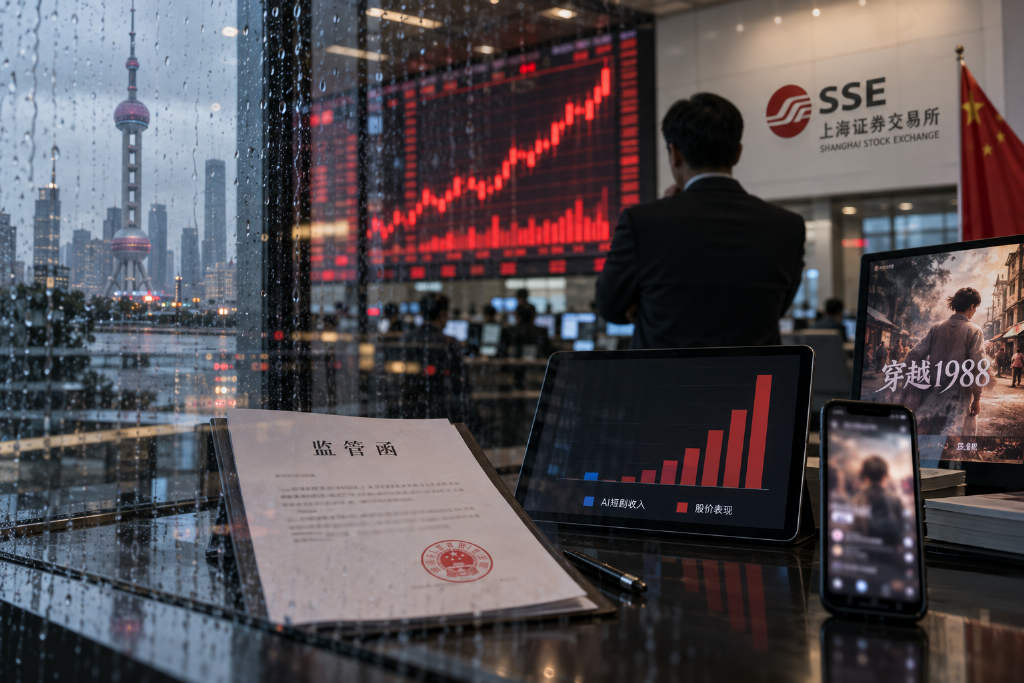
Longban Media2026-09-08 10:55:10Longban Media’s AI video unit reported just $11 in June revenue as stock surge draws exchange warningLongban Media, a listed publishing company in Heilongjiang, became one of the hottest AI-related trades in China’s A-share market after disclosing progress on its AI comic drama project. From Aug. 31 through the latest seven trading sessions, the stock posted seven straight limit-up moves, with its share price rising from RMB 9.58 to RMB 18.82 and market value climbing from RMB 4.3 billion to RMB 8.3 billion. The rally later collided with a stark revenue disclosure. In a Sept. 4 risk notice, the company said its AI video business generated about RMB 80 in June and about RMB 75,000 in July, accounting for less than 0.01% of its audited 2025 operating revenue. The Shanghai Stock Exchange then issued a regulatory warning to Longban Media and board secretary Sun Fujun, citing inaccurate disclosure, inadequate risk warning and inconsistencies across filings that could mislead investors. At the center of the dispute is the company’s AI comic drama "Across 1988," which Longban said had completed 170 episodes, surpassed 120 million views across platforms and posted a Hongguo popularity score above 40 million. The case has drawn attention because the project’s disclosed income remained tiny while the company’s valuation added roughly RMB 4 billion in a matter of days.970
Harmony2026-09-06 14:45:57Harmony proposes shutting down its mainnet, moving ONE to Ethereum, and pivoting to AI videoHarmony has published two non-binding proposals that would wind down the mainnet it launched in 2019, migrate its native ONE token to Ethereum, and shift the project toward an AI video remix business. The team said the plan to shut the network was driven by threats from nation-state attackers and AI agents. Under the migration outline, Harmony would take a snapshot at the chain’s final block covering user wallets, delegated staking, validator rewards, smart contracts, and tokens held on centralized exchanges, then airdrop new ONE on Ethereum to the same wallet addresses without requiring users to claim manually. Delegated stake and unclaimed rewards would be sent to the respective governor treasuries. The proposal says ONE’s total supply and issuance rate would stay unchanged, though newly issued tokens are intended for the new business. Harmony also said multisig wallets, liquidity pools, and onchain apps cannot be migrated, urged users to exit all smart contracts before Sept. 10, 2026, and outlined validator compensation including a one-time $1.372 million pool paid over four quarters. Both proposals may still change.980
GPT-62026-09-06 04:27:09GPT-6 Astra keeps teaming up with ByteDance’s Seedance 2.5 in viral AI video workflowsOpenAI’s GPT-6 Astra is quickly being pushed beyond product demos and into community-built video pipelines, with ByteDance’s Seedance 2.5 repeatedly taking the role of the final video generator. In several public examples cited by MarsBit, Astra handles story development, scene setup, previs work in Blender, camera planning, keyframe preparation, editing, and export, while Seedance 2.5 turns rough references into finished animated footage. One widely shared case starts with a high-level sword-fight brief. Astra writes the story, blocks the action inside Blender, generates reference frames, passes them to Seedance 2.5 for video creation, then assembles the resulting clips into a final cut. Similar workflows were also applied to a Naruto-inspired Konoha fan short and to a stylized remake that turns a 30-episode Chinese micro-drama into a U.S. version while preserving the original story beats and shot rhythm. The article also says Seedance 2.5 is being used with prompts written by GPT-6 Astra, Fable 5.1, and Gemini 3.8 Flash, producing noticeably different directorial styles from the same brief. Separate tests pushed Astra into DaVinci Resolve for color grading, where it tried to match a reference image in about four minutes. Reactions there were split, with some praising the speed and others saying the result missed the storytelling purpose of color.720
Policy and Re2026-08-31 10:03:08All-AI drama 'Post-Journey to the West' debuts in Hunan TV prime timeChina’s first all-AI long-form drama to reach satellite TV prime time premiered on Aug. 31, with "Post-Journey to the West" launching first on Mango TV at 6 p.m. and then airing on Hunan TV at 8 p.m. The series was jointly produced by Hunan TV and Mango TV, with production supported by Seedance 2.0 and 2.5. According to the report, no human actors appear on screen. The first season is planned at 30 episodes, each running 40 minutes, with the first five episodes released as the "Huaguoshan" arc. The project was produced by Mango TV’s AIGC content center, Mango Lingxi, through collaboration between a director, art staff, and an AI production team. The report said the show is the first series nationwide to adopt a "review-while-airing" process after China’s National Radio and Television Administration issued its Aug. 17 policy package known in the industry as the "21 Measures." On the market side, related A-share names moved higher on Aug. 31, with Mango Excellent Media hitting its 20% daily limit at RMB 16.98 during intraday trading.850
AI video2026-08-31 08:53:39AI series 'Post-Journey to the West' to air in Hunan TV prime time tonightMango TV’s AIGC-produced long-form series Post-Journey to the West is set to premiere tonight, with the show going live on Mango TV at 18:00 and then airing in Hunan TV’s prime-time drama slot at 20:00. The first season is planned for 30 episodes, with each episode running 40 minutes. The first batch, labeled the "Huaguoshan" arc, includes five episodes. According to BlockBeats, this is the first AI long-form drama in China to be broadcast on satellite television. The production does not use human actors, and both the visuals and character performances were generated through AIGC. Seedance 2.0 and Seedance 2.5 provided the AI technology for the project, while the director, art team, and AI production team completed the series together. The report also said the show is the first nationwide "review-while-airing" series released after the "21 radio and television measures," meaning production, review, and broadcast are moving forward at the same time, with later plotlines still able to change based on review comments and audience feedback.910
MiniMax2026-08-31 07:28:17MiniMax H3 Max Live Reaches Twitch as AI Video Streams Keep Generating in Real Timefal engineer Rehan Sheikh has connected H3 Max directly to Twitch in an experiment that turns AI video generation into a live, continuously updating stream. Because the model can generate footage faster than viewers consume it, the system can play one segment while rendering the next in the background, making a theoretically endless broadcast possible. Sheikh described the setup as an "infinite interdimensional television," and MiniMax later reposted the experiment. fal then continued with a broader H3 Max Live test. The stream is not pre-rendered: viewers can type !prompt in the Twitch chat, and fal said new instructions can appear on screen within seconds, letting the audience shape each scene as the broadcast unfolds. According to the source material, the lack of a fixed script or running time means the program can continue as long as generation continues. The report said the key shift is speed. H3 Max has reduced waiting time to below playback time, clearing a threshold that previously kept AI video from functioning as a true live format. fal Research said H3 Max was trained on top of MiniMax’s open-source H3 and accelerated for fal’s inference system. Official figures cited in the report said it can generate a 5-second video in under 3 seconds, with throughput about 35 times that of MiniMax’s official H3 API. On Artificial Analysis’ audio-enabled ranking, its image-to-video model sits first at 1202 Elo, while its text-to-video model ranks third at 1235 Elo behind only Wan 3.0 and Gemini Omni Flash.1090
Seedance 2.52026-08-03 14:33:00Seedance 2.5 handbook highlights longer video generation, timestamp control and multi-reference editingSeedance 2.5 has rolled out in full, with the official Feishu handbook laying out a broader set of controls for AI video creation than the previous 2.0 version. The update raises native single-pass generation length to 30 seconds, allows repeated extensions to 60 seconds, and adds an ultra-long mode that supports up to 180 seconds. The documentation frames that shift as a move away from generating isolated clips and toward producing more complete narrative sequences in one workflow. The handbook places timestamp-based prompting at the center of the update. Users can specify second-level time windows to direct motion, camera movement, scene transitions, sound and dialogue, then make targeted edits to selected segments after generation while keeping continuity across the rest of the clip. It also expands multi-modal reference handling, with guidance to upload references by priority and explicitly assign each image, video or audio sample a role inside the prompt. Other changes listed in the manual include cleaner default outputs with fewer unwanted subtitles and background music, stronger physical realism, more consistent cuts, smoother handling of complex actions, support for mainstream foreign languages through direct prompting in the target language, and a recommended workflow built around planning, reference preparation, scripting, generation, localized edits and final post-production.450
NVIDIA2026-08-02 08:57:13NVIDIA rolls out Video Codec SDK 13.1 with zero-copy transcoding and frame-level searchNVIDIA has released Video Codec SDK 13.1, adding a set of video encoding and decoding upgrades for developers. The update includes AV1 hierarchical reference mode, a zero-copy transcoding architecture, frame-level precise search, enhanced hardware decoding statistics, and a new Docker development environment. According to NVIDIA, the release is aimed at improving performance and efficiency in AI video processing, streaming, and large-scale content delivery workflows. On the decoding side, SDK 13.1 adds per-macroblock decoding statistics for H.264 and H.265, while avoiding extra CPU parsing overhead. NVIDIA said demand continues to rise for high-quality video streaming, generative AI video tools, remote collaboration, and content distribution at scale. The company said the new SDK is designed to help developers build video processing pipelines that are more efficient, lower in latency, and easier to scale.2010