AQAv2

Hyperliquid
2026-08-20 02:00:33

HYPE Faces AQAv2 Buyback Catalyst as Hyperliquid Prepares HIP-4 for Mainnet

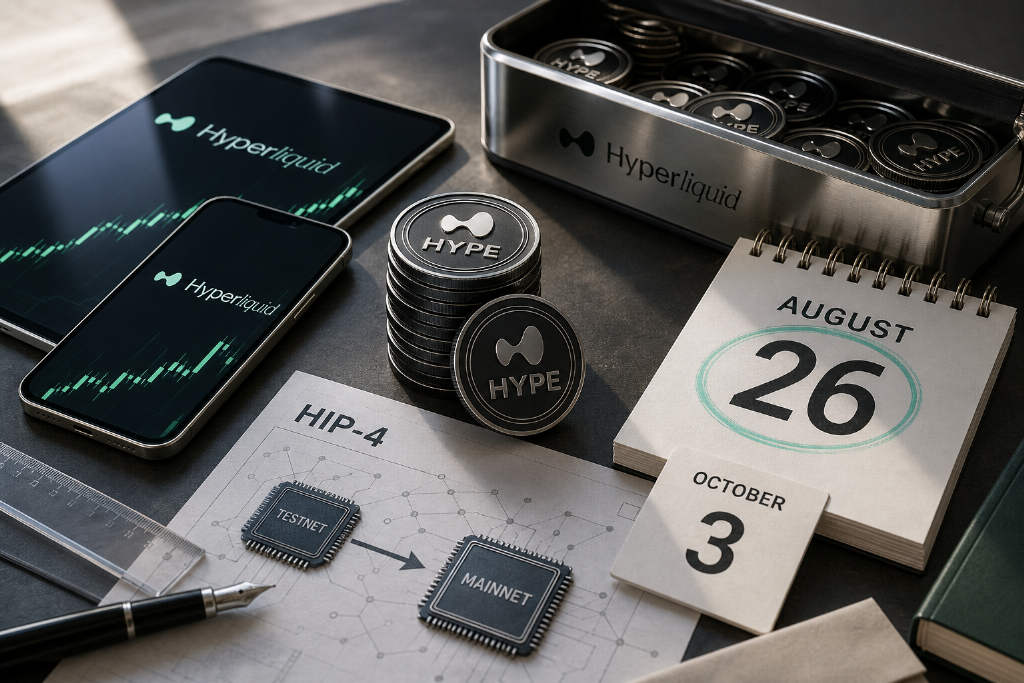
HYPE is entering a closely watched stretch after roughly two months of pullback following its mid-June all-time high, with Odaily arguing that both price structure and protocol fundamentals are turning more constructive. On the technical side, Odaily-cited analyst Cody said HYPE is trading in a rebound leg around $76-$77, while a clean move above and hold of the $58-$58.5 resistance zone would strengthen the rebound structure further. On the fundamental side, the bigger near-term catalyst in the report is Hyperliquid’s Aligned Quote Asset v2, or AQAv2, whose formal revenue accrual is set to begin on Aug. 26, with the first payout scheduled for Oct. 3. Under the mechanism, 90% of stablecoin reserve income is allocated to the protocol and then used entirely to buy back and burn HYPE. Using Hyperliquid stablecoin supply data cited in the article and a 3.82% 1-year U.S. Treasury yield, the report estimates that reserve income could amount to roughly $210 million annually, implying close to $200 million a year in potential HYPE buybacks. At the same time, Hyperliquid’s HIP-4 outcome market is moving ahead with permissionless deployment after going live on testnet on July 31, where more than 180 outcome contracts had been deployed by press time, over 95 of them tied to sports events.
30
HYPE Faces AQAv2 Buyback Catalyst as Hyperliquid Prepares HIP-4 for Mainnet
HYPE
2026-08-18 12:59:57

Russell inclusion puts PURR in more institutional portfolios as funds use it for HYPE exposure

Hyperliquid Strategies, traded on Nasdaq under the ticker PURR, was added to the Russell 3000 and Russell 2000 on June 30 after previously entering the S&P Global BMI Index. Following those index milestones and the launch of HYPE-related ETFs, newly disclosed 13F filings show a wider group of institutions either initiating or increasing positions in PURR, which Odaily frames as an indirect route to HYPE token and Hyperliquid ecosystem exposure. The filings highlight several notable holders. Duquesne, Stanley Druckenmiller’s family office, disclosed a $23 million stake. Renaissance Technologies reported roughly 2.4 million shares worth about $18.7 million. Slate Path Capital held around 2.7 million shares valued at about $21.4 million, while Discovery Capital Management disclosed roughly $10.3 million. Balyasny Asset Management held about $3 million, and Brazil-based Wealth High Governance Capital reported PURR accounting for about 1.82% of its portfolio, valued near $17.1 million. Odaily also points to passive buying after PURR’s index inclusion. Vanguard added about 843,000 shares in the second quarter, and Nuveen added about 1.07 million shares. MarketBeat data cited in the article put total institutional buying of PURR in Q2 2026 at about $142 million. The piece argues that interest in PURR has broadened from early crypto arbitrage firms to quant funds, hedge funds, and traditional Wall Street institutions.

40
Russell inclusion puts PURR in more institutional portfolios as funds use it for HYPE exposure
Circle
2026-08-08 12:01:24

Circle says it has 150+ USDC distribution deals, confirms Hyperliquid arrangement includes Coinbase and Circle

Circle used its fiscal 2026 second-quarter earnings call to answer a cluster of questions around USDC distribution incentives, its revenue-sharing structure with Coinbase, and how USDC held through Hyperliquid is attributed between the two companies. Management said Circle has signed more than 150 distribution agreements tied to USDC growth, product development, and token distribution, arguing that incentive-based channel expansion has been part of the company’s playbook for a long time rather than a new response to a single market challenge. The call also clarified that the Hyperliquid arrangement involves three parties: Coinbase, Circle, and Hyperliquid. As of quarter-end, about 90% of the USDC held by Hyperliquid was attributed to Coinbase’s platform and about 10% to Circle’s platform, according to Circle’s CFO. Circle did not disclose the exact commercial terms or the final split of economics between the parties. The company stressed that the 90%/10% figure describes where the balances are booked, not how final revenue is shared. The article also points to on-chain addresses on HyperEVM that appear to mirror that structure, with roughly $4.952 billion tied to Coinbase’s side and about $550 million tied to Circle’s side. Circle said those balances can be observed on-chain, but the detailed profit-sharing arrangement remains undisclosed.

550
Circle says it has 150+ USDC distribution deals, confirms Hyperliquid arrangement includes Coinbase and Circle
OpenUSD
2026-07-15 03:22:16

OpenUSD Targets Stablecoin Economics as Circle’s USDC Defenses Face a New Test

OpenUSD, launched on June 30 by the Open Standard alliance of more than 140 payment companies and banks including Stripe, BlackRock and Coinbase, is not framed as a direct assault on USDC’s supply. Its challenge is aimed at the revenue engine behind incumbent stablecoins: reserve income. Unlike Circle and Tether, which keep most reserve interest at the issuer level and then share part of it with distribution partners, OpenUSD is designed to send nearly all of that income to the partner network itself. That design immediately sharpened the market focus on Circle. CRCL fell 17% on June 30 after the announcement. Still, the onchain picture in the source material shows why USDC remains difficult to dislodge. USDC accounted for about 79% of adjusted onchain transfer volume out of roughly $38 trillion in the first half of 2026, with Base contributing 69% of that flow. It is also embedded across centralized exchanges, DeFi lending, liquidity pools and perpetuals venues. The article argues that the real battle is over who captures the float and controls distribution. Coinbase, Hyperliquid and other platforms are already taking a larger share of the economics tied to USDC. OpenUSD pushes that logic further, but Circle still holds deep liquidity, broad market integration and a stronger regulatory position, including OCC approval for Circle National Trust.

600
OpenUSD Targets Stablecoin Economics as Circle’s USDC Defenses Face a New Test
OpenUSD
2026-07-15 03:33:29

OpenUSD Targets Circle’s Profit Engine, but USDC’s Distribution Network Still Holds

OpenUSD has reignited the debate over who captures the economics of stablecoins. Announced on June 30 by the Open Standard consortium, which includes Stripe, BlackRock and Coinbase among 140 participating payments firms and banks, the new dollar-backed stablecoin routes nearly all reserve interest to its partner network rather than keeping that income at the issuer level. The market reaction was immediate: Circle’s stock, CRCL, fell 17% that day. The challenge, however, is less about instantly displacing USDC supply and more about redistributing the reserve income tied to stablecoin adoption. According to the source material, Circle derived 96% of its $2.7 billion in fiscal 2025 revenue from reserve income, while its revenue after distribution and transaction costs stood at about $1.08 billion. That makes distribution economics central to Circle’s model. At the same time, on-chain data still points to a deeply entrenched USDC network. In the first half of 2026, USDC settled about 79% of $38 trillion in adjusted on-chain transfer volume, with Base accounting for 69% of that activity. USDC is also embedded across Coinbase, Binance, Hyperliquid, Sky PSM and Aave v3, while Circle’s OCC-approved Circle National Trust strengthens its regulatory standing. The contest is shaping up around reserve income, market infrastructure and control of distribution channels.

170
OpenUSD Targets Circle’s Profit Engine, but USDC’s Distribution Network Still Holds