BitVM

Liquid
2026-09-06 23:15:09

Liquid Sidechain Halted After 3,998 BTC Leaves Federation Wallet

Blockstream’s Liquid sidechain has been paused after roughly 4,000 BTC left the federation wallet that backs L-BTC in circulation. The network said the withdrawals were made through the SideSwap Peg-out Authorization Key, or PAK, but added that the key itself was not compromised. Two transfers moved the funds to a single Bitcoin address, which later posted an onchain message identifying the sender as white hats and asking to be contacted onchain. Blockstream responded with an onchain message directing the party to security@blockstream.com. Liquid then disabled bridge nodes, told exchanges to pause L-BTC deposits and withdrawals, and said assets issued on Liquid, including USDT and DePix, were unaffected. The incident has raised questions because Liquid’s peg wallet uses an 11-of-15 multisig and peg-outs are also restricted by a PAK list that, according to Liquid documentation, takes three days to update. Commentators including JAN3 CEO Samson Mow and Ledger CTO Charles Guillemet weighed in as additional onchain messages appeared, including a Signal contact request sent to the address holding the funds rather than from it.

260
Liquid Sidechain Halted After 3,998 BTC Leaves Federation Wallet
Bitcoin
2026-08-11 03:21:18

Bitcoin splits at block 961632 as BIP-110 enforces rules despite 2.53% support

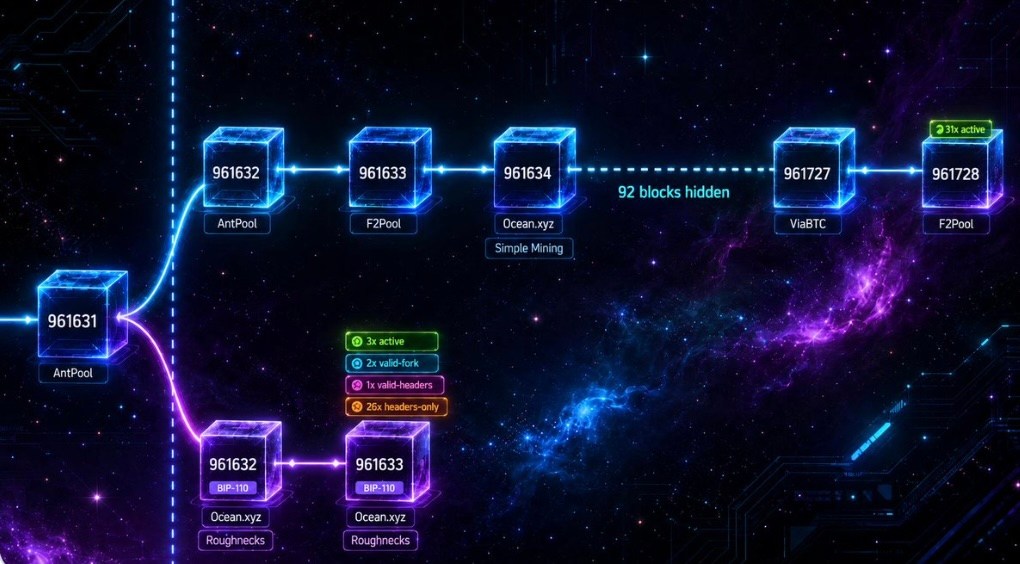
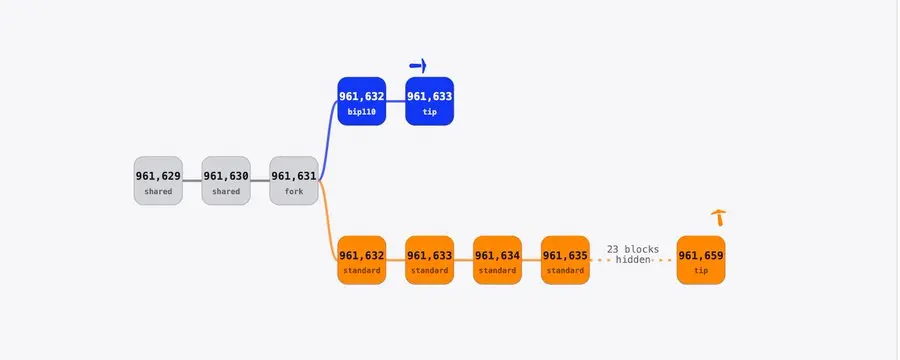
Bitcoin split into two incompatible chains on Aug. 8 after BIP-110 nodes began rejecting blocks that did not signal bit 4 at block height 961632, even though the proposal had received support from just 51 blocks in the prior 2,016-block window, or 2.53%. The higher-work chain continued under the existing rules, while the BIP-110 branch fell behind, reaching block 961633 by 9:00 a.m. Beijing time on Aug. 9, 21 blocks behind the main chain at 961654. The proposal was put forward by pseudonymous developer Dathon Ohm, with Luke Dashjr involved in the early draft and technical suggestions. Its reference implementation is based on Bitcoin Knots rather than Bitcoin Core, and it did not secure majority miner support. Supporters are trying a user-activated soft fork, arguing that nodes, exchanges, wallets and payment services can define valid blocks even without strong miner signaling. For now, BIP-110 has not activated its data limits on Bitcoin mainnet. What exists is a low-hashrate execution chain. The main chain still follows the original rules, and the 21 million BTC cap, existing balances and everyday payments remain unchanged. Risks are concentrated among nodes, wallets and services using BIP-110 infrastructure because the split came without dedicated replay protection.

1250
Bitcoin splits at block 961632 as BIP-110 enforces rules despite 2.53% support
ChainFeeds
2026-08-11 02:26:40

ChainFeeds roundup tracks Bitcoin’s BIP-110 split, Pump-FOMO rivalry, and Robinhood Chain’s meme-led launch

ChainFeeds’ Aug. 11 research roundup brought together five separate market and policy discussions that are shaping current crypto debate. The package led with the fallout from Bitcoin’s BIP-110, where nodes enforcing the proposal began rejecting blocks without bit 4 signaling even though support in the prior 2,016-block window was only 51 blocks, or 2.53%. The result was a chain split, with the higher-work main chain moving ahead while the BIP-110 branch lagged. The report also reviewed the competitive battle between Pump and FOMO over the social trading interface, arguing that the real contest is not token issuance alone but control over discovery, amplification, distribution, and execution. A separate Bitcoin market note focused on ETF flows, hash rate, node distribution, MVRV, the 200-week moving average, and three portfolio approaches ranging from dollar-cost averaging to options hedging. On Ethereum, ChainFeeds highlighted a debate around EIP-8363 and whether staking rewards should eventually rely only on execution-layer revenue once network staking surpasses 50%. The final section examined Robinhood Chain, which generated $3.6 million in REV in July and out-earned several established Layer 2 networks, though early activity was dominated by meme coin trading rather than RWA usage.

1480
ChainFeeds roundup tracks Bitcoin’s BIP-110 split, Pump-FOMO rivalry, and Robinhood Chain’s meme-led launch
Bitcoin
2026-08-10 10:49:00

Why 98.5% of Bitcoin Is Still Idle: A Close Look at BTC Yield, DeFi Risk, and the Stacks Thesis

A research piece by Castle Labs argues that Bitcoin has reached institutional scale without developing a comparably deep native financial layer. The report says only 311,000 BTC, or about 1.5% of the 20.05 million active supply, is generating any kind of yield, while the other 98.5% remains idle. By contrast, 32.5% of circulating ETH is staked for roughly 2% native yield, with liquid staking products such as Lido’s stETH extending that base layer into broader DeFi. The study maps the current BTC yield stack across three routes: failed centralized lenders, DeFi activity on EVM chains and Solana through wrapped or bridged representations of BTC, and Bitcoin L2 and staking protocols such as Babylon, Lombard, Stacks, Rootstock, and BOB. Each route carries a different trust model. CeFi exposed depositors to opaque counterparties and custody loss, while DeFi requires users to accept bridge, custodian, and smart contract risk. Bitcoin L2 systems move closer to Bitcoin’s trust assumptions, but still rely on signer sets, committees, or staged security models. The report uses Stacks as a case study for what it calls a more Bitcoin-native financial architecture. It highlights Stacks’ Bitcoin-anchored execution, the 15-signer sBTC bridge, and the upcoming PoX-5 upgrade, which is expected in late August and is designed to let BTC holders earn BTC-denominated yield while keeping BTC locked on Bitcoin L1 under self-custody. The paper argues that the core challenge is no longer whether demand exists, but whether BTC finance can grow without pushing holders too far away from Bitcoin’s original security model.

1440
Why 98.5% of Bitcoin Is Still Idle: A Close Look at BTC Yield, DeFi Risk, and the Stacks Thesis
Bitcoin
2026-08-10 08:11:00

Bitcoin’s BIP-110 soft fork stalls after two blocks in eight hours

PANews reported that Bitcoin Improvement Proposal BIP-110 entered its mandatory signaling phase on August 9 but quickly ran into a wall. The minority chain tied to the proposal produced only two blocks in roughly eight hours, both mined by Roughnecks, after signaling support fell far short of the activation threshold. In the last difficulty period before activation, only 51 blocks signaled support, or about 2.53% of the 2,016-block window. Roughnecks and later PyBLOCK then paused support, while developer Luke Dashjr drew public criticism over the dispute.

1970
Bitcoin’s BIP-110 soft fork stalls after two blocks in eight hours
Bitcoin
2026-08-10 04:06:11

Castle Labs maps Bitcoin’s yield market, from CeFi failures to Stacks’ native-finance pitch

Castle Labs argues that Bitcoin has reached institutional scale without developing a comparable native yield layer. In its review of the BTC on-chain finance market, the firm says only about 311,000 BTC out of roughly 20.05 million active supply — around 1.5% — currently earns any form of yield. The rest, despite Bitcoin’s roughly $1.3 trillion market capitalization and growing role in corporate treasuries, ETFs, and portfolios, remains largely idle. The report breaks the market into three broad routes: failed centralized lending models such as Celsius, BlockFi, and Voyager; BTC deployed into DeFi through wrapped, bridged, or liquid staking-style assets like WBTC, cbBTC, tBTC, and LBTC; and Bitcoin L2 or staking protocols including Babylon, Lombard, Stacks, Rootstock, and BOB. Castle Labs compares the trust assumptions behind each approach, focusing on custody risk, bridge signer risk, smart contract exposure, and slashing. It then uses Stacks as a case study for what it calls a closer-to-Bitcoin model. The paper outlines Stacks’ Bitcoin-anchored finality, the 15-signer sBTC bridge, the proposed PoX-5 upgrade that would let BTC holders earn BTC-denominated yield while keeping coins locked on Bitcoin L1, and an application layer built around Zest, Bitflow, Hermetica, and StackingDAO’s planned stBTC product.

1460
Castle Labs maps Bitcoin’s yield market, from CeFi failures to Stacks’ native-finance pitch
Bitcoin
2026-08-10 04:33:55

Why Bitcoin’s BIP-110 failed as OCEAN, Jack Dorsey backers and critics clashed

Bitcoin’s proposed soft fork BIP-110 failed to win broad support, but the debate around it exposed a deeper split over what Bitcoin should allow on-chain and who gets to decide. The proposal was backed by OCEAN founder Luke Dashjr, whose mining pool previously raised a $6.2 million seed round led by Block CEO and Twitter co-founder Jack Dorsey. Supporters argued that non-financial data such as Ordinals, BRC-20 and inscriptions should be filtered at the consensus layer to protect Bitcoin’s core monetary role and reduce chain bloat. Critics, including Strategy founder Michael Saylor and Blockstream CEO Adam Back, said paid transactions should be treated neutrally and warned that filtering them would damage Bitcoin’s permissionless neutrality. The fight quickly spilled onto X, where both camps argued over censorship, governance and miner rights. The article also ties the proposal to OCEAN’s broader effort to decentralize mining through non-custodial payouts and the DATUM protocol, while noting that the pool’s hash share has fallen to about 1%. In practice, BIP-110 also ran into a major hashpower problem: the main chain held roughly 97.4% to 97.5% of support, while the BIP-110 side had only about 2.5% to 2.6%, leaving the forked chain facing severe delays and a near-paralyzed difficulty adjustment cycle.

3400
Why Bitcoin’s BIP-110 failed as OCEAN, Jack Dorsey backers and critics clashed