BitVM

Starknet
2026-07-21 10:18:25

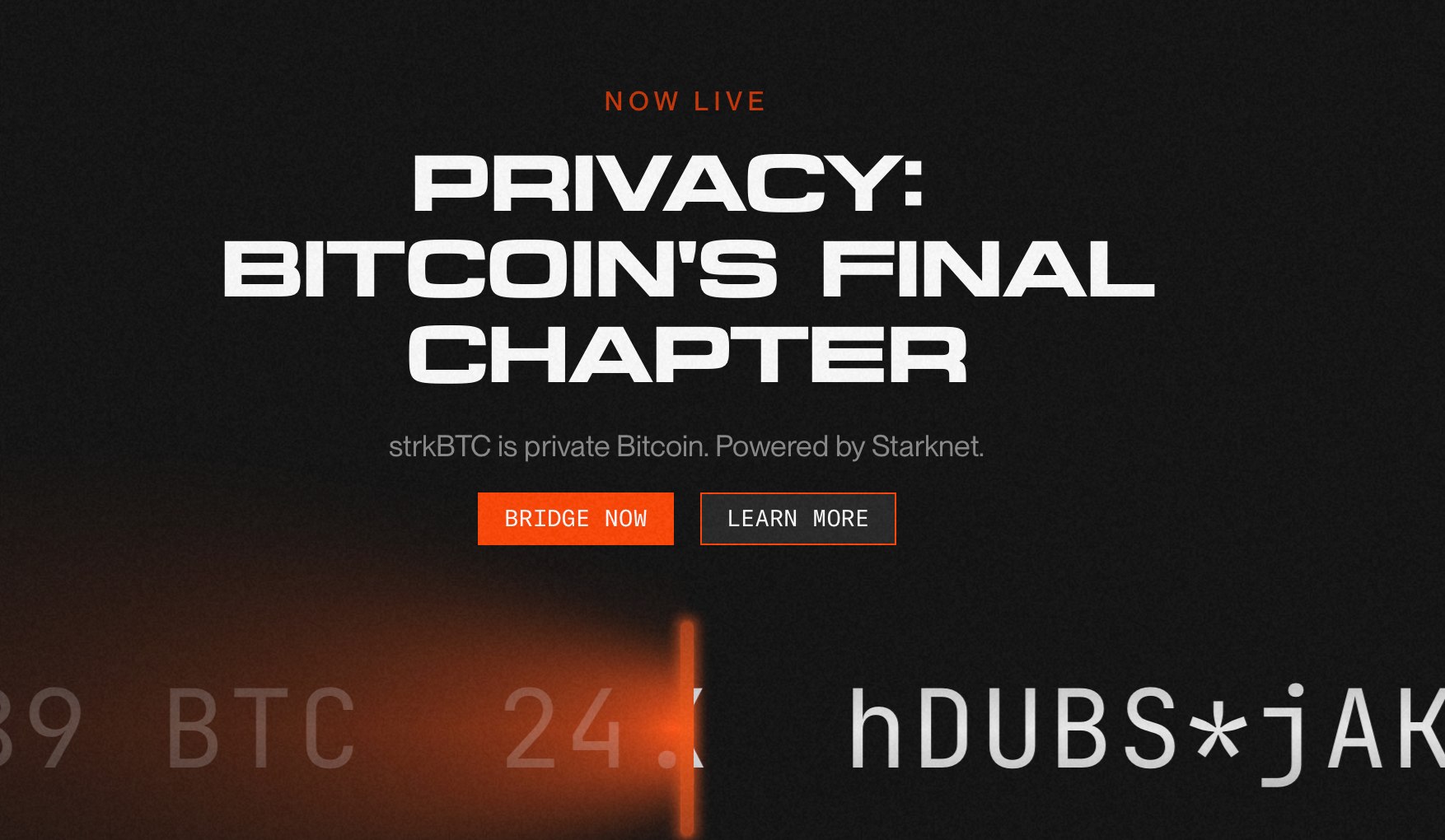
Starknet pitches strkBTC as a private Bitcoin rail with a post-quantum edge

Starknet is framing Bitcoin as the clearest test case for two problems it says onchain finance still has not solved: full public visibility of asset flows and the long-term security risks posed by quantum computing. Its answer is strkBTC, an ERC-20 on Starknet backed by BTC locked on the Bitcoin network and built on StarkWare’s STRK20 privacy framework. The token can operate in a standard public mode or a shielded mode that hides selected balances and transfers from public view, while allowing selective disclosure through compliance infrastructure run by Financial Privacy Inc. The current bridge is operated by a trusted consortium that includes Twinstake, NEAR Intents, Luganodes, UTXO Management and Xverse. The article also ties the product to Starknet’s broader post-quantum positioning. It cites a March report from Google Quantum AI, co-authored by Ethereum Foundation researcher Justin Drake and Stanford professor Dan Boneh, which estimated that about $100 billion in the Ethereum ecosystem is at risk and said Starknet stands out among major L2s because its proving system relies on hash-based STARK assumptions rather than elliptic-curve cryptography. Even so, the piece says Starknet is not fully post-quantum today. Risks inherited from Ethereum, the consortium bridge model, and the real-world use of viewing keys all remain open questions as the network pushes its roadmap toward end-to-end security before a future “Q-day.”

1210
Starknet pitches strkBTC as a private Bitcoin rail with a post-quantum edge
Bitcoin
2026-07-18 10:22:09

BIP-110 Heads Toward Bitcoin’s August Enforcement Window With Miner Support Still Below 1%

Debate over Bitcoin proposal BIP-110 is heating up again as its August enforcement window approaches, even though support from miners remains below 1% and only 15,035 of 102,674 nodes are willing to run it. Introduced by Dathon Ohm in December 2025 and backed by Bitcoin Core developer Luke Dashjr, the proposal seeks to limit arbitrary or non-monetary data in Bitcoin transactions for one year, targeting Ordinals, Bitcoin NFTs, and other large data payloads. Supporters argue the change would reduce spam and preserve Bitcoin’s monetary use, while critics say it would introduce subjective transaction filtering, restrict future innovation, and risk splitting the chain. Opponents including Adam Back, Jameson Lopp, and Michael Saylor also argue that BIP-110 does not solve the underlying fee-market issue and could create new coordination and security problems. The proposal’s activation design has become the center of the dispute because nodes running BIP-110 would reject non-compliant blocks during the enforcement window even without broad consensus, raising the prospect of a minority chain fork in August.

1440
BIP-110 Heads Toward Bitcoin’s August Enforcement Window With Miner Support Still Below 1%
Bitcoin
2026-07-17 10:07:54

BIP-110 Faces Thin Support but Could Still Push Bitcoin Toward a Fork in August

Debate around Bitcoin Improvement Proposal 110, or BIP-110, has intensified as its August enforcement window approaches. The proposal, introduced by Dathon Ohm in December 2025 and backed by Bitcoin Core developer Luke Dashjr, seeks to restrict arbitrary and non-monetary data in Bitcoin transactions for one year, with Ordinals and Bitcoin NFTs as its main targets. Supporters say the change would reduce spam and refocus Bitcoin on monetary use, but current network backing remains limited: miner support is below 1%, and only 15,035 of 102,674 nodes, or 14.64%, are willing to enforce it, well short of the 55% activation threshold. The dispute centers on BIP-110’s activation design. If it fails to reach the threshold before block height 961632, nodes running the proposal would begin rejecting non-compliant blocks during a mandatory window from 961632 to 963647, leading to forced activation at block 965664. Critics argue that this could split Bitcoin into a minority BIP-110 chain and the existing main chain. Backers led by Dashjr and Ocean frame the measure as a rollback of unwanted changes, while opponents including Adam Back, Jameson Lopp, and Michael Saylor say it would not solve spam at the root, could restrict future innovation, and may weaken Bitcoin’s neutrality and censorship resistance.

1340
BIP-110 Faces Thin Support but Could Still Push Bitcoin Toward a Fork in August