
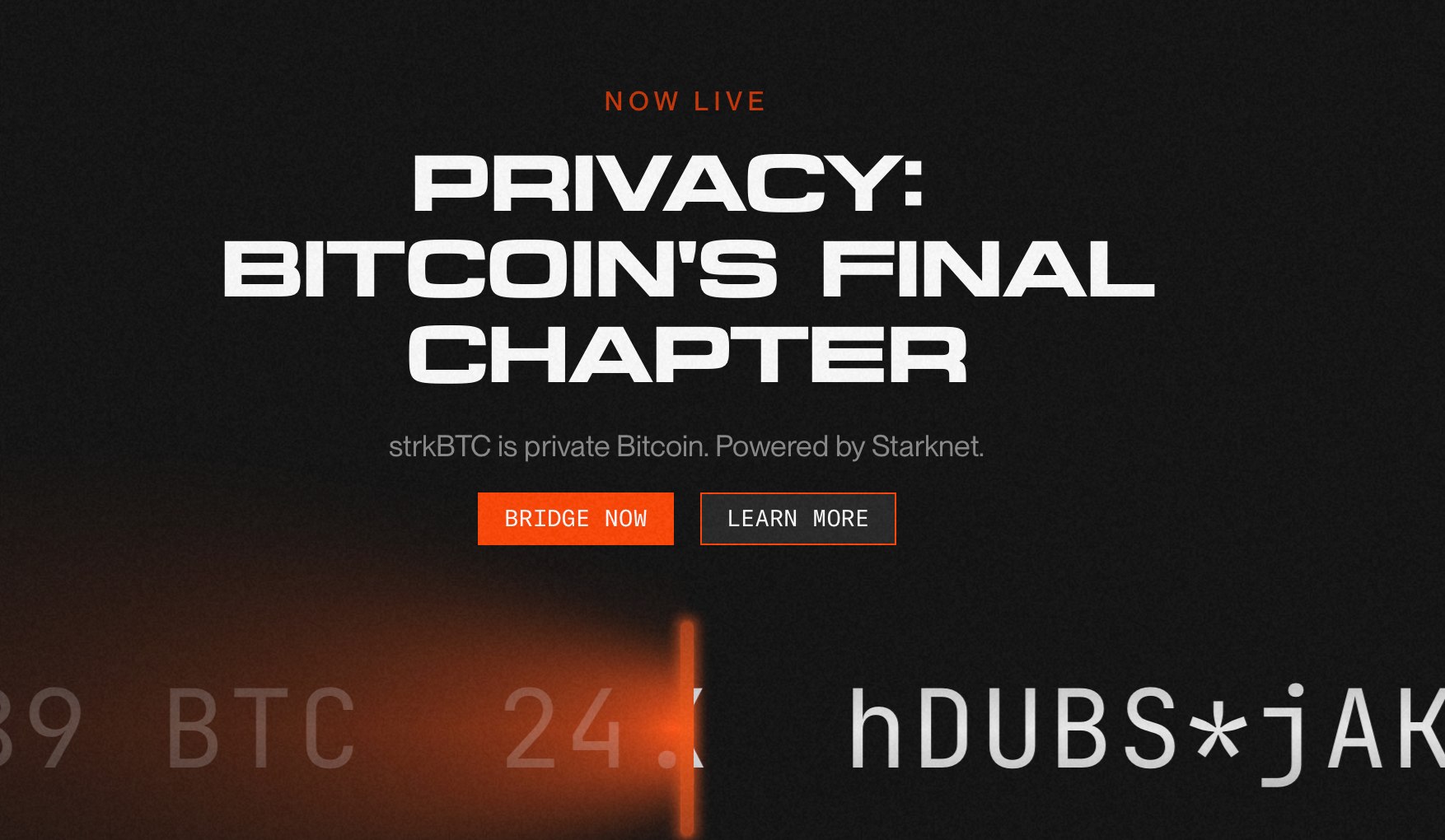
strkBTC, a Bitcoin privacy solution built with ZK technology, went live on Starknet on May 12. The product is aimed at a problem that has become harder to ignore: public blockchain data can expose wallet activity, reveal financial behavior, and in some cases contribute to real-world threats against holders. Starknet says strkBTC is meant to shield users from that exposure while still allowing compliance-related disclosures where required.
The launch material frames privacy as a safety issue, not just a technical preference. Damian Chen, vice president of the Starknet Foundation, said criminals can monitor public ledgers, use AI tools to track wallets, and target people because of their crypto holdings. In that context, keeping every balance and transfer visible to the public is no longer treated as a feature by the project team.
A Bitcoin wrapper designed for shielded activity
At its core, strkBTC is described as a technical wrapper that brings Bitcoin into Starknet’s privacy environment. Once assets enter this shielded mode, account balances and transaction history are hidden from public view. The design does not aim for total opacity. Instead, the system includes a compliance layer built around Viewing Keys, which can be used under lawful regulatory requests by independent third-party compliance reviewers to share limited and specific information with tax authorities, auditors, or other regulators.
That structure is central to the pitch. For individuals, it reduces default exposure on-chain. For institutions, it addresses a practical barrier to operating with Bitcoin at scale, since public visibility into balances, transfers, and financial flows can be unacceptable in regulated business settings. Starknet presents strkBTC as an attempt to combine privacy with auditability inside one framework rather than force users to choose between them.
Two live features and one planned expansion
The project lists two core functions available now. One is Re-anonymization, a mechanism that allows assets to be bridged back to a new and unrelated Bitcoin address. The other is Compliance-Ready screening, which uses Viewing Keys together with integrated third-party asset checks to support tax and legal audit needs while blocking restricted or sanctioned assets from entering the privacy pool.
The next feature on the roadmap is Confidential DeFi. According to the launch description, that would allow private lending, trading, and yield farming on Starknet without stripping assets of their utility. Eli Ben-Sasson, CEO of StarkWare and a co-founder of Zcash, said strkBTC advances ideas tied to private digital cash, especially the ability for users and institutions to keep account balances hidden while remaining compliant.
Launch narrative centers on physical security risks
The source material repeatedly connects blockchain transparency with real-world crime. It says armed robberies and extortion cases targeting Bitcoin holders rose 75% in 2023. It also cites an estimate that AI tools can link public wallet addresses to real-world identities with up to 90% accuracy. France is highlighted as a severe case, with 41 crypto-related kidnapping incidents recorded there this year.
Within that framing, strkBTC is positioned as a direct response to the so-called $5 wrench attack—situations where attackers do not need to break encryption because public knowledge of a person’s holdings is enough to make them a target. The project argues that the transparency long associated with Bitcoin’s public ledger has, under current conditions, become a map to private lives.
Use cases and technical roadmap
The launch notes several financial applications made easier by confidential transactions with selective disclosure. These include private payroll, supplier payments, and strategic capital deployment without exposing compensation data, business relationships, pricing strategy, or trading intent. The stated goal is to make Bitcoin usable as private on-chain cash without removing accountability mechanisms.
StarkWare also outlined future technical work tied to strkBTC. That includes research into quantum-resistant cryptography, integration with BitVM and a 1-of-N security model to reduce trust assumptions, and a longer-term plan for a fully trustless cross-chain bridge supported by an OP_CAT soft fork so Bitcoin could natively verify Starknet proofs.
The original source also says the article was supplied by Starknet as sponsored material and should not be treated as investment advice. Final service details and rules remain subject to project-side announcements.