

Debate around Bitcoin Improvement Proposal BIP-110 has picked up again as its August enforcement window gets closer. The proposal was introduced by Dathon Ohm in December 2025 and backed by Bitcoin Core developer Luke Dashjr. It would limit arbitrary or non-monetary data in Bitcoin transactions for one year, mainly targeting Ordinals, Bitcoin NFTs, and other large data storage uses that supporters describe as spam.
By the current numbers, BIP-110 does not have support from mainstream miners or nodes. Its activation threshold is 55%, but miner support is still below 1%. Of 102,674 nodes on the network, only 15,035 are willing to enforce BIP-110, equal to 14.64%.
The enforcement window is at the center of the dispute
Under normal conditions, a proposal with support this low would not pass on Bitcoin. What makes BIP-110 unusual is that nodes running the proposal are set to enforce it even without broad agreement.
If BIP-110 fails to reach the 55% activation threshold before block height 961632, it moves into an enforcement window from block 961632 to 963647. During that period, nodes running BIP-110 would reject blocks they consider non-compliant, pushing the passage rate to 100% inside that subset of the network. The proposal would then be forcibly activated at block height 965664.
At the current Bitcoin block production pace, that enforcement window would begin in early August. That means BIP-110, while framed as a soft fork proposal, could still lead to a chain split between a minority chain that enforces the rule set and the main chain that does not.
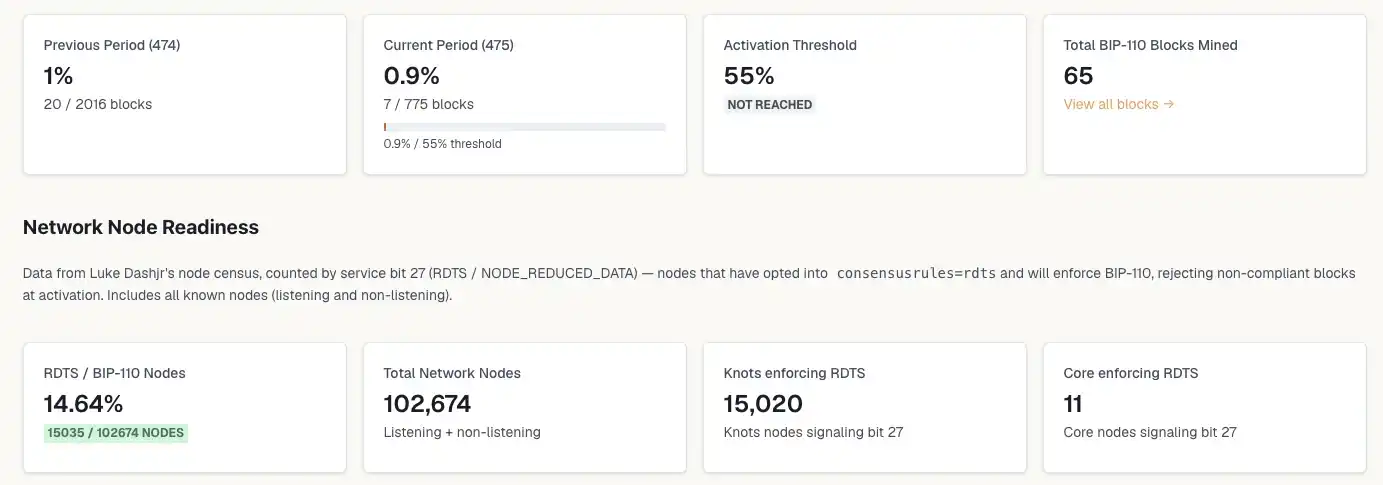
Under Bitcoin’s longest-chain rule, only a chain backed by a majority of real mining hashpower, more than 50%, can become the dominant chain and bring the network onto the new rules. So even if BIP-110 reaches its forced activation point, whether it survives depends on consensus. Without that support, it could end the way many earlier Bitcoin soft-fork attempts did: fading out on its own.
Supporters say BIP-110 restores Bitcoin’s intended use
The best-known backers of BIP-110 are Luke Dashjr and his mining pool, Ocean. Dashjr has long been one of the most outspoken critics of BRC-20 tokens and inscriptions, and he provided drafting suggestions for the proposal.
Supporters take the view that Bitcoin block space should not be used for anything beyond Bitcoin transfers. In the proposal, inscriptions that emerged in 2022 are described as a form of “attack” on Bitcoin. The argument is that arbitrary data embedded in transactions adds unnecessary burden to nodes and consumes block space that would otherwise be available for monetary transfers, forcing users to bid higher fees just to get those transactions confirmed.
Dashjr wrote on X that BIP-110 is not a change, but a rejection of change. In responses to critics, he said the proposal is not hostile and does not force anyone to accept it, while also saying those who oppose BIP-110 are the real attackers of Bitcoin.
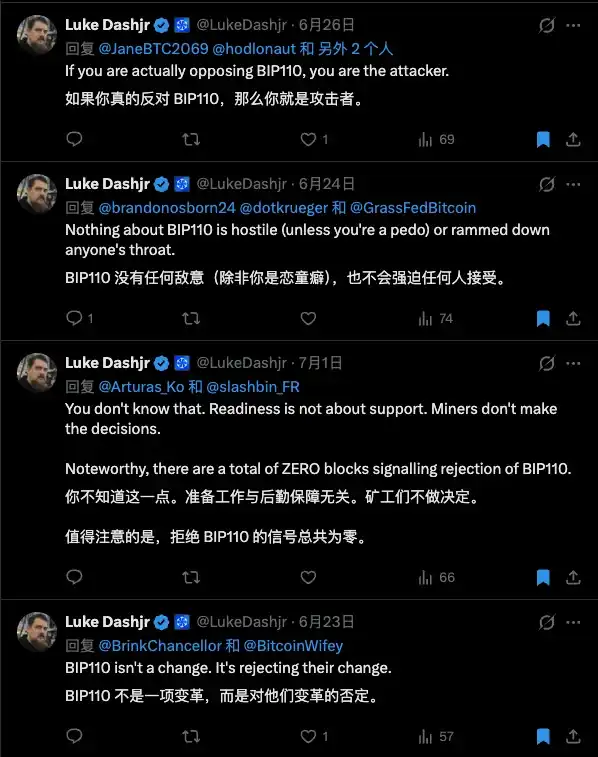
He has also argued that, although miner voting in favor of BIP-110 is currently below 1%, direct miner voting against it is also close to zero. His point is that miners are not the ones making the decision and will follow once BIP-110 activates.
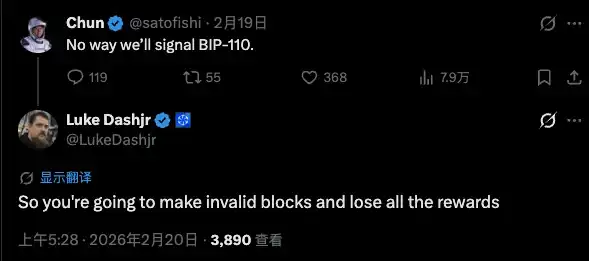
In practice, the only mining pool that has publicly supported BIP-110 so far is Ocean. F2Pool co-founder Wang Chun said as early as February that he would never support BIP-110. Dashjr replied under that post: “then you will mine invalid blocks and lose all rewards.”
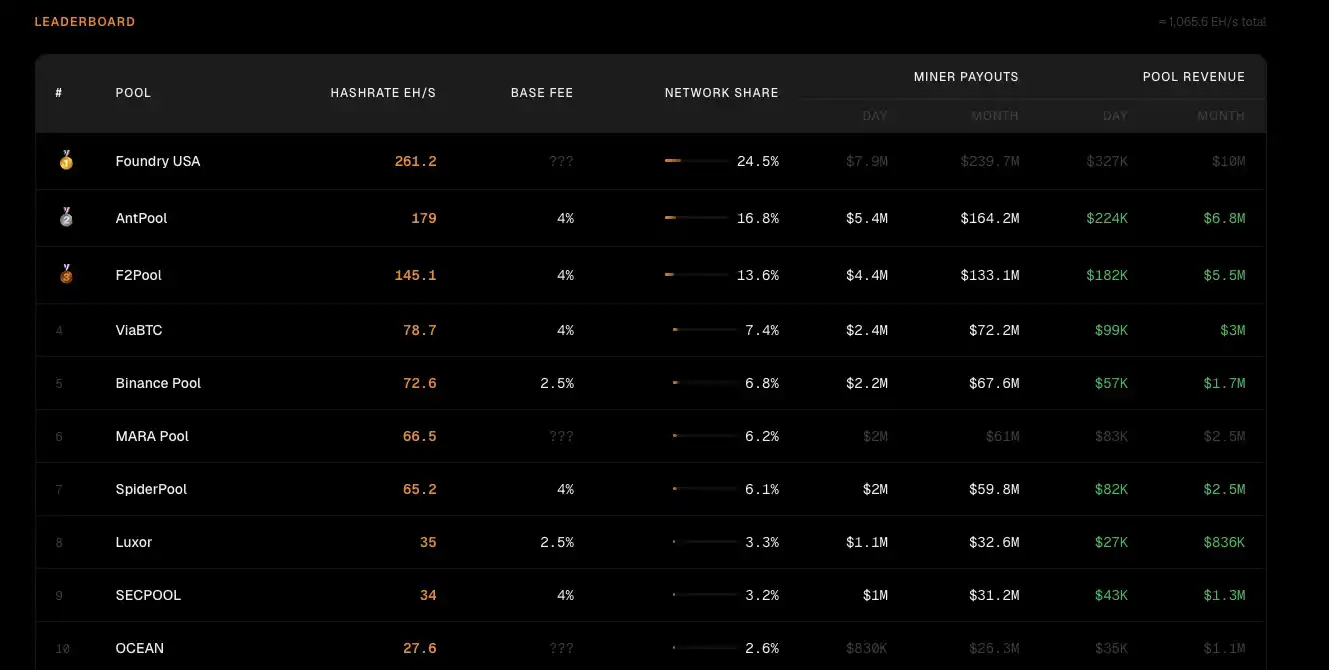
According to miningradar data, F2Pool is the third-largest Bitcoin mining pool with 13.6% of network hashpower. Ocean has 24.6 EH/s, or 2.6% of the network. If Ocean ends up as the only pool supporting BIP-110 on a forked chain, it would be able to produce only 3 to 5 blocks a day, which would make it very difficult for that chain to become the longest chain on Bitcoin.
Critics say it solves little and creates more risk
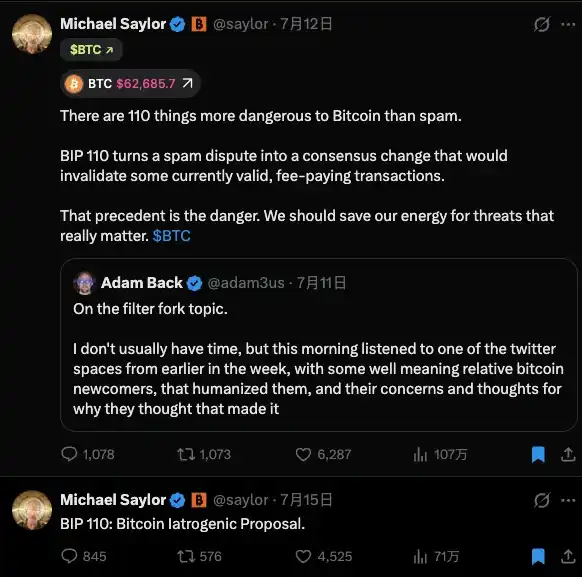
Opposition to BIP-110 is not limited to the question of whether activation would succeed. Critics also argue that the proposal would fail to solve the spam problem it targets while opening a series of new problems. The most visible opponents include cypherpunk pioneer Adam Back, Bitcoin Core developer Jameson Lopp, and Strategy founder Michael Saylor.
One line of criticism is that BIP-110 does not fully solve Bitcoin’s spam-transaction issue. The proposal’s author acknowledges that it can only provide temporary relief. Lopp argues that Bitcoin’s block size limit and fee market for block space already address the issue to some extent. In his view, Bitcoin remains a target for this kind of activity because very few people actually use the network, leaving fees low and preventing the kind of sustained fee pressure that would price out most spam on its own.
Lopp also argues that BIP-110 would choke off future innovation on Bitcoin. The proposal itself concedes that restrictions on Taproot would hinder advanced functions such as BitVM and the deployment of more complex contracts on Bitcoin. Although BIP-110 is presented as a one-year temporary restriction, Lopp said that may simply be a delaying tactic by Dashjr. If the limits materially block future upgrades, the result could be a hard fork rather than a soft fork.
Back has focused more on Bitcoin’s censorship resistance and decentralized ethos. In his view, BIP-110 introduces subjective censorship of transactions inside blocks, and its underlying purpose is to regulate how others use the network. He argues that this cuts against the neutrality and censorship-resistant principles Bitcoin has maintained since it began, and represents a dangerous move toward central control.
Saylor used the label “Bitcoin Iatrogenic Proposal” to describe BIP-110, suggesting that the treatment itself would injure Bitcoin rather than fix the existing problem. He also said that if BIP-110 were converted into consensus, some valid paid transactions would become invalid, and that creating a precedent for this kind of censorship is the more serious danger.
Another major concern among critics is the possibility that BIP-110 could split the Bitcoin ecosystem into two competing chains. Each could try to claim the status of the real Bitcoin. In that kind of contest, because the outcome of the fork is uncertain, the network could face a double-spend risk. Even without double spending, if BIP-110 eventually became a separate chain, it would still divide developer attention, hashpower, and monetary consensus.
For opponents, BIP-110 is an attempt to solve a cultural problem with a technical tool, while creating more uncertainty in the process.
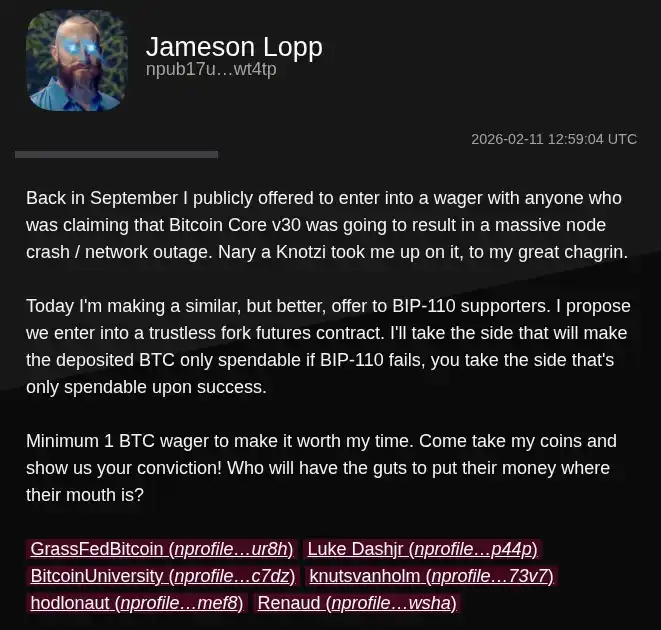
Even with those concerns, critics remain confident the proposal will fail. Back in February, Lopp offered a wager on BIP-110 with a minimum stake of 1 BTC. As of now, no BIP-110 supporter has publicly accepted it.
On prediction market Predyx, the probability attached to the event that “BIP-110 will activate and be forcibly enforced on Bitcoin during Sept. 1 to Sept. 7, 2026” stands at 10%. The market’s “Yes” resolution requires the BIP-110 chain to become the “longest Bitcoin chain” and be accepted by most nodes.
What could happen after forced activation
The article outlines several possible paths once BIP-110 reaches its forced activation height of 965664, which it places around late August to early September.
In the first scenario, once the activation height is reached, BIP-110 nodes reject blocks from the main chain, but too few miners produce new blocks that comply with BIP-110 rules. In that case, the BIP-110 chain would produce blocks very slowly and could eventually stop growing altogether.
In the second scenario, a portion of miners supports BIP-110. Supporters say they have an “asymmetric advantage” because the BIP-110 rules are stricter. BIP-110 nodes would reject blocks that contain prohibited data such as inscriptions, but non-BIP-110 nodes, meaning mainstream Core nodes, would still treat blocks mined by BIP-110 nodes as valid.
Supporters also point to current block-space composition. Inscriptions now account for 5% of Bitcoin block space, while more than 95% is still conventional Bitcoin transfer activity. On that basis, BIP-110 nodes would still be able to accept a large share of mainstream blocks, which is why Dashjr believes BIP-110 could still become the longest chain and unify the network.
In the third scenario, some miners support BIP-110 but their combined hashpower never overtakes the existing majority chain. Miners are usually highly rational because their machines begin consuming electricity as soon as they are turned on. In a competition between two chains, miners weigh cost against return. A miner on the BIP-110 side would be more likely to abandon sunk costs and move back to the majority chain because the minority chain would trail in both chain length and accumulated block rewards. That path would likely collapse into the first scenario.
The article also considers a more extreme possibility: if Dashjr could rally enough miners that they keep mining on the BIP-110 chain despite poor economics, the chain could continue operating as an independent network. Block times could be very slow, and miners would be consuming energy with little meaningful reward. Under that outcome, the article says the most plausible end state would be a permanent split in which BIP-110 supporters manually adjust mining difficulty and launch a new network token.
Dashjr, however, has repeatedly said he rejects a hard fork for BIP-110 and does not believe the time has come to use one. Even so, a minority chain run by BIP-110 supporters could continue at a technical level. The larger problem would be whether wallets, exchanges, and users support it. Bitcoin has seen similar examples before. Most failed, and even the ones that kept going found their ceiling as separate assets such as BCH and BSV.