GPT-6 Astra’s robot demos revive a familiar question: could OpenAI become the OpenAI of robotics?
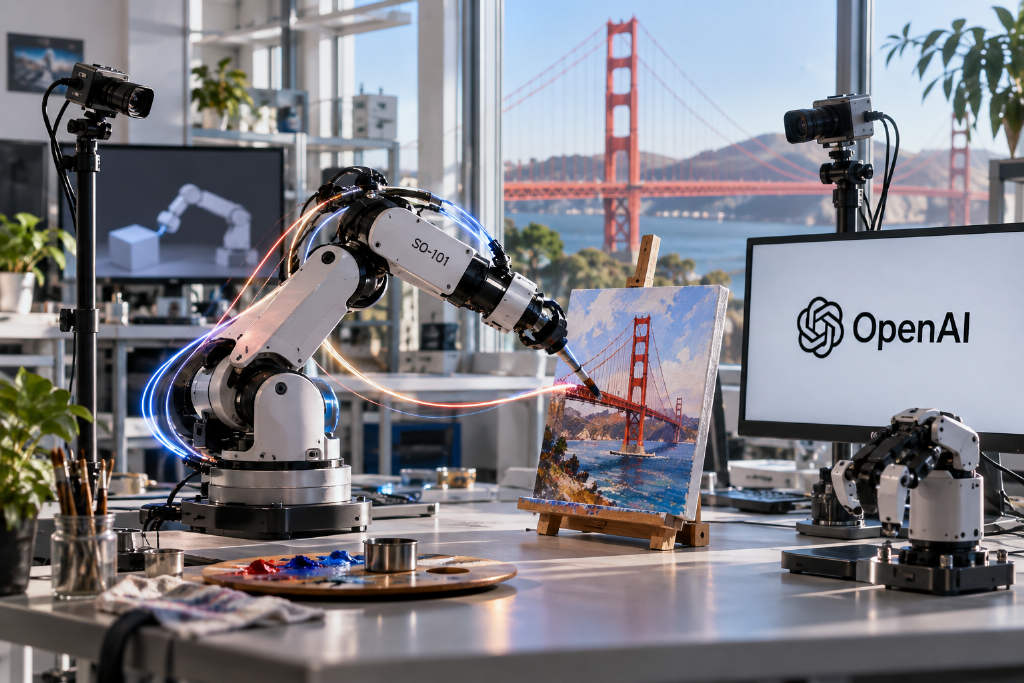
A low-cost SO-101 robotic arm drawing the Golden Gate Bridge under GPT-6 Astra’s control has pushed OpenAI back into the center of robotics discussion. The demo was not based on a preset path: Astra planned the strokes, watched the canvas through a camera, and adjusted as it drew. Since then, a series of public experiments have shown the model handling one-shot task imitation, building real2sim environments from robot demonstrations, and controlling more complex embodiments in simulation and on real hardware. The strongest data point came from RoboCurve, which connected GPT-6 Astra to two real I2RT YAM robotic arms. In a pick-and-place test, Astra succeeded 19 times out of 20, or 95%, while Fable 5.1 succeeded 8 times in the same setup. Those results have sharpened a broader industry debate: if a general-purpose model is already strong enough at perception, reasoning, and action planning, robotics may not need to train every “brain” from scratch on massive robot-specific datasets. The article also traces OpenAI’s earlier robotics work with Dactyl, the company’s retreat from the field because of data constraints, and its possible return through a different route. At the same time, Astra still shows clear limits in millisecond-level control and in the “last millimeter” of precise insertion tasks, where contact, force, and hardware error remain hard problems.