South Korea2026-10-18 02:10:36South Korea to Meet Five Crypto Exchanges on Oct. 20 for Feedback on 2027 Tax PlanSouth Korea plans to hold a meeting on Oct. 20 with representatives from five major virtual asset exchanges — Upbit, Bithumb, Coinone, DigitalX, and Gopax — as well as executives from the Digital Asset eXchange Alliance (DAXA), according to Yonhap News Agency as cited by Odaily. The session is intended to gather industry feedback on the country’s virtual asset taxation policy, which is currently scheduled to take effect in January 2027. Under the current plan, income from virtual asset transfers and lending would be taxed at 22% after a basic exemption of 2.5 million won. The tax proposal was first introduced in 2020 and has already been postponed three times. Even so, the government is still preparing on the basis of the existing implementation schedule, and South Korea’s National Tax Service is expected to release a related notice in November. Separately, financial regulators in South Korea are also accelerating work on the government draft of the Digital Asset Basic Act. That draft is expected to be completed by the end of this month, after which related consultation procedures are set to begin.70
France2026-10-16 14:37:55France weighs 31.4% tax on some Bitcoin-to-stablecoin tradesFrance is considering a package of crypto tax measures that would affect certain Bitcoin-to-stablecoin transactions, large crypto holdings, and self-custodied wallets, according to a post by Bitcoin News on X cited by Odaily. The proposal would apply a 31.4% capital gains tax to some Bitcoin swaps into stablecoins. It would also impose an exit tax on crypto assets valued above 800,000 euros and require disclosure of self-custodied wallet holdings worth at least 100,000 euros. Another provision would allow crypto losses to be carried forward for 10 years. None of these measures has become law at this stage. Odaily said the revenue section of France’s 2027 budget has already been rejected by the National Assembly, meaning the proposed measures will need to be resubmitted for further review.150
Policy Regula2026-10-16 10:31:01France weighs a 31.4% tax on stablecoin swaps as Russia sets an end date for direct P2P crypto tradesFrance and Russia are moving on two different parts of the crypto market, but both are pointing to the same destination: tighter state control by 2027. According to market coverage cited from Coin Bureau and policy disclosures tracked by CoinMarketCap, a budget amendment under discussion in France would classify conversions into European Union MiCA-compliant electronic money tokens, or EMT stablecoins, as taxable disposals. The proposal would apply the country’s default 31.4% capital gains tax rate and, if adopted, would take effect on Jan. 1, 2027. That would mark a break from the current treatment in which crypto-to-crypto swaps, including moves into stablecoins such as USDT and USDC, generally do not trigger taxation so long as funds are not cashed out into bank-account fiat. In Russia, the central bank has set July 1, 2027, as the deadline for lawful direct peer-to-peer crypto trading between individuals. After that date, crypto-fiat exchange and transfers would have to go through authorized intermediaries, including licensed operators, digital financial asset platforms, or controlled brokers. The report says the French tax proposal previously faced procedural resistance, while Russia’s rules on admitting authorized intermediaries are expected to be submitted to the State Duma later this year.150
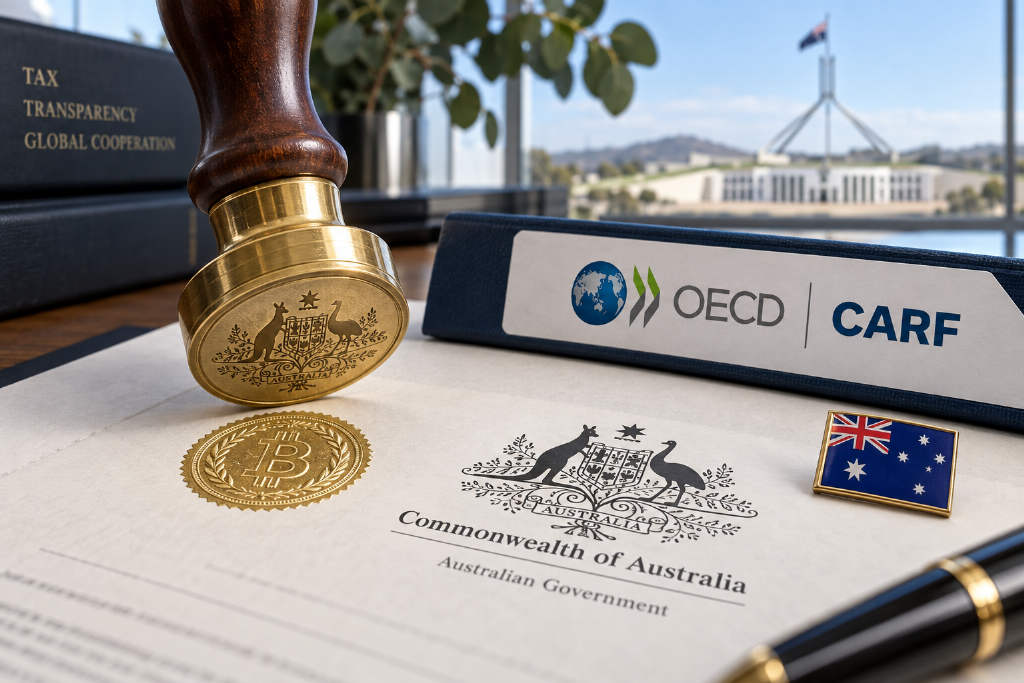
Australia2026-10-16 02:01:45Australia Moves to Write OECD Crypto Tax Rules Into Law, With Automatic Cross-Border Data Sharing Set for 2028Australia’s Treasury has released draft legislation to bring the OECD’s Crypto-Asset Reporting Framework, or CARF, into domestic law, opening the latest step in a policy process that has been developing since 2023. The proposal, formally titled the Treasury Laws Amendment Bill 2026: Taxation Information Reporting, is open for public comment until Oct. 28 and would create a two-track system: one part to meet CARF’s international exchange requirements, and another to establish a local crypto-asset reporting regime inside Australia. The timeline matters. Australia backed CARF in November 2023 as one of the first 47 jurisdictions to do so, launched public consultation on local implementation in late 2024, and later said in its 2025-26 Mid-Year Economic and Fiscal Outlook that international crypto tax data exchanges would begin in 2028. The newly released bill is the first legislative step to turn those commitments into statute. CARF, introduced by the Organisation for Economic Co-operation and Development in August 2022, is meant to extend tax reporting and information-sharing rules to crypto assets, much as the Common Reporting Standard did for bank and investment accounts. Australia said 77 jurisdictions have now committed to adopt the framework. The Treasury has also signaled follow-up guidance for compliance duties, reporting formats, and transition arrangements for crypto service providers.140
Australia2026-10-15 23:45:47Australia releases draft to adopt OECD crypto tax reporting framework CARFAustralia has released a draft proposal to adopt the Crypto-Asset Reporting Framework, or CARF, developed by the Organisation for Economic Co-operation and Development (OECD). Under the framework, crypto-asset service providers would be required to collect and report customer transaction information, a move aimed at improving tax transparency. Australia is one of 77 jurisdictions that have committed to implementing CARF. The first international exchange of crypto tax data under the framework is expected to take place in 2028. The update was cited by Techub News, which referenced reporting from Cointelegraph.120
France2026-10-14 10:56:55French committee backs proposal to tax Bitcoin-to-stablecoin swaps at up to 31.4%A proposal approved by the finance committee of France’s National Assembly would tax Bitcoin conversions into stablecoins at rates of up to 31.4%, according to a post by Bitcoin News on X. The measure would apply even when crypto is not converted into fiat currency, extending the tax trigger beyond traditional cash-out events. The proposal also includes a potential exit tax on unrealized crypto gains for residents who move abroad while holding more than €800,000 in crypto assets. That would bring unrealized holdings into scope if a taxpayer relocates overseas with a large portfolio. The amendment has not become law. It was withdrawn after the committee rejected the revenue section of the budget and would need to be reintroduced during debate in the full National Assembly. If it is eventually passed, the new rules would take effect on Jan. 1, 2027.230
South Korea2026-10-14 05:18:40South Korea’s tax agency says crypto tax rules will be released around NovemberSouth Korea’s National Tax Service is preparing to publish a notice setting out taxation standards for cryptocurrency transactions around November, according to remarks made by Commissioner Lim Kwang-hyun during a parliamentary audit by the National Assembly’s Strategy and Finance Committee. The notice is expected to spell out tax rules for different types of crypto transactions. It is also intended to support the rollout of cryptocurrency taxation scheduled to begin in January 2027. The update was reported by CoinPost and cited by Techub.160
South Korea2026-10-14 02:43:49South Korea prepares crypto tax rollout in January, but offshore trades and private wallet transfers remain hard to trackSouth Korea is preparing to begin taxing cryptocurrency from January next year, according to National Tax Service Commissioner Lim Kwang-hyun, who spoke during a parliamentary audit. He said the country is getting ready for the tax rollout, but key blind spots remain in enforcement. Transfers between private wallets and trading activity on overseas platforms are still difficult to track in full. Lim said that even if the Crypto-Asset Reporting Framework, or CARF, is introduced, it would still be hard to capture every transaction. That leaves parts of the market outside effective oversight as the tax regime approaches. The issue is not limited to the tax authority. South Korea’s central bank had already exposed similar regulatory blind spots when it appeared in a separate parliamentary audit earlier. The remarks point to a gap between the government’s plan to start crypto taxation and its current ability to monitor all relevant activity across wallets and offshore venues.170