DBS

DBS
2026-09-02 01:14:09

DBS and Stripe Forge Strategic Partnership to Boost Asia Agency Commerce and Cross-Border Payments

DBS and Stripe have formed a strategic partnership to accelerate growth in agency commerce and cross-border payments across Asia. The partnership leverages DBS's Asian network and Stripe's programmable financial services to help businesses move funds more efficiently. They will also explore agentic AI to improve transaction security and efficiency. DBS CEO Chen Sushan highlighted that Asia's digital economy is entering a new phase of innovation, with AI agents gaining traction. Stripe's CCO Fran Ryan noted that over half of users in the region already engage in cross-border sales. The collaboration supports Stripe's expansion in Asia and its transformation into a full-stack financial infrastructure provider. Forecasts suggest AI agents could orchestrate $5 trillion in global consumer commerce by 2030, and Asia's cross-border payment outflows may reach $24 trillion by 2033, accounting for 36% of the global total.

60
DBS and Stripe Forge Strategic Partnership to Boost Asia Agency Commerce and Cross-Border Payments
Swift
2026-08-29 17:03:35

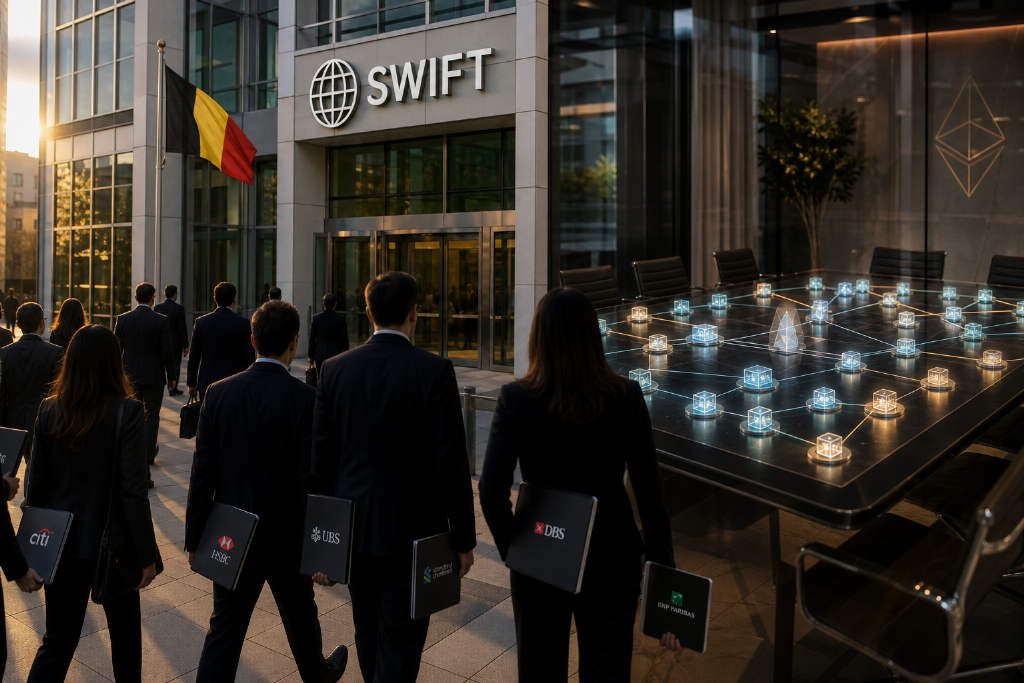
Swift tests a blockchain shared ledger on Linea with 17 banks in pilot

Swift is testing whether blockchain infrastructure can plug into its existing cross-border messaging network, which handles about $1.5 quadrillion in annual traffic, according to a CoinDesk report published on Aug. 29. The pilot uses a shared ledger built on Linea, the Ethereum Layer 2 network developed by ConsenSys, to explore round-the-clock tokenized payments that could operate outside standard banking hours. The initial trial includes 17 major banks across six continents, including ANZ, BNP Paribas, BNY Mellon, Citi, DBS, HSBC, Standard Chartered, UBS, Mitsubishi UFJ and Wells Fargo. Under the current setup, final settlement still runs through existing payment rails, while the blockchain ledger is being used first for messaging and coordination. The test lines up with a wider push in traditional finance toward tokenized cross-border payments, including JPMorgan’s Kinexys. For Swift, the main challenge is not simply whether the technology works, but whether it can run with the scale, reliability and regulatory standards required by a network that sits at the center of global banking flows.

90
Swift tests a blockchain shared ledger on Linea with 17 banks in pilot
HashKey
2026-08-27 10:33:02

HashKey reports 20.6% revenue growth in H1 2026 as institutional trading volume jumps 58.8%

HashKey Holding released its interim results for the first half of 2026 on Aug. 27, posting higher revenue, narrower adjusted losses and a bigger institutional trading mix despite a broad contraction in the global crypto market. Total revenue reached HK$343 million, up 20.6% from a year earlier, while gross profit rose 12.5% to HK$208 million and gross margin improved to 60.6% on a sequential basis. Adjusted loss narrowed from HK$398 million in the same period last year to HK$315 million, a 21% reduction. The exchange facilitation business remained the biggest contributor, generating HK$268 million in revenue, up 38.6%. Platform trading volume climbed 31.8% to HK$282.2 billion, with institutional clients accounting for HK$231.5 billion, up 58.8% year over year and representing 82% of the total. The report also highlighted growth in tokenization and on-chain services, where total on-chain RWA value reached HK$2.68 billion, up 167.8%, including what it described as Hong Kong’s first real-estate RWA and first regulated silver RWA token. Alongside the financial results, HashKey disclosed a string of expansion moves spanning Singapore, Vietnam, Dubai and Bermuda, as well as partnerships with JPMorgan, DBS Bank, Canton and Morpho.

230
HashKey reports 20.6% revenue growth in H1 2026 as institutional trading volume jumps 58.8%
HashKey
2026-08-27 09:17:11

HashKey posts 20.6% revenue growth in 2026 interim results as adjusted loss narrows 21%

HashKey Holding Limited reported unaudited interim results for the six months ended June 30, 2026, showing higher revenue, improved gross profit and a narrower adjusted loss despite a broader pullback in the global crypto asset market. The company said total revenue reached HK$343 million, up 20.6% year over year, while gross profit rose 12.5% to HK$208 million. Gross margin improved to 60.6% from the second half of 2025, and adjusted loss, measured on a non-IFRS basis, narrowed 21.0% to HK$315 million from HK$398 million a year earlier. HashKey’s trading business remained the main growth driver, with trading facilitation revenue climbing 38.6% to HK$268 million and total platform trading volume increasing 31.8% to HK$282.2 billion. The company also reported growth in tokenization and asset management, disclosed a proposed acquisition involving Singapore’s Asia Pacific Exchange, and outlined strategic investments in Vietnam’s CAEX and derivatives technology firm SignalPlus.

380
HashKey posts 20.6% revenue growth in 2026 interim results as adjusted loss narrows 21%
DBS Bank
2026-08-27 03:22:07

DBS and Stripe team up on AI and cross-border payment services in Asia

DBS Bank has entered into a partnership with payments platform Stripe to jointly develop artificial intelligence and cross-border payment solutions in Asia, according to Techub News, citing Tech in Asia. The tie-up centers on payment efficiency and regional expansion, with both companies working on services aimed at the Asian market. DBS CEO said the bank expects AI technology to generate more than $768 million in additional revenue by 2025. Beyond product development, DBS will also help Stripe manage liquidity and cash positions across its corporate entities. The arrangement adds an operational banking layer to the partnership while linking it to Stripe’s broader payments business in the region.

90
DBS and Stripe team up on AI and cross-border payment services in Asia
RWA
2026-08-26 09:02:46

Wall Street’s Next Crypto Bet May Be the Onchain Product Layer Behind RWA

A TechFlowPost market analysis argues that Wall Street’s most valuable skill over the past five decades has not been stock picking, but product manufacturing. In that framework, the next major crypto opportunity may not sit at the asset-tokenization layer itself, but one level above it: the onchain infrastructure that turns tokenized assets into standardized investment products. The article points to several data points to support that view. Global ETF assets reached a record $23.09 trillion by the end of June 2026, with $1.33 trillion in net inflows during the first half of the year. In tokenized markets, stablecoin supply has climbed above $300 billion, while tokenized real-world assets, or RWA, expanded from $11.8 billion to $33.5 billion in one year. The piece also notes that the GENIUS Act took effect in July 2025, while market structure legislation has moved into the U.S. Senate process. Against that backdrop, the author says the asset side, demand side, and regulatory side have matured at the same time for the first time in the past 18 months. The analysis highlights activity from BlackRock, JPMorgan, MGX, Nasdaq, DBS, BNY Mellon, and Goldman Sachs as signs that not only assets, but products themselves, are moving onchain. It argues that the most obvious gap in current crypto-financial infrastructure is an issuance and operations layer for structured products, and names City Protocol as one project attempting to fill that opening.

600
Wall Street’s Next Crypto Bet May Be the Onchain Product Layer Behind RWA
AI agents
2026-08-24 01:25:56

AI agents are emerging as a new payment user base, with USDC taking an early lead in machine-to-machine transactions

AI agents are starting to function as a new class of customers in digital payments, paying on their own for data, compute, APIs, and online tools. In this early machine-to-machine market, stablecoins, especially USDC, have gained a visible head start. Coinbase said its x402 payment protocol has processed more than 165 million payments worth a combined $50 million, with roughly 99% of those transactions settled in USDC and an average payment size of about $0.30. The company also said its ecosystem counted more than 480,000 agents in an April update. The broader market is still experimental. Coinbase’s Lincoln Murr compared the current phase to the Napster and LimeWire era, saying many participants are testing ideas while viable business models remain unsettled. He also said 25% to 30% of transaction volume comes from leaderboard-driven testing rather than genuine purchasing demand. Cloudflare, Circle, MoonPay, Visa, Mastercard, DBS, and Turnkey are all building or testing pieces of the stack, from micropayment gateways to agent spending controls and card-linked flows. At the center of the debate is whether stablecoins or traditional card networks are better suited to tiny, frequent payments. Stablecoin backers point to global availability, always-on settlement, and lower friction for sub-$1 purchases. Card networks are not stepping aside: Mastercard is pushing a voucher-based model for agent payments, while banks and card providers continue testing higher-value use cases that need refunds and dispute handling. Wallet onboarding, spending controls, and responsibility for mistaken purchases remain unresolved.

560
AI agents are emerging as a new payment user base, with USDC taking an early lead in machine-to-machine transactions
HSBC
2026-08-19 14:45:42

HSBC and Standard Chartered complete first live interbank tokenized-deposit transaction on Swift ledger

HSBC and Standard Chartered have completed the first live cross-border bank-to-bank tokenized-deposit transaction on Swift’s blockchain-based ledger, moving the system from initial readiness to its first interbank use. The banks exchanged payment messages through the shared ledger and recorded the resulting obligations on HSBC’s Tokenised Deposit Service and Standard Chartered’s tokenized-deposit infrastructure. Swift then matched and netted those obligations, while final settlement was completed through existing systems. The setup is designed to let separate bank-issued tokenized-deposit platforms work together rather than forcing participants onto a single infrastructure. Swift and the two banks said the model could help corporate and institutional clients move liquidity across institutions outside conventional operating hours. The announcement did not disclose the size of the payment, the currencies involved, or the geographic corridor, and it did not say whether the transfer was routine production activity or a controlled live transaction. The deal follows Swift’s July update that its ledger was ready for initial use, with 17 banks across six continents preparing to pilot live transactions.

270
HSBC and Standard Chartered complete first live interbank tokenized-deposit transaction on Swift ledger