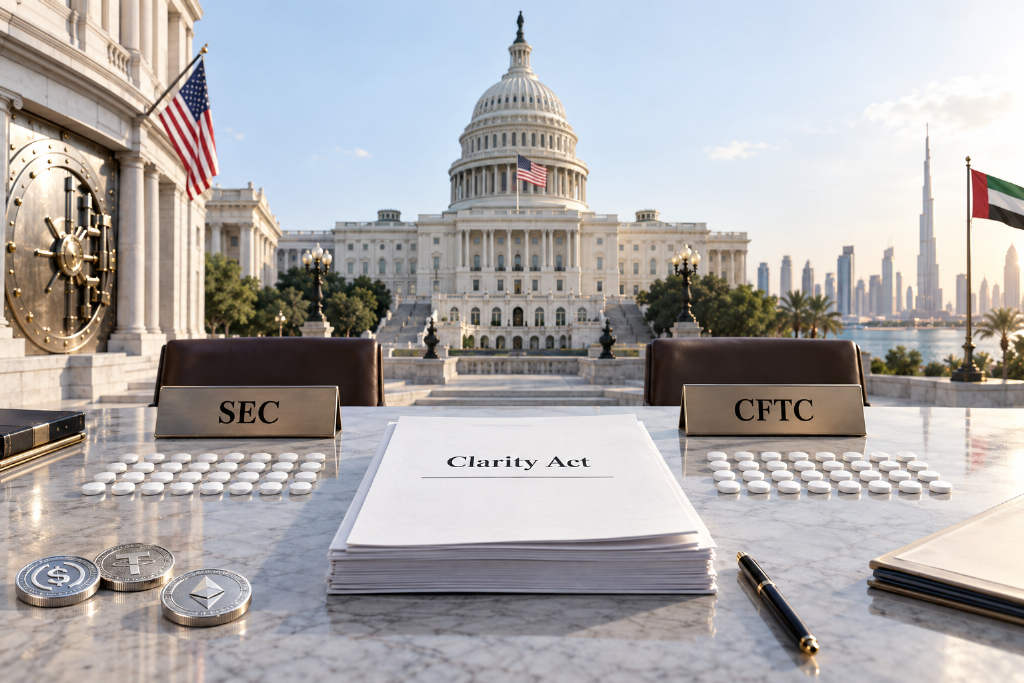
Policy and Re2026-09-21 14:53:52Senate’s failure to advance Clarity Act leaves room for banks and offshore crypto hubs, critics sayThe U.S. Senate’s 49-50 cloture vote on the Clarity Act has left the crypto industry without the federal market-structure framework it had been seeking, keeping policy formation largely in the hands of the Securities and Exchange Commission and the Commodity Futures Trading Commission. Lawyers and industry participants cited by CoinDesk said the result favors two groups in particular: U.S. banks, which have opposed stablecoin rewards that could compete with deposits, and overseas jurisdictions with clearer crypto rules, including the United Arab Emirates. Anton Golub of Forte said banks “won this round,” arguing that lenders increasingly see stablecoins as a direct challenge to deposit gathering rather than just another crypto product. After the vote, the SEC issued a temporary conditional exemption allowing eligible venues to trade tokenized U.S. stocks through permissioned liquidity pools on public blockchains. The CFTC also sent a new crypto proposal to the White House for review, though details were not disclosed. Dubai-based lawyer Irina Heaver said the UAE already offers the clarity that the U.S. is still debating. She said more than 110 regulated virtual-asset businesses operate there, with about 20 more holding in-principle approvals. Kyle Bligen of the Decentralization Research Center said Congress remains the best route to a comprehensive framework, even if the Senate vote was a setback.410
Dubai2026-09-04 17:46:06Dubai's VARA and Securitize Sign MOU to Advance Tokenization MarketThe Dubai Virtual Assets Regulatory Authority (VARA) has signed a Memorandum of Understanding with tokenization platform Securitize to jointly explore support for tokenization projects in Dubai's virtual asset ecosystem. The collaboration covers regulatory engagement, knowledge sharing, ecosystem development, and market education. It will also examine the development of tokenized financial products operating within Dubai's regulatory framework. Securitize stated that the partnership will provide licensed market participants with its global expertise while supporting market integrity and investor protection.860
VARA2026-09-03 13:08:41Dubai VARA Signs MoU with Securitize to Advance Tokenization InfrastructureDubai’s Virtual Assets Regulatory Authority (VARA) has signed a Memorandum of Understanding (MoU) with Securitize, a tokenization platform backed by BlackRock, to advance tokenization and digital asset infrastructure in the UAE and Dubai. The agreement establishes a collaborative framework to support regulated tokenization initiatives and strengthen Dubai’s digital asset ecosystem. A VARA spokesperson said the MoU aims to combine VARA’s regulatory perspective with Securitize’s institutional tokenization expertise, though no specific projects have been disclosed. Securitize co-founder and CEO Carlos Domingo called Dubai one of the most forward-looking jurisdictions for digital asset innovation. The news comes amid surging demand for tokenized assets: data from RWA.xyz shows tokenized asset holders grew 103% to 3.2 million over the past 30 days, with total value reaching $38.5 billion. Securitize remains the largest tokenization platform globally with $4.9 billion in assets under management, followed by Ondo Finance at $3.5 billion.860
Dubai2026-09-02 07:58:57Blockchain Life 2026 set for Dec. 1-2 in DubaiBlockchain Life 2026 is scheduled to take place in Dubai on Dec. 1-2, 2026, bringing together participants from across the global crypto industry. According to the event description, the conference is expected to draw more than 15,000 attendees from over 130 countries, along with more than 200 speakers and over 200 sponsors. Organizers position the event as a major gathering for founders, executives, investors, fund representatives, industry experts, and traders. The conference will open what it describes as the largest technology and business week of 2026, with topics spanning Web3, digital finance, investment, artificial intelligence, and future technologies. The agenda includes three themed stages, a large-scale brand expo, a trading competition, and a new AI Future Forum focused on real-world AI applications, robotics, and the intersection of AI with crypto and business. Organizers also said the event will close with a party at a top club in Dubai featuring international performers.410
Real Estate T2026-08-27 04:00:00OneAsset Says Real Estate Tokenization Hinges on Legal Rights, Asset Quality and Buyer DemandReal estate tokenization is drawing more attention as real-world assets move on-chain, but the model remains far less standardized than tokenized Treasuries, money market funds or private credit. In an interview with PANews, OneAsset CEO Sonia Shaw said the hard part is not issuing a token. It is building a structure that ties digital instruments to enforceable economic rights, ongoing property management and rules that can hold up across jurisdictions. OneAsset, a Dubai-based company focused on institutional-grade commercial real estate, is building around single-asset vaults, bankruptcy-remote SPVs, independent valuations and continuing disclosure on leases, costs and cash flows. Shaw said token fragmentation does not create liquidity on its own, and that secondary trading depends on the quality of the underlying property, reliable income, transparent reporting and enough qualified buyers. The company plans to start on Base rather than build its own chain, and is pursuing regulatory work with Dubai’s Virtual Assets Regulatory Authority, or VARA. It also said it has obtained ISO/IEC 27001:2022 certification. PANews framed the discussion around a broader shift in property RWA: away from issuance speed and low entry thresholds, and toward legal structure, underwriting discipline, lifecycle management and machine-readable asset data that could eventually support AI-driven allocation.1130
Binance2026-08-21 13:00:46Binance says two employees questioned in the UAE have given statements and were cleared to leaveBinance said two employees who had been questioned by authorities in the United Arab Emirates have completed their statements and were allowed to leave, adding that they have been confirmed not to be targets of the related investigation. A Binance spokesperson said the matter involved explaining third-party fund flows that moved through company client fund accounts. According to the exchange, UAE police and other authorities were conducting what it described as 「routine inquiries」, and the employees were released after providing the requested information. Earlier reports had said the two Binance employees were stopped at an airport in the UAE while police examined possible financial crimes tied to a trading platform. Binance said the operating structure for crypto assets and institutional client fund accounts remains a new area in some jurisdictions, and that it is in active communication with Dubai police and regulators in other emirates to establish a clearer coordination mechanism.1230
Cregis Custod2026-08-11 10:13:46Cregis Custody FZE Gets VARA In-Principle Approval for VASP License in DubaiCregis Custody FZE, a digital asset custodian, announced it has received an in-principle approval (IPA) from Dubai's Virtual Assets Regulatory Authority (VARA). This marks a key milestone in its application for a Virtual Asset Service Provider (VASP) license. Upon satisfying remaining regulatory requirements and obtaining final authorization, the company will offer regulated digital asset custody services.1910
tokenization2026-08-11 07:26:02ADI Chain, Shipfinex Partner to Tokenize Ship FinanceADI Chain has partnered with Shipfinex, a Dubai-based firm focused on ship tokenization, with plans to bring the roughly $680 billion ship finance market to a wider range of institutional capital through blockchain. Ramana Kumar, president of the stablecoin ecosystem at ADI Foundation, said maritime finance has the scale, physical assets and commercial activity to become a significant real-world asset class. The collaboration signals that tokenization is no longer limited to financial instruments such as government bonds; it is now reaching physical infrastructure like vessels. Shipfinex has identified around 35 ships with a total value of $500 million as candidates for tokenization. However, the company has only received preliminary regulatory approval from Dubai's VARA. It has not yet obtained a full operating license, and it has not issued any maritime asset tokens.2050