
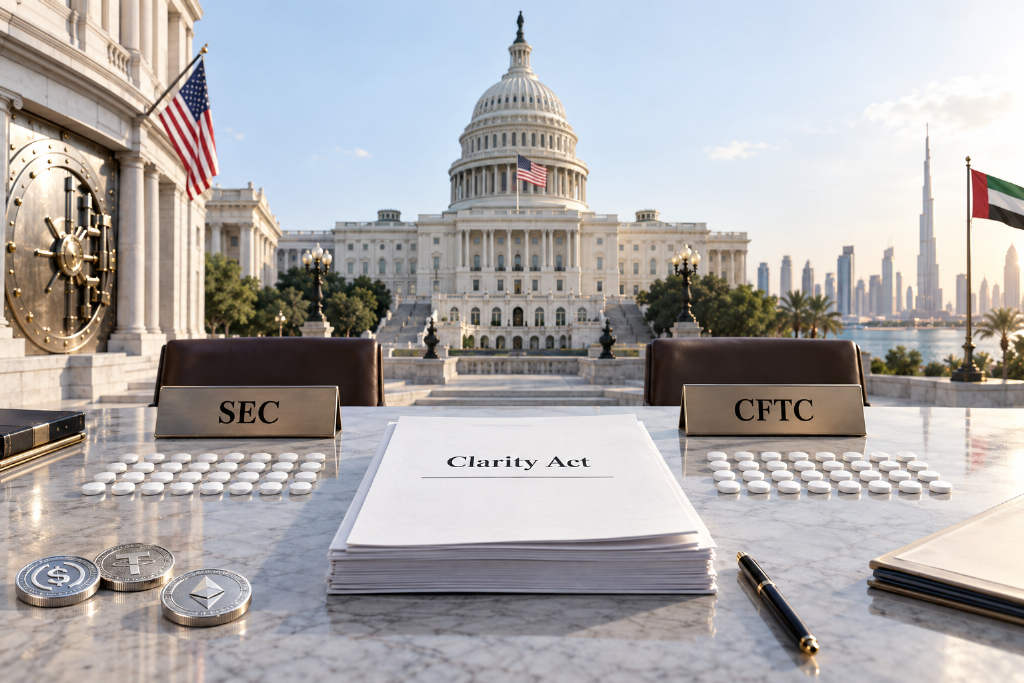
The U.S. Senate’s failure last week to advance the Clarity Act has left American crypto policy largely in the hands of the Securities and Exchange Commission and the Commodity Futures Trading Commission, and lawyers and industry experts say that outcome may favor U.S. banks and offshore crypto hubs such as the United Arab Emirates.
The bill failed to move forward after a 49-50 Senate cloture vote. That means the crypto sector will not get the federal market-structure framework it had sought through the legislation. Instead, the SEC and CFTC will keep shaping policy through existing rules, interpretations and exemptions.
The fight over the bill was not limited to the question of which agency should oversee crypto. It also exposed a broader dispute over whether stablecoin platforms should be allowed to offer rewards that could compete with bank deposits, along with ethical questions involving people in government.
Banks gain ground in the stablecoin rewards debate
Anton Golub, head of exchange go-to-market at Forte, said in a Telegram message: “Banks won this round. But the reason they are fighting so hard is that banks increasingly see stablecoins as competition for deposits, not just as another crypto product.”
In the near term, the failed vote means U.S. crypto regulation will continue to be developed outside Congress. The SEC moved quickly after the vote and issued a temporary conditional exemption that allows eligible venues to trade tokenized U.S. stocks through permissioned liquidity pools on public blockchains.
CFTC proposal heads to the White House with few details public
Soon after that, the CFTC sent crypto rules to the White House for review. The agency submitted a new proposal, but the details were not disclosed.
For now, it remains unclear which crypto assets the proposal covers, what exchanges would need to do to qualify for licenses, what restrictions would apply, and how far the agency believes its authority extends. Jesse Hamilton, CoinDesk’s deputy managing editor in charge of global policy and regulation, wrote in an analysis that the “Clarity Act is dead, at least for now,” while also explaining what he described as a point very few people appear to understand: what the Clarity Act actually is.
Dubai lawyer says the UAE already has the clarity the U.S. is debating
“While the U.S. continues debating the Clarity Act, in the UAE we actually have clarity,” Dubai-based crypto lawyer and NeosLegal founder Irina Heaver said via Telegram.
She added that more than 110 regulated virtual-asset businesses are operating in the country, with about 20 more holding in-principle approvals.
“Every additional year that major markets spend debating how crypto should be regulated gives jurisdictions that have already created functioning regulatory frameworks another year to attract businesses, founders, talent and capital,” she said. “Regulatory clarity is no longer just a legal issue. It is a competitive advantage for the country.”
Industry voices still point to Congress as the best route
Kyle Bligen, executive director at the Decentralization Research Center, said “Congress remains the best route to a comprehensive market structure framework.”
He said the Senate’s vote “was disappointing, but it does not change the underlying problem: digital assets still need clear and durable rules.”