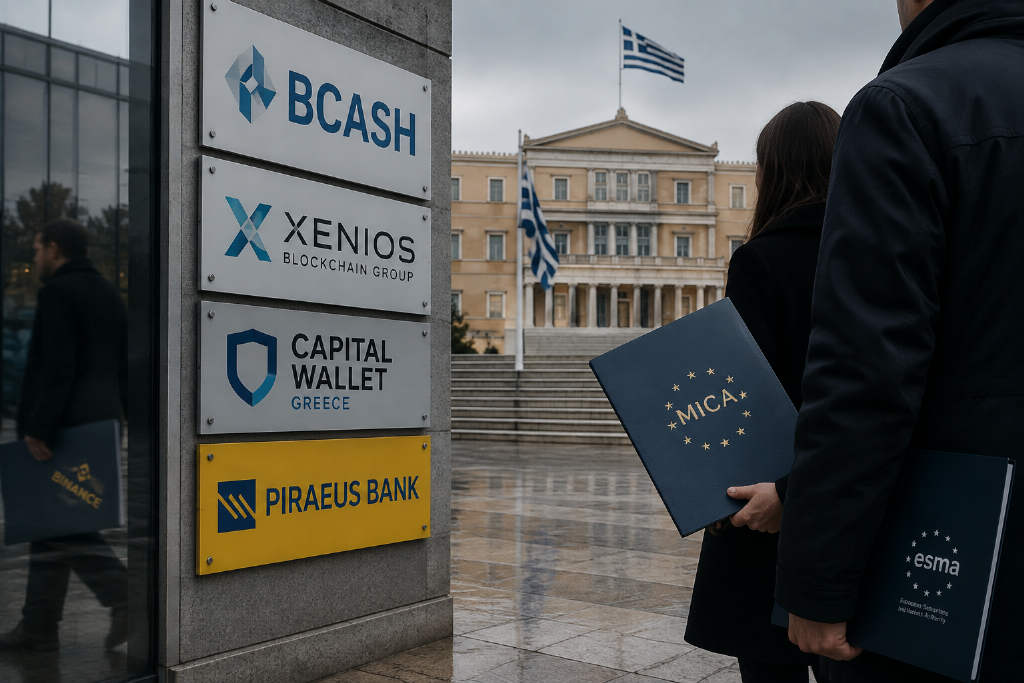
Greece2026-09-29 10:05:00Four Greek entities join ESMA’s MiCA crypto register for the first timeGreece has appeared in the European Securities and Markets Authority’s register of Markets in Crypto-Assets (MiCA) crypto-asset service providers for the first time, with four entities approved: BCash, Xenios Blockchain Group, Capital Wallet Greece, and Piraeus Bank. Their addition brings the total number of registered service providers to 359, according to a Cointelegraph report cited by PANews. Regulatory oversight is split between two Greek authorities. The Hellenic Capital Market Commission (HCMC) is responsible for supervising BCash, Xenios Blockchain Group, and Capital Wallet Greece, while crypto-related banking activity involving Piraeus Bank falls under the Bank of Greece. The report also referenced earlier claims that European Central Bank President Christine Lagarde had intervened to block Binance from seeking a MiCA license through Greece. In a written response, HCMC said it had never communicated with the ECB or Greek government officials on the matter and "firmly denied" that the remarks in question had been made by its officials.180
ESMA2026-09-29 10:00:52ESMA updates MiCA register, adding first Greece-based crypto service providersThe European Securities and Markets Authority (ESMA) has updated its Markets in Crypto-Assets (MiCA) register, adding BCash, Xenios Blockchain Group, Capital Wallet Greece and Piraeus Bank as the first Greece-based crypto-asset service providers on the list. The update also added six institutions from Germany, France and Slovenia, bringing the total number of registered entities to 359. According to the information cited by ChainCatcher, the Hellenic Capital Market Commission (HCMC) supervises the first three firms, while the Bank of Greece oversees Piraeus Bank. HCMC also denied that its officials had communicated with European Central Bank (ECB) officials regarding Binance’s Greek MiCA application, and rejected statements alleging that Christine Lagarde had intervened in the process. Binance withdrew its application on June 24.190
MiCA2026-09-29 10:00:21Four Greek firms join MiCA register for the first time as HCMC denies claims of interference in Binance applicationThe European Securities and Markets Authority has updated its Markets in Crypto-Assets (MiCA) register, adding four Greece-based entities for the first time: BCash, Xenios Blockchain Group, Capital Wallet Greece, and Piraeus Bank. The update also brought in six more institutions from Germany, France, and Slovenia, taking the total number of registered entities to 359. Regulatory oversight in Greece is split between two authorities. The Hellenic Capital Market Commission, or HCMC, supervises BCash, Xenios Blockchain Group, and Capital Wallet Greece, while the Bank of Greece oversees Piraeus Bank. HCMC also pushed back on claims tied to Binance’s MiCA application in Greece. The regulator said its officials did not communicate with European Central Bank officials regarding the application, and it denied making statements that European Central Bank President Christine Lagarde had intervened in the process. Binance withdrew its application on June 24. The development was reported by Cointelegraph.170
ESMA2026-09-28 14:14:04ESMA says MiCA focus will shift from rulemaking to enforcementVerena Ross, chair of the European Securities and Markets Authority, said the regulatory focus under the Markets in Crypto-Assets framework will move from drafting rules to supervising how they are carried out as MiCA takes effect. According to the report cited by Techub News, ESMA plans to watch crypto-asset service providers closely in several areas, including operational resilience, outsourcing arrangements and reverse solicitation practices. The agency is also working to improve coordination and harmonize reporting among national regulators across Europe. The comments point to the next phase of MiCA implementation, where supervisory consistency and day-to-day compliance checks become more central than writing new standards.250
ESMA2026-09-28 14:14:08ESMA sets 2027 MiCA priorities with focus on CASP resilience, outsourcing and reverse solicitationThe European Securities and Markets Authority has published its 2027 work plan, laying out how it intends to coordinate national supervision of crypto-asset service providers under the Markets in Crypto-Assets framework. The agenda centers on operational resilience, outsourcing risk, liquidity, reverse solicitation and asset classification. ESMA Chair Verena Ross said the MiCA effort has moved away from rulemaking and toward supervision and supervisory convergence across member states. The regulator also plans to standardize the periodic reports that CASPs submit to national authorities and develop common risk indicators and supervisory dashboards. In parallel, ESMA will continue building MIDAS, a centralized crypto market monitoring system designed to detect potential market abuse under MiCA. The first phase of MIDAS is expected to be fully operational in 2027. Subject to board approval, ESMA said it plans to add analytical functions and broaden the types of data available to MIDAS in the fourth quarter, while feeding supervisory experience into the European Commission’s MiCA review due by June 2027.290
ESMA2026-09-28 14:14:50ESMA sets 2027 plan to coordinate CASP supervision across the EU, with MIDAS rollout in focusThe European Securities and Markets Authority has published its 2027 work plan, laying out a coordinated supervisory approach for crypto-asset service providers, or CASPs, across EU member states. According to Cointelegraph, ESMA said its oversight will focus on operational resilience, outsourcing risk, liquidity, reverse solicitation, and asset classification. ESMA Chair Verena Ross said the Markets in Crypto-Assets framework, known as MiCA, is moving from rulemaking into supervision and convergence. As part of that shift, the regulator plans to standardize the periodic reports CASPs submit to national authorities and develop common risk indicators and supervisory dashboards. ESMA is also advancing MIDAS, a centralized crypto market monitoring system designed to detect potential market abuse under MiCA. The first phase is expected to be fully operational in 2027. Subject to board approval, ESMA plans to add analytical functions and broaden the types of data available to MIDAS in the fourth quarter, while feeding supervisory experience into the European Commission’s MiCA review, which is expected to be completed by June 2027.280
Polymarket2026-09-22 04:51:21Polymarket lobbies across Europe to have prediction contracts treated as financial derivativesPolymarket is lobbying regulators in the UK, Brussels and several European Union countries in an effort to have its prediction market contracts classified as financial derivatives rather than gambling products, according to the Financial Times. The company wants those contracts brought under financial services rules including MiFID, instead of remaining subject to national gambling laws. The report said Polymarket has been in contact with the European Securities and Markets Authority, the European Commission and the UK Financial Conduct Authority, while also seeking a license to operate in Europe. The push comes as regulators in several European markets continue to take a strict view of retail prediction markets. Authorities in the UK, France, Germany and Italy have previously indicated that similar businesses may require gambling licenses. At the same time, Polymarket is raising funds at a valuation of more than $20 billion, the report said.370
MiCA2026-09-18 14:11:06Banks on the EU MiCA register doubled to about 80 by Sept. 16, Cointelegraph analysis saysBanks are taking a larger share of the European Union’s MiCA-registered crypto services market, according to Cointelegraph’s analysis of registration data from the European Securities and Markets Authority, or ESMA. The number of banks on the MiCA crypto service provider list rose from about 40 on June 26 to about 80 on Sept. 16, lifting their share from roughly 17% to nearly 23%, close to one-quarter of the total. Over the same period, the total number of registered crypto-asset service providers, or CASPs, increased from 243 to 349. Even as the overall pool expanded, non-bank providers saw their relative share fall from about 84% to 77%. Germany was identified as the main driver of the increase in bank participation. Newly listed institutions on ESMA’s MiCA register included Volksbank, Raiffeisenbank and VR Bank entities. Separately, Deutsche Bank said on Wednesday that it plans to launch digital asset custody services for institutional and corporate clients in Europe, and a spokesperson told Cointelegraph the bank expects to receive regulatory approval under MiCA in October. Under Article 60 of MiCA, banks can offer crypto-asset services through a notification procedure rather than the standard CASP authorization route.450