ETC

US stocks
2026-09-09 08:32:57

CoreWeave jumps 11.72% as AI compute names diverge, while AVAV heads into a key post-merger earnings test

U.S. stocks closed lower on Sept. 8, but AI compute leasing names broke from the broader tape. CoreWeave rose 11.72% to $99.83 even though Palantir’s partnership announcement centered on rival Nebius, which gained 7.73%. The move stood out because the signal was read as demand for the broader rental-compute trade rather than a company-specific order, while chip suppliers Micron and Nvidia both finished in the red. The report also shifts to AeroVironment, which is scheduled to release earnings after 20:00 UTC, with a call at 20:30. According to the source article, this is the first quarter in which AVAV faces a like-for-like year-over-year comparison after its May 2025 BlueHalo acquisition was fully annualized. That matters because the company’s previous triple-digit growth rates, including 133% in fiscal 2026 fourth quarter revenue, were lifted by consolidation base effects, while fiscal 2027 guidance points to roughly 10% growth on a fully comparable basis. The article further examines how the AI compute chain split between rental-capacity providers and chip sellers, and why rare-earth mining is less constrained than refining and magnet production in the U.S. supply chain discussion.


200
CoreWeave jumps 11.72% as AI compute names diverge, while AVAV heads into a key post-merger earnings test
Ethereum
2026-09-08 10:20:25

Ethereum’s Frame Transactions plan would let users pay gas through stablecoins, while ETH stays the settlement asset

A fresh debate around Ethereum’s upcoming roadmap picked up after a post on X claimed the network’s next major upgrade would let users pay transaction fees in stablecoins instead of ETH. The key correction from community members was that Ethereum is not replacing ETH at the protocol level. Under the proposed EIP-8141, users may see fees deducted from balances such as USDC, but validators would still receive ETH and the chain would still settle gas in ETH. The proposal, known as Frame Transactions, was moved from Considered for Inclusion to Scheduled for Inclusion at the Aug. 27 All Core Devs Execution meeting, placing it on the roadmap for the 2027 Hegotá hard fork. It would split a transaction into as many as 64 programmable frames, allowing identity checks, gas payment and execution logic to be handled separately while remaining atomically linked. The article argues that the proposal does not automatically erase ETH demand. Instead, it may shift demand away from millions of retail users holding small ETH balances for gas and toward wallets, paymasters and app operators that would need larger ETH inventories to sponsor user activity. In that model, ETH demand becomes more concentrated, not necessarily smaller.

90
Ethereum’s Frame Transactions plan would let users pay gas through stablecoins, while ETH stays the settlement asset
Polkadot
2026-09-08 21:32:57

Polkadot Leads a Rotation Into Older Layer-1 Tokens as Fed Hike Odds Reach 54.5%

Older layer-1 tokens launched before 2018 led parts of the crypto market on Tuesday, with Polkadot rising 16.7% after a proposal to create the network’s native stablecoin, dotUSD, entered OpenGov. Bitcoin and ether finished lower as traders increased bets on a 25-basis-point Federal Reserve rate hike at next week’s meeting. Polymarket priced the hike at 54.5%, with $104.6 million in volume. Bitcoin traded at $78,539, down 0.83% over 24 hours but up 1.6% over seven days, while ether fell 0.29% to $2,484.83. Cosmos Hub, Decred and Ethereum Classic also advanced without a dated catalyst. Zcash gained 0.82% after Grayscale said its ZCSH fund was available for options trading on the NYSE, though no exchange notice or SEC filing confirming the listing was retrieved. Injective rose 5.25% following announcements tied to native USDC on Kraken, INJ trading on Robinhood and record on-chain staking. Useless Coin gained 24% after Bithumb and Upbit opened trading. Brent crude settled at $99.31 a barrel, while U.S. equities closed lower.

250
Polkadot Leads a Rotation Into Older Layer-1 Tokens as Fed Hike Odds Reach 54.5%
Harbin Engine
2026-09-06 09:18:11

Harbin Engineering University alumni emerge as a force in China’s deep-sea robotics funding wave

A cluster of deep-sea robotics startups in China is drawing investor attention, and Harbin Engineering University keeps appearing at the center of the story. According to a report by PEdaily carried by MarsBit, Suzhou-based Gongzhi Ocean and Shihang Intelligence, along with Greater Bay Area-based DeepSea Humanoid, have all disclosed major financing rounds, with founders or core figures tied to Harbin Engineering University’s ship and ocean engineering system. Gongzhi Ocean said it closed an angel round worth nearly RMB 100 million, while DeepSea Humanoid completed an A round of more than RMB 500 million and Shihang Intelligence announced an A round above RMB 1 billion in June. The report argues that this is not a coincidence. Harbin Engineering University has long focused on shipbuilding, naval equipment, ocean development, and nuclear applications, and has built deep expertise in marine engineering and underwater robotics. It links that academic base with a broader industrial shift, as deep-sea technology gained policy support in 2025 and this year’s March approval of the 15th Five-Year Plan outline called for stronger capabilities in deep-sea access, exploration, development, and security. The article also widens the lens to Harbin Institute of Technology, presenting the two Harbin universities as a pair of northeastern hard-tech talent hubs now feeding China’s latest startup wave.

100
Harbin Engineering University alumni emerge as a force in China’s deep-sea robotics funding wave
China
2026-08-19 02:51:53

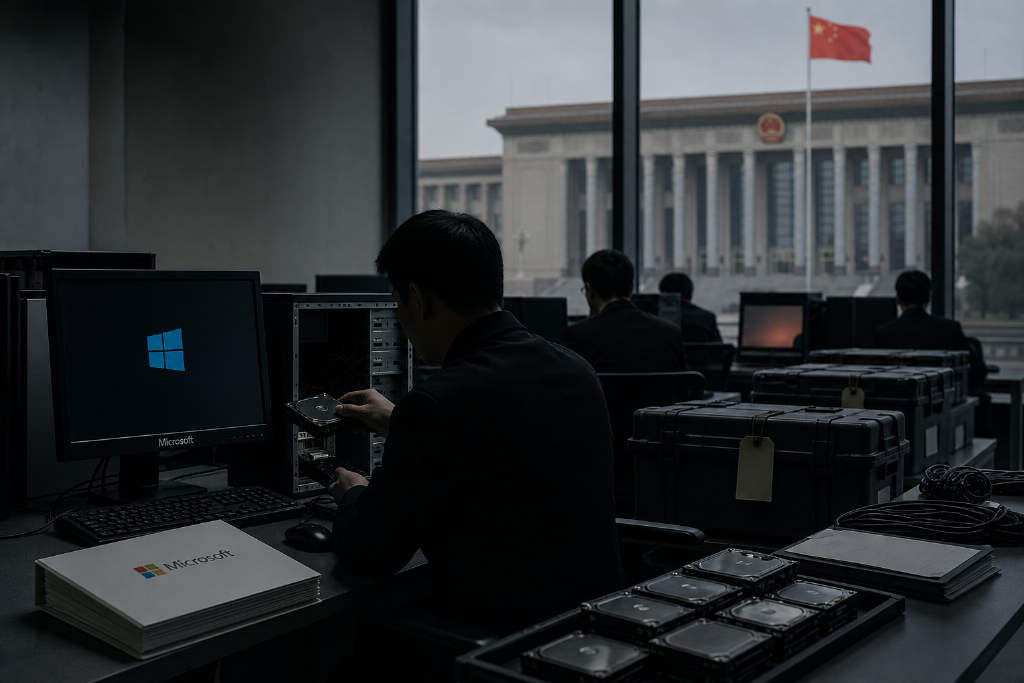
Bloomberg says China moved up removal of Microsoft’s government-tailored Windows 10 at some state-linked agencies

Bloomberg reported that China’s Ministry of State Security has ordered some government-linked institutions to remove a customized government edition of Microsoft Windows 10 months earlier than previously planned. The system, formally called Windows 10 CMIT Government Edition, had been scheduled to exit in February 2027, according to the report. Bloomberg said the software was developed by CMIT, a joint venture set up in 2016 by Microsoft and China Electronics Technology Group, to adapt Windows 10 for Chinese government use with certain native functions disabled and locally developed security modules added. Markets reacted quickly after the report appeared. Kylinsec and Archermind Technology both hit the 20% daily limit, while China National Software rose 10%. The report placed the move within Beijing’s broader push to replace foreign technology in sensitive public-sector environments, including earlier efforts involving foreign-branded computers, iPhones in some sensitive offices, and a wider shift toward domestic operating systems and chips.

470
Bloomberg says China moved up removal of Microsoft’s government-tailored Windows 10 at some state-linked agencies
China governm
2026-08-18 08:41:34

Bloomberg: Some Chinese government-linked bodies told to remove Windows 10 CMGE edition early

Bloomberg, citing people familiar with the matter, reported that China’s Ministry of State Security has recently instructed some government-related institutions to remove the government edition of Windows 10 developed by China Standard Software, or Shenzhou Wangxin, bringing forward an end-of-support plan that had originally been set for February 2027 by several months. The operating system was developed by Shenzhou Wangxin, a joint venture between Microsoft and China Electronics Technology Group, which was established in 2016 to make sure Windows 10 met Chinese government security requirements. According to the report, the new directive came only weeks before a planned summit between Chinese and U.S. leaders, catching some staff at government bodies by surprise. Bloomberg also said the earlier discontinuation would further reduce reliance on U.S. technology as China gradually removes foreign tech products from government procurement white lists. Shenzhou Wangxin had not publicly responded to the report.

490
Bloomberg: Some Chinese government-linked bodies told to remove Windows 10 CMGE edition early
Ethereum
2026-08-12 15:16:07

What Ethereum Might Look Like in 2026 if The Merge Never Happened

Ethereum’s September 15, 2022 Merge cut the network’s energy use by about 99.95% and replaced proof-of-work with proof-of-stake, reshaping both ETH issuance and the chain’s security model. Nearly four years later, that decision is back in debate through a counterfactual lens: what if Ethereum had stayed on PoW through 2026 instead of moving to PoS? The discussion centers on a trade-off. On one side is the idea that Ethereum’s former GPU mining base could have evolved into one of the world’s largest distributed compute pools, potentially giving the network a stronger position in the AI era. Waterdrip Capital co-founder Jademont and crypto KOL 嗯哼 both argue that millions of GPUs once tied to ETH mining might have been reorganized into a decentralized AI cloud if the protocol and ecosystem had developed mechanisms for task scheduling, verification and revenue sharing. On the other side are the costs. Ebunker co-founder 0xTodd said Ethereum was producing roughly 13,000 ETH per day near the end of PoW, versus about 3,000 ETH after the switch, implying daily sell pressure of around $26 million versus $6 million at a $2,000 ETH price. The article also argues that staying on PoW would likely have meant more inflation, heavier miner selling, more constraints on scaling, and harder conversations around energy use, ESG and institutional adoption.

1060
What Ethereum Might Look Like in 2026 if The Merge Never Happened
Amazon
2026-08-10 00:40:07

Amazon internal Claude project reportedly burned $1.8 million and still failed to launch

Amazon employees said the company recently tried to use Claude Sonnet to generate detailed author information for its website, but the effort ended up costing $1.8 million, running 860% over budget, going unnoticed for five months, and ultimately never reaching deployment. The episode comes as Amazon sharply increases spending on artificial intelligence and automation, with CEO Andy Jassy saying 2026 capital expenditures are expected to reach about $220 billion, most of it earmarked for Amazon Web Services, in-house AI chips, and power infrastructure. The company’s latest quarterly results showed AWS net sales of $42.2 billion for the quarter ended June 30, 2026, up 37% year over year, while AWS generated roughly 60% of Amazon’s $27.5 billion in total operating profit despite contributing only 21% of total revenue. The report also places Amazon’s case in a wider pattern that includes Meta, Uber, and OpenAI, where rapid AI adoption has exposed runaway token consumption, weak cost visibility, and a new push toward spending caps, centralized monitoring, and budget controls.

1170
Amazon internal Claude project reportedly burned $1.8 million and still failed to launch