GHO

Aave
2026-08-01 01:14:15

Stani Kulechov says Aave will cut risk exposure and refine its multichain strategy

Aave founder Stani Kulechov said the protocol plans to reduce its economic and technical risk exposure through a new risk framework and a technical asset listing framework. He said the move should not be read as a reversal of Aave’s multichain expansion, but rather as a strategic refocus on selected protocols. Kulechov also said Aave will keep conducting ongoing risk assessments across all assets already deployed on the protocol. The comments come after Aave launched on Avalanche earlier this month and as it prepares to deploy its V3 lending market and the GHO stablecoin on Monad, according to Cointelegraph. The remarks point to a narrower and more selective approach to expansion while keeping existing deployments under review.

1260

Stani Kulechov says Aave will cut risk exposure and refine its multichain strategy
Castle Labs
2026-07-30 03:33:26

Why token prices still lag even as top crypto protocols post strong revenue

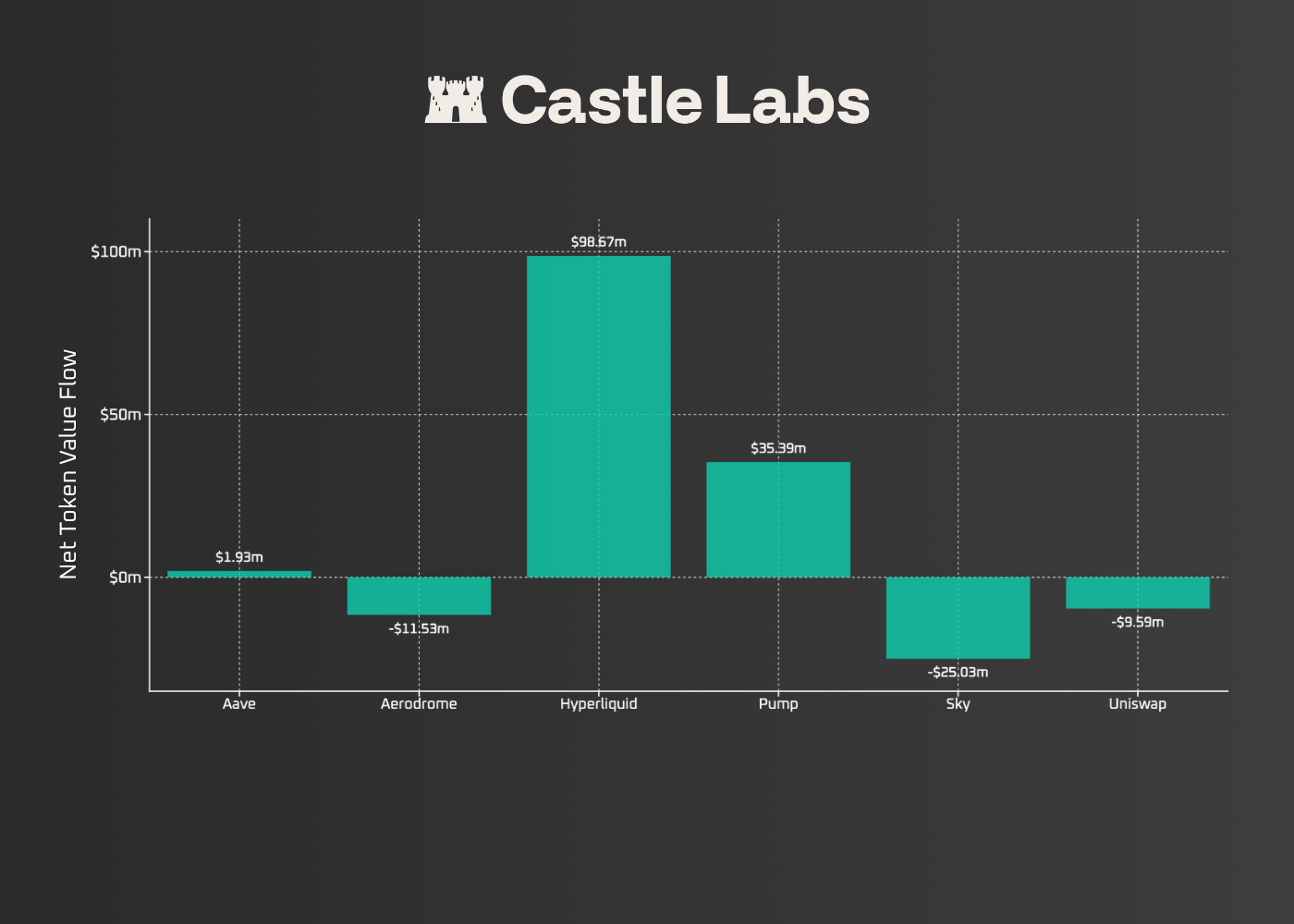
A new analysis from Castle Labs argues that strong protocol revenue alone has not been enough to lift many crypto tokens, because the real driver for holders is the link — or lack of link — between revenue, distribution and token supply expansion. The report reviews six major protocols, Aave, Aerodrome, Hyperliquid, Pump, Sky and Uniswap, which together generated $726 million in revenue in the first half of 2026. Even so, many of their tokens failed to match the strength of the underlying businesses. Castle Labs says investors are now asking harder questions than they did in earlier market cycles: How durable is a protocol’s revenue? How much of that revenue reaches token holders? How much value is offset by inflation, unlocks and incentives? And do equity holders capture economics that token holders do not? The report points to examples across buybacks, burns, fee-sharing and ve-token models, while also showing how fast unlock schedules, treasury discretion and weak value capture can overwhelm otherwise healthy revenue. Its core conclusion is plain: a good protocol does not automatically make a good token.

1310
Why token prices still lag even as top crypto protocols post strong revenue
HTX Research
2026-07-27 09:05:30

HTX Research says RWA and DeFi are moving into the next phase of programmable finance

HTX Research argues in a new report that the tokenized real-world asset, or RWA, market has moved past basic proof of concept and is now being judged on whether on-chain assets can actually be used inside financial systems. The report says the non-stablecoin tokenized asset market grew from under $3 billion in mid-2024 to more than $30 billion in April 2026 before stabilizing around $34 billion in the second quarter of 2026. In its view, that rise shows that traditional assets can be issued, settled and managed on-chain, but it does not yet prove large-scale financialization. The report pairs that argument with a similar shift in decentralized finance. HTX Research says DeFi is moving away from valuation frameworks centered on TVL and headline scale, and toward models based on revenue quality, risk costs, treasury allocation and how value is transmitted to tokens. It uses Aave as a case study, describing the lending protocol as a key meeting point between stablecoins, tokenized collateral and on-chain credit markets. HTX Research also says stablecoins, RWA products and DeFi protocols are forming a three-layer structure for on-chain finance: stablecoins as the cash leg, tokenized assets as collateral and yield-bearing instruments, and DeFi protocols as the layer for trading, lending, leverage and risk transfer. The report closes by tying these themes to HTX’s own products, including Earn, Structured Products, On-chain Earn and margin-based coin exchange, which it says translate institutional narratives into products retail users can actually use.

540
HTX Research says RWA and DeFi are moving into the next phase of programmable finance
TYLsemi
2026-07-24 11:08:55

TYLsemi raises $43 million in early funding and rolls out AI chiplet platform

TYLsemi, an AI infrastructure chiplet platform company, said it has raised $43 million in early-stage funding. The round was led by Matter Venture Partners, with participation from Viola Ventures, GHOVC and Egis Technology. Alongside the financing, the company introduced a standardized chiplet portfolio spanning IO interconnect, power management and memory, and said it also offers chiplet-based custom XPU design, packaging and integrated supply chain services. TYLsemi said its approach can cut the time and cost of taking custom AI chips from architecture to mass production by as much as 50%. Its first products include TYL.IO for high-bandwidth interconnects such as PCIe, ESUN and UALink, TYL.Power as an integrated voltage regulation chiplet for XPUs, and the planned memory connectivity product TYL.Mem. Through its TYL.Forge full-stack platform, the company said it provides custom AI silicon solutions for leading customers.

1240
TYLsemi raises $43 million in early funding and rolls out AI chiplet platform
Aave
2026-07-24 04:45:15

Aave DAO Approves $25M Funding Package with 75% Community Vote

Aave DAO has approved a $25 million funding package for Aave Labs with 75% support. The package includes stablecoins and AAVE tokens, released in phases over 12 months and with a 48-month vesting period. The vote marked the first major allocation under the 'Aave Will Win' framework, though Aave Chan Initiative cast 166,200 AAVE against.

10
Aave DAO Approves $25M Funding Package with 75% Community Vote