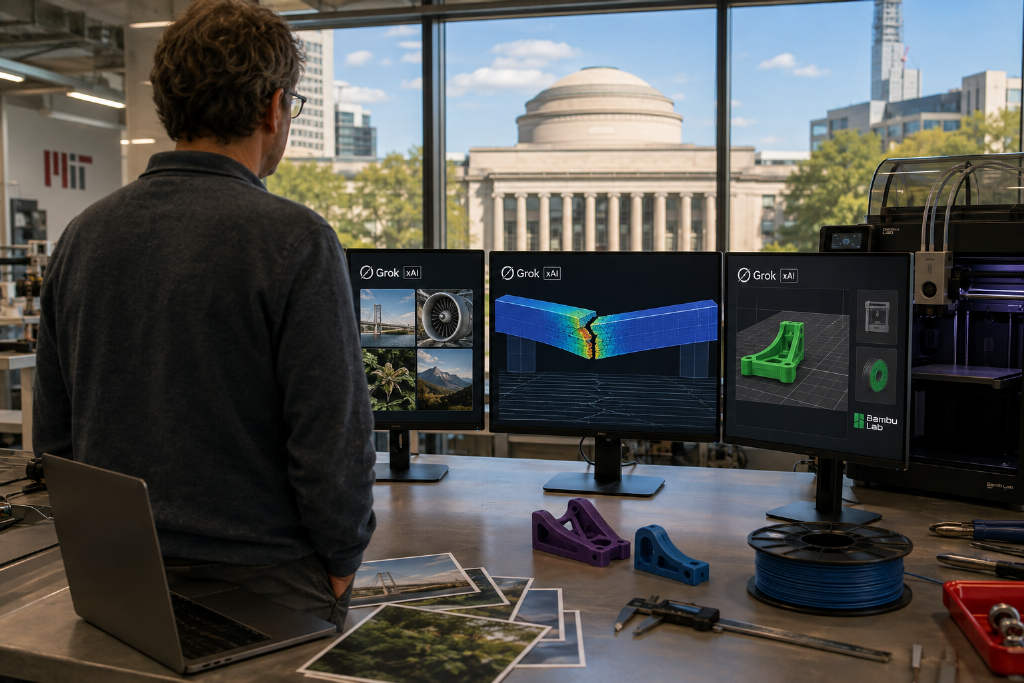
MIT professor uses three Grok bots to build a fracture simulator and print parts in about an hour
MIT engineering professor Markus Buehler said he handed three Grok bots just two inputs: four unrelated reference photos and a mechanics question about how hierarchy, redundancy, disorder, and interlayer strength affect stiffness, peak load, energy absorption, and the shift from brittle fracture to progressive failure under a fixed material budget. Roughly 20 minutes later, the system had built an interactive 2D hierarchical Euler-Bernoulli beam-network lab, including a physics simulator it wrote from scratch and named HIER-FRACTURE v1.0.0. After passing nine self-checks in 220 milliseconds, it ran 47 simulations, with six held out for testing. The workflow then moved into manufacturing. A 3D-printing bot used Bambu Studio, connected to a printer named Leonas3DP, scaled two selected designs by 50x, sliced them, sent the job, and watched the live camera feed as the machine printed two plastic parts weighing 19.48 grams in total in under an hour. According to Buehler and the original report, the result points to a lower-cost route into physical experimentation: rather than relying on robotic arms or custom hardware interfaces, the bots operated the same graphical software humans already use.