OpenAI2026-10-19 08:10:23OpenAI briefly exposed three Aurora alpha models, and Arena tests pointed to image generationOpenAI briefly listed three alpha models in its API backend — aurora-red-alpha, aurora-green-alpha, and aurora-blue-alpha — before pulling them back almost immediately. The short-lived appearance triggered speculation that the models could be tied to a new coding or reasoning release, especially because the Aurora name had previously been associated by the community with speed-focused inference and code generation. That assumption did not hold for long. Users soon found that while the API entries had disappeared, the models were still accessible inside Arena’s gray-release testing pool. Early tests showed the models generating images rather than code, with cat pictures becoming the first widely shared examples. Reports described clear stylistic differences between the red and green variants, while later testing suggested the blue version produced more detailed outputs. In Arena’s blind voting setup, aurora-green-alpha was said to be outperforming aurora-red-alpha by a wide margin. The article frames the incident as a possible accidental exposure of OpenAI’s next image-generation stack, or a visual foundation model for a broader multimodal system. It also places the episode alongside several other OpenAI product moves mentioned in the source, including GPT-6 with Intelligent UI, Dots, and the appearance of gpt-rosalind-discovery on a pricing page.450
Alibaba2026-10-10 03:13:13Alibaba open-sources Qwen-Image-2.1-Turbo, cutting image generation steps from 40 to 8Alibaba’s Tongyi Qianwen team has released Qwen-Image-2.1-Turbo and opened its model weights, introducing a faster version of Qwen-Image-2.1 built on the same 7 billion-parameter image generation architecture. In official examples, the denoising process used for image creation drops from 40 steps in the original model to 8 steps in the Turbo version, a reduction of 80%, though that does not automatically translate into an 80% reduction in real-world generation time. The new model still supports 2K image generation, text-guided image editing, multi-image reference input, and transparent background output. Developers can run it locally through Hugging Face’s Diffusers library, which automatically applies the recommended 8-step sampling setup. Alibaba has also put the Turbo and Pro APIs online. Under Alibaba Cloud Bailian’s listed pricing for the Beijing region, Turbo costs 0.1 yuan per image, versus 0.25 yuan for Pro, making Turbo 60% cheaper. Early user feedback points to noticeably faster generation, but image quality reviews are mixed, and there is still not enough independent testing to show that Turbo matches the original version. The model is released under the Qwen Research License, which allows free use only for non-commercial research and evaluation, while commercial development with the downloadable weights requires separate authorization.630
Elon Musk2026-10-08 20:37:24Elon Musk says Grok has been automatically integrated with X account @BotElon Musk said in a post on X that the Grok AI bot has been automatically integrated with the platform account @Bot. The update means the integration is already enabled, according to Musk’s statement published via his X account, @elonmusk. Techub carried the brief report. Musk’s post did not include more technical details in the item provided, but the note added that some Grok features, including image generation, had already been rolled out earlier. The latest comment points to another step in Grok’s deployment across X-facing functions and accounts, based on the information available in the source material.650
Microsoft2026-10-07 17:56:46Microsoft executive says RTX Spark beats Apple’s fastest chip in image generationA Microsoft executive said RTX Spark devices powered by Nvidia chips are faster than Apple’s fastest chip for image generation, according to a ChainCatcher news brief. The item was published under the technology category and did not include benchmark details, testing conditions, device specifications, or exact performance figures. Based on the source text, the claim was limited to image-generation speed and referenced RTX Spark hardware using Nvidia silicon in comparison with Apple’s top-performing chip. No additional context, named executive, or technical methodology was provided in the input.510
Google2026-10-07 07:15:21Google rolls out Nano Banana 2.1 with cheaper 4K image generation and stronger editing scoresGoogle has launched Nano Banana 2.1, a new image model in the Gemini 3 family built on Gemini 3.6 Flash, with a knowledge cutoff of March 2026. The release centers on image generation and editing rather than broad multimodal positioning: mask-based local edits, stronger subject consistency across repeated revisions, multilingual text rendering, and direct 4K output. According to the source article, Google’s own benchmarks show gains in visual design, editing, and consistency, while areas such as small text rendering, 3D reasoning, and factuality still leave room for improvement. The model’s public positioning also leans heavily on price. Image generation is priced at $30 per million tokens, half the rate of Nano Banana 2. The article says a 1K image now costs $0.034, down from $0.067, while 4K output falls from $0.151 to $0.076. At the same time, input pricing rises from $0.5 to $1.5 per million tokens, and text and reasoning output increases from $3 to $7.5. Nano Banana 2.1 is already available in AI Studio under the model name gemini-nano-banana-2.1. Google also plans to bring it to Gemini App, Search AI Mode, Flow, Stitch, Google Ads, and the Gemini enterprise platform starting today. The previous Nano Banana 2 API will be shut down on Oct. 29.430
Google2026-10-06 19:38:27Google releases Nano Banana 2.1 image model at lower costGoogle has introduced Nano Banana 2.1, a new image generation model built on Gemini 3.6 Flash. According to Techub, citing The Decoder, the model outperformed the previous Pro model in some benchmark tests while also coming in at a lower cost. That gives the new release a measurable edge on select standardized evaluations and pricing. Still, benchmark results did not fully carry over to hands-on use. In practical testing, the older Pro model sometimes produced better image quality. The update points to a trade-off between benchmark performance, cost efficiency, and real-world output quality, based on the information disclosed so far.400
Alibaba2026-09-21 16:44:23Alibaba’s Qwen team releases Qwen-Image-2.1 for image generation and editingAlibaba’s Tongyi Qianwen team has released Qwen-Image-2.1, a unified model for text-to-image generation and image editing. The visual generation component has 7 billion parameters, and a single checkpoint covers text-to-image creation, multi-reference image editing, localized editing, and transparent RGBA output. The model supports 2K resolution by default and includes native transparent image generation as well as multi-reference editing capabilities. Qwen-Image-2.1 is already supported in Diffusers, ComfyUI, and vLLM-Omni for research and evaluation. Commercial deployment is not open by default and requires a separate license application to the Qwen team. According to tests run by the team on its internal Qwen-Image-Bench benchmark, the model posted a composite score of 60.28, above the other listed open-weight models. The item cited MarkTechPost as the source.710
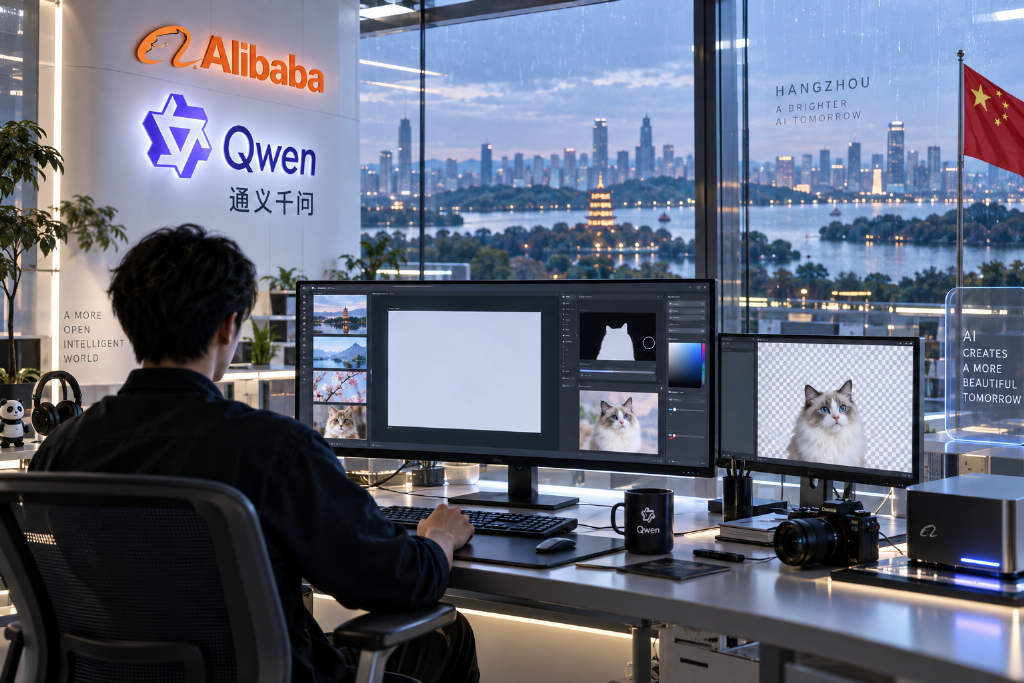
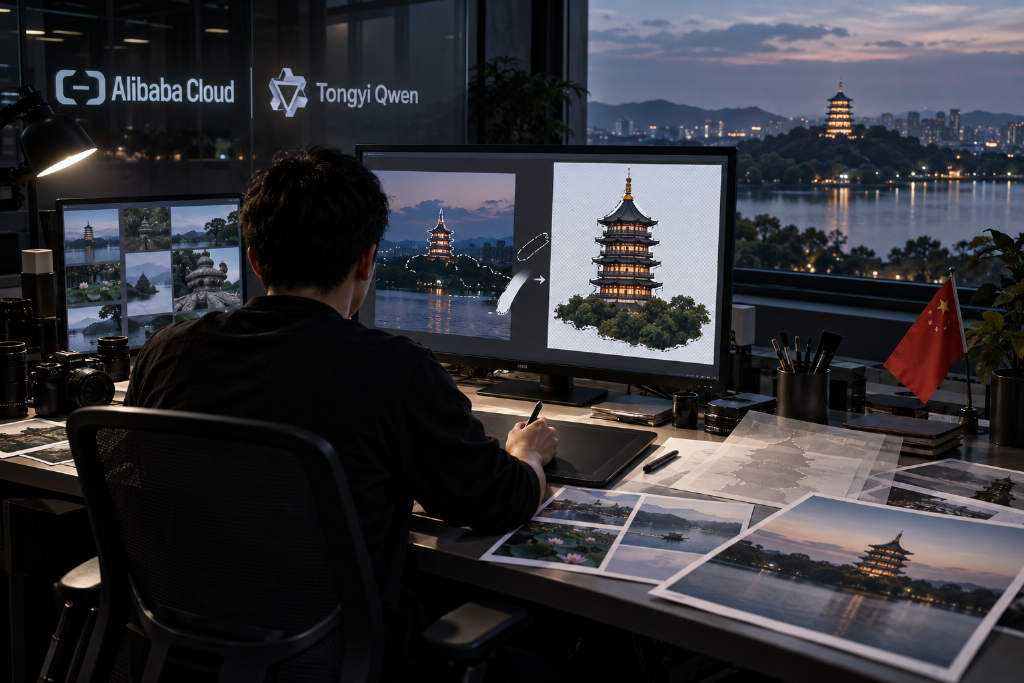
Qwen2026-09-20 13:08:42Qwen releases Qwen-Image-2.1 with open weights for generation, editing, and transparent imagesQwen has released Qwen-Image-2.1 and made the model weights public, combining text-to-image generation and image editing in a single 7B-parameter model. The release natively supports 2K images and transparent-background output, with editing positioned as the central upgrade in this version. According to the announcement cited by BlockBeats, the model can take up to 10 reference images at once, allowing users to recombine multiple people or products into one image. For localized edits, users can directly select areas, draw over them, or provide masks without switching to a separate editing model. Qwen-Image-2.1 can also generate RGBA images with an Alpha channel and extract subjects from photos. On the tooling side, Diffusers, ComfyUI, vLLM-Omni, and SGLang were already integrated on the first day. The release is not fully open for unrestricted use, however. While the weights are available, the model is distributed under the Qwen Research License, which allows only non-commercial research and evaluation. Commercial use requires separate authorization from Qwen.850