Ink

Policy and Re
2026-08-30 10:55:00

Crypto week ahead: U.S. payrolls, Revolut’s USDT delisting, and multiple service shutdowns

The coming week brings a dense slate of macro, regulatory, and project-specific events for the crypto market. The U.S. will release August unemployment and nonfarm payrolls data on Sept. 4, the last payrolls report before the Sept. 15-16 Federal Open Market Committee meeting. Revolut has confirmed that it will delist USDT on Aug. 31, citing regulatory and risk-compliance considerations, after already stopping purchases and suspending deposits earlier in the process. A wave of project shutdowns and service closures is also scheduled, including HyENA, Printr, Vision, Summer.fi, NFTfi, TON bridge-v3, Cosmostation Wallet, and Cypher. Several token unlocks are on the calendar as well, including SUI, EIGEN, ENA, OPN, and HYPE. Other items to watch include the G20 technology ministers’ meeting in North Carolina, Vietnam’s new crypto penalty rules taking effect, the launch of Russia’s digital ruble, a proposed Secret Network migration to Arbitrum, Binance’s planned delisting of ICX, SCRT, and STORJ, and Pakistan’s deadline for virtual asset service providers to file licensing applications.


750
Crypto week ahead: U.S. payrolls, Revolut’s USDT delisting, and multiple service shutdowns
Kraken
2026-08-30 06:28:42

Kraken Wallet Announces Co-Signer Multi-Sig, iOS App Now Live

Kraken's on-chain product lead subugatai has published a 'Kraken Wallet Manifesto,' revealing that the iOS version of the wallet is now available for download and the Android release is scheduled for next week. The manifesto also previews a forthcoming 'Kraken co-signer multi-sig' feature. This design lets users split their private key into multiple shards, with one shard placed in Kraken's custody. That shard participates in signing only after the user completes two-factor authentication (2FA) through their Kraken account. The manifesto also stressed that the wallet charges a 0.1% fee. The wallet supports a range of account types, including EOA, 7702 smart accounts, and embedded wallets, and users are free to choose which account model to use. It can connect to existing hardware signers or multi-sig wallets, and it enables different wallet types to be assigned to funds with different risk profiles. In its roadmap, the wallet will support xStocks trading, conversion between stablecoins and fiat, non-custodial debit cards, K-Assets on-chain via qualified custody, and native integration with the Ink ecosystem.

110
Kraken Wallet Announces Co-Signer Multi-Sig, iOS App Now Live
crypto stocks
2026-08-20 04:51:13

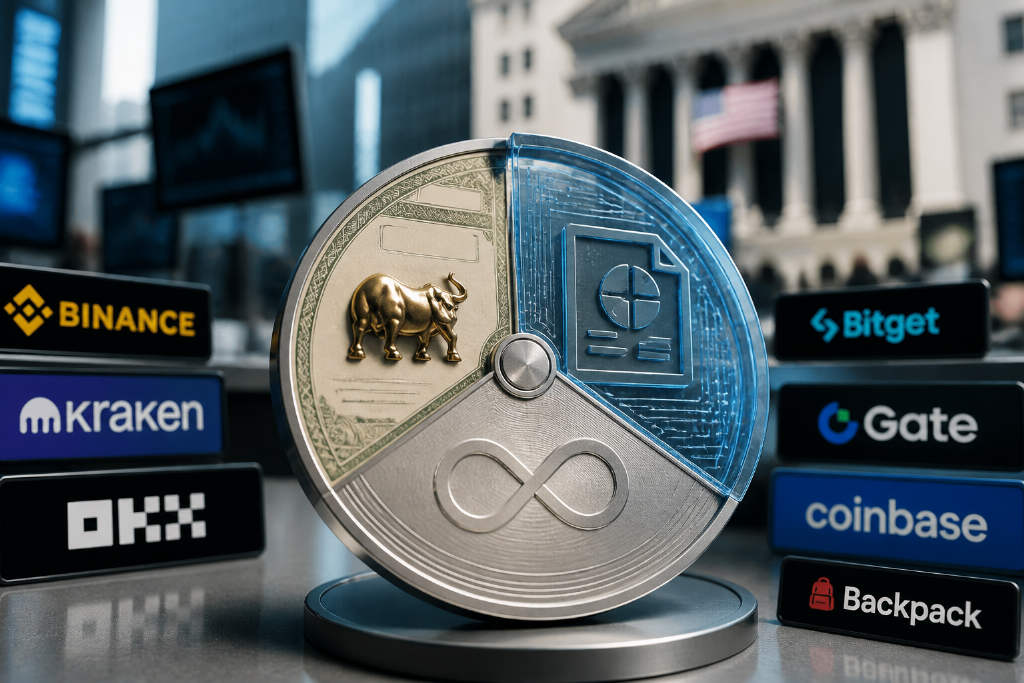
How Major CEXs Are Building Crypto Stock Products Across Brokerage, Tokenized Equities and Perpetuals

Crypto exchanges are pushing deeper into equities, turning stocks into one of the clearest product expansion paths in this market cycle. CoinGecko data cited in the report shows monthly stock perpetual volume across the top 13 crypto trading platforms climbed from about $831 million in July 2025 to roughly $34 billion in May 2026, a jump of nearly 40 times in less than a year. TradFi and RWA perpetuals spanning stocks, commodities and indexes reached $347.17 billion in May 2026 alone, with year-to-date volume above $1.32 trillion. The landscape is no longer limited to synthetic price exposure. Binance, Kraken, OKX, Bitget, Gate, Coinbase and Backpack are each combining different layers of product infrastructure, including direct access to real U.S. stocks and ETFs, tokenized stocks backed 1:1 by underlying securities, onchain-transferable equity tokens, stock perpetuals, CFDs and pre-IPO contracts. Their structures differ in important ways, especially around custody, investor rights, redemption and whether users actually own shares or only gain economic exposure. The report argues that crypto stocks remain early relative to traditional equity markets, with CoinGecko data indicating activity in crypto stock derivatives is still less than 1% of traditional stock market volume. Even so, the segment is moving from a niche RWA experiment toward a core competitive arena for centralized exchanges that want to extend from crypto into broader financial trading.

920
How Major CEXs Are Building Crypto Stock Products Across Brokerage, Tokenized Equities and Perpetuals
crypto stocks
2026-08-20 05:03:01

How Major CEXs Are Building Crypto Stock Products Across Brokerage, Tokenization and Perpetuals

Crypto stock products are turning into one of the clearest expansion paths for centralized exchanges as they push beyond digital assets and into traditional finance. The competitive set is no longer limited to synthetic price exposure. By 2026, major platforms had rolled out a mix of real stock brokerage, tokenized equities, stock perpetuals, CFDs and pre-IPO products, often inside a single account system. According to CoinGecko figures cited in the source article, monthly trading volume for stock perpetuals across the top 13 crypto trading platforms climbed from about $831 million in July 2025 to roughly $34 billion in May 2026, an increase of nearly 40 times in less than a year. The article also notes that cumulative stock-perpetual volume in the first five months of 2026 had already surpassed the whole of 2025. On the tokenized spot side, xStocks had logged more than $35 billion in cumulative trading volume by July 2026 and nearly 200,000 holders globally, while expanding beyond U.S. stocks and ETFs into Hong Kong, the U.K., Europe and South Korea. The report reviews how Binance, OKX, Bitget, Gate, Kraken, Coinbase and Backpack approach the market through different legal and product structures. It argues that the category now spans four distinct models: traditional brokerage access to real shares, tokenized securities backed by underlying stocks, total-return or synthetic equity tokens, and stock perpetuals or CFDs that do not require 1:1 share backing. The result is a market that is still early by global equity standards, yet increasingly central to how exchanges compete for the next phase of user growth.

480
How Major CEXs Are Building Crypto Stock Products Across Brokerage, Tokenization and Perpetuals
Arbitrum
2026-08-14 04:55:19

Arbitrum, Polygon and MegaETH push beyond blockspace as chains hunt for app-level revenue

Selling blockspace is no longer a strong standalone business for blockchain networks, according to a new analysis from Castle Labs Research translated by TechFlow and published by MarsBit. As infrastructure gets cheaper and more interchangeable, the gap between application fees and chain-level fees keeps widening, leaving many networks with growing usage but weaker direct revenue capture. The report groups recent responses into two tracks. One is ecosystem expansion, where chains such as Arbitrum and Polygon try to earn more through infrastructure distribution, payments, and revenue-sharing arrangements. The other is product expansion, where networks such as MegaETH and Sophon move closer to the application layer and try to internalize value that would otherwise accrue to third-party builders. The piece highlights Arbitrum Stack’s revenue share from Robinhood’s L2, Timeboost’s treasury contribution, Polygon’s role in stablecoin payments, MegaETH’s first-party app strategy and USDm stablecoin model, and Sophon’s shift away from operating its own chain. The broader argument is that chains are no longer content to remain neutral infrastructure providers. More of them are trying to become ecosystem operators, application owners, or both, as they search for revenue models that can better support token value and long-term sustainability.

690
Arbitrum, Polygon and MegaETH push beyond blockspace as chains hunt for app-level revenue
Sentora
2026-08-06 18:40:17

Sentora Opens Morpho Vault Using Wellington-Backed mWIN as Collateral

Sentora has launched a curated lending vault on Morpho that lets users deposit PayPal USD (PYUSD) while taking exposure to loans backed by mWIN, a token issued by Midas and tied to an actively managed credit portfolio run by Wellington Management. The setup brings a large traditional asset manager’s native onchain credit strategy into DeFi collateral markets rather than wrapping an existing offchain fund after launch. As of Aug. 6, the vault was close to its 10 million PYUSD cap, while the underlying market showed $3.91 million in borrowing against $6.44 million in posted collateral. Sentora said the product carries duration and credit risk and should not be treated like a yield-bearing stablecoin. The vault’s headline net APY of 8.31% was driven mostly by PYUSD incentives, while the base yield excluding rewards was 0.70%.

590
Sentora Opens Morpho Vault Using Wellington-Backed mWIN as Collateral
Optimism
2026-08-06 13:33:26

Optimism Foundation Issues Fifth-Year Budget: 343M More OP Set to Enter Circulation

Optimism Foundation has published its fifth-year budget update for May 2026 through April 2027, saying OP circulating supply is expected to rise from approximately 2.161 billion tokens to around 2.504 billion, or 58.3% of total supply. That implies roughly 343 million OP entering circulation during the period. The breakdown shows the ecosystem fund adding 200 million OP, early core contributors 47.6 million, investors 15.3 million and the governance fund 10 million, with zero allocation for airdrops and Retro Funding. The foundation stressed that all tokens come from the original allocation framework, and no additional token distribution was requested. For the fourth year, it committed about 150 million OP in new expenditures, roughly one-third lower than the prior year. OP Enterprise launched in January 2026, with Bitpanda, Ink, Dunamu and Ether.fi among early clients. Monthly OP mainnet transaction volume rose more than 60% during that period. A 12-month buyback plan approved by governance directs up to 50% of Superchain revenue to monthly OP purchases; more than 9 million OP has been bought back so far. Token deployment remains focused on OP mainnet growth and enterprise customer acquisition.

1200
Optimism Foundation Issues Fifth-Year Budget: 343M More OP Set to Enter Circulation
MoonPay
2026-07-28 08:16:08

MoonPay, Circle and Kraken press acquisitions as crypto shakeout deepens

A fresh wave of failures in crypto has not stopped larger firms from buying infrastructure. This month, three crypto companies filed for Chapter 11 protection in the United States and two exchanges said they would shut down, yet MoonPay, Circle and Kraken each moved ahead with deals tied to their core operations. The three transactions reflect very different strategic needs. MoonPay is expanding around fiat-to-crypto and cross-platform money movement without tying itself to one blockchain or one stablecoin. Circle, whose revenue is closely linked to USDC, is using a purchase of nearly 1,000 granted blockchain patents from IBM to strengthen the ecosystem around its stablecoin, payments network and Arc platform as competition from OUSD puts pressure on reserve-interest economics. Kraken, meanwhile, is buying Magic Labs’ wallet-as-a-service business to push deeper into an all-in-one trading account model that spans onchain and offchain assets. Taken together, the deals show how crypto M&A is being used less as a simple margin play and more as a way to stay relevant no matter which exchange venue, blockchain or dollar stablecoin ends up dominating the market.

1180
MoonPay, Circle and Kraken press acquisitions as crypto shakeout deepens