IonQ

US stocks
2026-08-03 05:19:08

Nasdaq posts its worst July since 2004 as money rotates back into cloud giants

U.S. stocks finished last Friday with a V-shaped rebound, but the late-session rally did little to change what was still a weak month for risk assets. The Dow Jones Industrial Average rose 0.53%, the S&P 500 gained 0.70%, and the Nasdaq climbed 1.00% on the day. For July, however, the S&P 500 was essentially flat, marking its weakest July since 2014, while the Nasdaq fell 3.2%, its worst July performance since 2004. Outside equities, oil sold off sharply after Donald Trump said he had canceled a planned new military strike on Iran following requests from Saudi Arabia, the UAE and Qatar, while OPEC+ agreed to lift September production quotas by 188,000 barrels per day. WTI crude dropped more than 8% at the Monday open and briefly fell below $78 a barrel. Gold, by contrast, edged up 0.91% in July and was trading near $4,050 an ounce after a roughly 30% pullback from its January peak. Markets were also digesting confirmed joint U.S.-Japan currency intervention that pushed USD/JPY below 156, as well as rising long-end Treasury yields, with the 30-year yield near 5.281%, the highest level since July 2007. In technology, de-leveraging continued across semiconductors and memory, but cloud names surged. Microsoft, Amazon and Google added nearly $1.5 trillion in combined market value last week, pointing to a clear rotation toward companies seen as converting AI spending into cash flow more effectively.

1330
Nasdaq posts its worst July since 2004 as money rotates back into cloud giants
Quantum Compu
2026-07-16 03:30:34

Quantum computers are not about to break Bitcoin, and the article’s timeline points no earlier than 2035

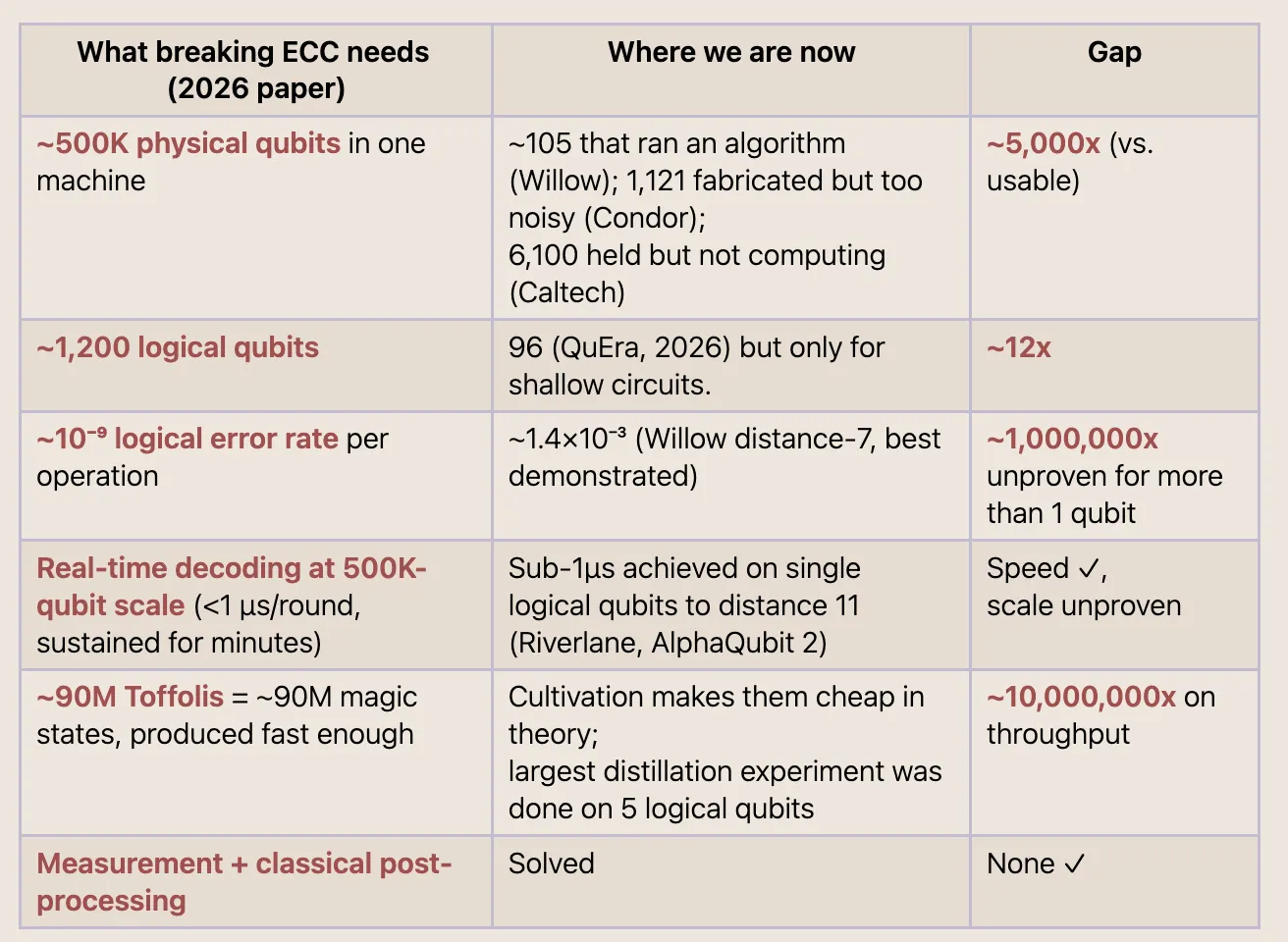
Fears that quantum computers could soon crack Bitcoin keep resurfacing, but the source article argues the gap between theory and practical attack capability remains vast. In theory, the hardware required to break elliptic curve cryptography, or ECC, has fallen sharply, from about 317 million physical qubits in 2022 to fewer than 500,000 in a 2026 paper. That is a major change on paper. The problem is that current machines can only run real algorithms with about 105 usable qubits, leaving several orders of magnitude still missing. The article walks through what would actually be needed to run Shor’s algorithm against ECC, including logical qubits, error correction, decoding speed, and the production of magic states needed for non-Clifford gates such as Toffoli gates. It says the 2026 design would require around 1,200 logical qubits, about 90 million sequential Toffoli gates, roughly 500,000 physical qubits under current error-correction assumptions, and a runtime measured in minutes. It also separates abstract cryptographic risk from actual wallet exposure. For Bitcoin, addresses only become vulnerable once a public key is revealed on-chain, which is why the article highlights roughly 6.7 million BTC as already exposed. Ethereum faces a related issue because it uses the same secp256k1 curve and ECDSA signatures, while its persistent account model makes repeated address use more common.

1120
Quantum computers are not about to break Bitcoin, and the article’s timeline points no earlier than 2035
Quantum Compu
2026-07-16 03:04:03

Quantum computing is still far from breaking ECC, despite sharp gains in theory

A TechFlowPost article translated from Derrick Cui argues that practical quantum attacks on elliptic curve cryptography, or ECC, are still several orders of magnitude away even after major theoretical advances. The piece says recent research has cut the estimated hardware needed to break ECC from about 317 million physical qubits in 2022 to fewer than 500,000 in 2026, but today’s machines can run real algorithms on only about 105 qubits. It walks through what would actually be required to attack ECC with Shor’s algorithm, including logical qubits, error correction, decoding, Toffoli gates and magic-state distillation, then compares those requirements with current hardware. The article also discusses what a quantum break would mean for Bitcoin and Ethereum. In Bitcoin, the main risk is tied to addresses whose public keys have already been revealed on-chain, while Ethereum’s persistent account model would leave any wallet that has sent a transaction exposed if quantum attacks were available today. The piece concludes that the gap between theory and deployable machines remains enormous, and that no reliable timeline can be inferred from current progress alone.

270
Quantum computing is still far from breaking ECC, despite sharp gains in theory
Trump
2026-07-16 00:45:00

Trump’s push for state-held stakes and newborn stock accounts ties Wall Street closer to the U.S. fiscal story

A PANews commentary argues that Donald Trump is trying to bind America’s fiscal future more tightly to the stock market by combining three tracks: taking equity or special rights in private companies, encouraging or pressing major AI firms to hand over stakes, and launching investment accounts for newborns that automatically buy U.S. equities. The piece frames those efforts as a response to mounting debt pressure, with U.S. government debt described at $39 trillion as of May 2026 and annual interest costs projected to exceed $1 trillion in fiscal 2026. It highlights the government’s 9.9% stake in Intel, funded through previously approved subsidies and federal allocations rather than fresh money, and says similar structures have spread to rare earths, mining, defense technology and quantum computing. The article also cites reports from NOTUS and the Financial Times that OpenAI proposed giving the government a 5% stake, worth about $42.6 billion at a reported $852 billion valuation. Alongside that, the so-called Trump Account would place $1,000 into market-tracking funds for eligible newborns, with the Treasury handling the contribution and the assets flowing into S&P 500-linked products. PANews presents the strategy as an attempt to expand the government’s “asset side” while broadening household exposure to U.S. equities.

1070
Trump’s push for state-held stakes and newborn stock accounts ties Wall Street closer to the U.S. fiscal story
2026-07-07 20:21:39

Quantum Computing Stocks Rally in U.S. Trading as Arqit Jumps Nearly 13%

Quantum computing stocks surged in U.S. trading on April 15, led by Arqit Quantum’s nearly 13% gain. IonQ, SEALSQ, and D-Wave rose over 9%, while trading volume in the sector hit a recent high, highlighting rising investor interest in quantum computing and quantum-safe security.

180
Quantum Computing Stocks Rally in U.S. Trading as Arqit Jumps Nearly 13%