Llama

Fidelity
2026-08-14 01:59:25

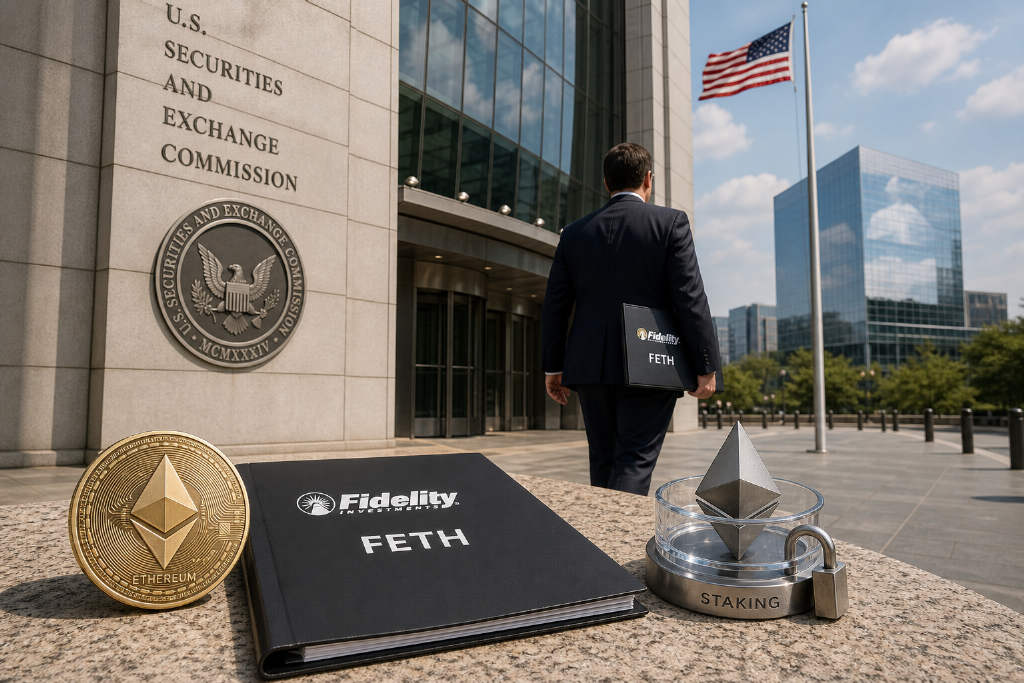
Fidelity seeks staking for FETH as Anthropic investors float a possible $2 trillion-plus IPO valuation

A dense 24-hour news cycle brought fresh filings, earnings, market calls and regulatory signals across crypto and adjacent tech markets. Fidelity filed an amended registration statement with the U.S. Securities and Exchange Commission on Aug. 11 to add ETH staking to its spot Ethereum ETF, the Fidelity Ethereum Fund (FETH). Under normal conditions, the fund said it could stake as much as 100% of the ETH it holds, with no minimum staking threshold, and its investment objective would change to include staking rewards if approved. Elsewhere, some existing Anthropic investors said the AI company could be valued at more than $2 trillion if it goes public as early as October, with one investor putting the upside case at $3 trillion based on a roughly 30x revenue multiple. The estimates remain investor forecasts, and several investors said Anthropic management has not set an IPO valuation target. The session also featured quarterly updates from Bullish, BitGo and Securitize, new SEC steps around tokenized fund operations and tokenized equities, ETF flow data for Bitcoin and Ethereum products, and a series of policy, infrastructure and security developments spanning Europe, the U.K., Brazil and the U.S.
640
Fidelity seeks staking for FETH as Anthropic investors float a possible $2 trillion-plus IPO valuation
Meta
2026-08-14 03:41:08

Jiahui Yu leaves Meta to start a company after leading key Muse multimodal work

Jiahui Yu, a core researcher in Meta’s superintelligence effort, has announced that he is leaving the company to start a new venture. Yu joined Meta in late June 2025 and disclosed his departure on August 14, 2026, ending a stint of a little over one year. His personal website has already been updated to reflect the change. The move comes only days after Meta released Muse Spark 1.2, the latest update in a product line developed by the team Yu helped build. In his public statement, Yu said working with CEO Mark Zuckerberg and Meta Chief AI Officer Alexandr Wang to build TBD Lab had been 「inspiring and fulfilling」. He also referenced a question he described as highly important to humanity yet still underexplored, saying it would now receive his full attention. He did not disclose the name of the new company, its research agenda, or any co-founders, adding only that there would be more to share as the work takes shape. Yu was one of the most watched names in Meta’s AI hiring push, during which reports and public comments fueled speculation around compensation packages at the $100 million level. While Meta executives later said such figures did not apply broadly and could reflect stock, bonuses, tenure, and performance conditions, Yu remained closely associated with that recruitment wave. Before Meta, he worked at Google Brain and OpenAI and contributed to projects including Gemini, GPT-4o, and GPT-4.1.

240
Jiahui Yu leaves Meta to start a company after leading key Muse multimodal work
BLINK
2026-08-14 01:33:00

Former Swarms Foundation member says he rotated into BLINK, outlining a thesis tied to Fomo’s issuance layer

SongShu, a former Swarms Foundation member and founder of NexGen Venture, said he sold Long platform’s $AI and BSC-based $bStocks and shifted both capital and attention to $BLINK, disclosing that he now holds more than 2% of the token. He framed the move not as a bet on a fairer market, but as a wager that user behavior in crypto will remain the same: people chase winners, compete for early access, show positions, and let profit and loss validate their judgment. In his view, Blink’s potential does not rest on a fairness slogan alone. He argued that the product could matter if it turns already-existing market behavior — token launches, early-position competition, FOMO-driven participation, public theses, social distribution, and fee generation — into a verifiable and repeatable product loop. He also positioned Blink as a possible issuance and user-acquisition layer for Fomo rather than a replacement for it, while stressing that Fomo and Blink are independent platforms and that some of the product logic he described remains his own proposal rather than a live feature set. SongShu also listed the conditions that would invalidate his thesis, including failure to bring net new funded users to Fomo, weak retention after initial launches, bot or multi-wallet circumvention, poor creator repeat issuance, and a lack of transparent, sustained, verifiable fee capture.

640
Former Swarms Foundation member says he rotated into BLINK, outlining a thesis tied to Fomo’s issuance layer
Hyperliquid
2026-08-13 22:46:50

Kain Warwick Says Hyperliquid’s 50% Fee Split With Market Builders Is Unlikely to Hold

Kain Warwick, founder of Infinex and Synthetix, said Hyperliquid’s current arrangement with outside market builders looks hard to sustain. Speaking on the August 12 episode of Unchained’s Uneasy Money, Warwick argued that letting builders keep as much as 50% of trading fees is unusually generous and will probably change over time. He pointed to his own experience at Synthetix, where market makers pushed for larger economics but fee sharing never reached those levels. The issue matters because Hyperliquid sends nearly all of its own share of trading fees, about 99% after the builders’ cut, to an Assistance Fund that buys back HYPE. DefiLlama data cited in the report shows gross revenue fell from about $357 million in Q3 2025 to roughly $202 million in Q2 2026 even as volume held up, while quarterly buybacks dropped from nearly $290 million to about $149 million. HIP-3 markets, many tied to tokenized real-world assets, have grown from around 2% of platform volume at the start of 2026 to about half today. Warwick also flagged concentration risk. One builder, trade.xyz, accounts for more than 90% of HIP-3 open interest, and tokenized real-world-asset perpetuals reached a record $3.6 billion in open interest in July, overtaking bitcoin on the platform.

680
Kain Warwick Says Hyperliquid’s 50% Fee Split With Market Builders Is Unlikely to Hold
Andre Cronje
2026-08-13 12:27:44

Andre Cronje says DeFi no longer exists, calling today’s market onchain or open finance

Andre Cronje, the creator of Fantom and founder of Flying Tulip, said on Cointelegraph’s Chain Reaction X Spaces that DeFi, outside of a very small niche, no longer exists. In his view, a protocol only qualifies as true DeFi if it is decentralized, immutable and free of intermediaries, a standard he said very few live systems now meet. Instead, he argued, the sector has shifted into what he calls onchain finance or open finance, where companies, decision-makers, vault curators and risk committees have taken over roles once associated with traditional banking. The report ties that argument to recent market structure and governance data. It notes that curator-led lending vaults now direct capital allocation and risk settings while depositors absorb tail risk, and points to the November 2025 collapse of Stream Finance, which hit three lending platforms and pushed utilization on multiple Morpho and Euler vaults to 100%. It also cites a March 26 working paper from the European Central Bank that found the top 100 governance token holders controlled more than 80% of supply in Aave, MakerDAO, Ampleforth and Uniswap. Separately, DefiLlama data showed DeFi total value locked fell from $167.1 billion on Oct. 8, 2025 to $75.1 billion at the time of writing, a 55% drop over 10 months.

160
Andre Cronje says DeFi no longer exists, calling today’s market onchain or open finance
Standard Char
2026-08-13 15:14:41

Standard Chartered says its $100 UNI target may be too low as Robinhood Chain drives faster token burns

Standard Chartered now thinks its own long-term price target for UNI may be conservative. Geoff Kendrick, the bank’s global head of digital assets research, said Thursday that the $100 target he set in June for the end of 2030 could be too low after Uniswap began burning UNI at a much faster pace using protocol fees earned on Robinhood Chain. The new burn rate is based on a short sample. Kendrick’s extrapolation uses 17 days of data, much of it tied to a chain that launched on July 1. Even so, the numbers have changed quickly. DefiLlama data cited in the report shows Uniswap protocol revenue averaged $244,222 a day between July 27 and Aug. 12, up from $99,770 a day in the prior 17-day period. Under UNIfication, the December 2025 upgrade that routes protocol fees into buybacks and burns, that revenue is used to buy and burn UNI. At UNI’s current price of $3.53, the recent run rate would fund the purchase and burn of about 25 million tokens a year, or roughly 4% of the 624.2 million circulating supply. Kendrick said that level is clearly unsustainable over time, but added that more partnerships like Robinhood could keep the economics stronger than he had previously modeled. Data from the past seven days also shows Robinhood Chain accounting for 60% of Uniswap’s protocol revenue, though the article notes that governance changes taking effect on July 17 also coincided with the jump.

630
Standard Chartered says its $100 UNI target may be too low as Robinhood Chain drives faster token burns
SharpLink
2026-08-13 15:10:55

SharpLink Plans $200 Million ETH Allocation to Lido’s wstETH

SharpLink said it plans to route $200 million worth of ETH into Lido’s liquid staking system, receiving wstETH that will be custodied by Anchorage Digital. Based on Kraken’s displayed ETH price of $1,889.84, the planned allocation works out to roughly 106,000 ETH, or about 12% of the company’s 888,938 ETH holdings reported as of Aug. 3. The move adds Lido to SharpLink’s existing treasury setup, where nearly all of its ETH had already been deployed in staking as of June 28 across native ETH, Liquid Collective’s LsETH, and Ether.fi’s weETH. SharpLink said the new route extends that existing staking and restaking strategy rather than replacing it. CEO Joseph Chalom said Lido’s composability could let the company add new yield sources on top of its ETH exposure and staking returns. The company also reported that staking generated $11.2 million in second-quarter revenue, while LsETH and weETH produced a $76.1 million noncash impairment charge that, under its accounting treatment, cannot be reversed after a market recovery.

530
SharpLink Plans $200 Million ETH Allocation to Lido’s wstETH
Policy and Re
2026-08-13 13:56:50

WuBlockchain daily roundup: U.S. jobless claims rise, Cronje says DeFi has become onchain finance

WuBlockchain’s latest daily crypto roundup spans five separate developments across macro data, onchain finance, fraud enforcement, and media access litigation. In the U.S., initial jobless claims for the week ended Aug. 8 came in at 209,000, above the 202,000 expectation and the highest since the week of July 11, while the prior reading was revised from 199,000 to 200,000. July producer price inflation also cooled, with PPI at 4.7% year over year versus a 4.9% forecast and a previous 5.50%, marking the lowest level since March. Andre Cronje, founder of Flying Tulip and a core Fantom developer, said in a recent program that most DeFi protocols no longer meet the standard of being truly decentralized, immutable, and intermediary-free. He argued the sector has shifted toward “onchain finance” or open finance as traditional banking-style structures such as circuit breakers, emergency controls, decision-makers, curators, and risk committees have been added. The roundup also covers a court ruling in Guizhou over a crypto airdrop scam, a probe into an alleged Ponzi scheme in Guinea, and a lawsuit challenging paid priority access to Donald Trump’s Truth Social posts through Truth API.

860
WuBlockchain daily roundup: U.S. jobless claims rise, Cronje says DeFi has become onchain finance