Llama

Bitcoin
2026-08-12 08:52:09

Bitcoin Lags as Stocks and Gold Rally, With Only Partial Bottom Signals Emerging

Bitcoin has yet to join the rebound seen in U.S. equities and gold, even as some market conditions begin to improve. After peaking at about $126,000 in October last year, the asset has stayed in a prolonged correction and has recently traded sideways between $62,000 and $66,000 over the past 30 days, according to CoinGecko. PANews, in a report by Nancy cited by MarsBit, said the disconnect has persisted despite renewed inflows into U.S. spot Bitcoin ETFs and a pickup in several long-term valuation and cycle indicators. Data cited in the report showed U.S. spot Bitcoin ETFs posted net inflows for five straight trading days last week, totaling $854 million, the strongest weekly performance since April 17, according to SoSoValue. At the same time, Santiment Intelligence recorded 2.27 million new BTC wallets over the past week and 751,000 active wallets, though the jump in activity was linked in part to security concerns triggered by the Coldcard wallet incident rather than outright risk appetite. The report argued that persistent selling from miners and crypto DAT companies, along with weak U.S. spot demand reflected in an 80-day negative Coinbase Bitcoin Premium Index streak, has capped price recovery. PAData’s bottom-fishing dashboard showed 4 of 12 core indicators have entered hit zones, but broader metrics tied to valuation, sentiment, profitability, liquidity, and on-chain activity have not yet reached the extreme levels that have historically marked a confirmed cycle bottom.


1030
Bitcoin Lags as Stocks and Gold Rally, With Only Partial Bottom Signals Emerging
Hyperliquid
2026-08-11 14:49:03

Hyperliquid’s trading engine keeps pulling in capital while HyperEVM struggles to become a real app layer

Debate over whether HyperEVM is effectively dead has picked up after a string of weak app-layer metrics and criticism from crypto commentators. ChainCatcher’s latest analysis argues that the gap inside Hyperliquid is no longer easy to dismiss: HyperCore, the chain’s closed trading engine, continues to dominate on-chain perpetuals and generate tens of millions of dollars in fees, while HyperEVM, the Ethereum-compatible layer launched in February 2025 for developers, remains far smaller in fees, active addresses, and sustainable protocol depth. Data cited in the report shows Hyperliquid exchange produced about $46.17 million in fees over the 30 days through Aug. 10, and roughly $56 million when trade.xyz is included, while all DeFi protocols on HyperEVM combined generated less than $6 million. The piece says this imbalance comes from structure rather than poor execution alone. HyperCore controls matching and liquidity, leaving third-party builders to operate around a system they do not control. Shared liquidity pushes activity toward a small number of dominant venues, while Hyperliquid’s “no insiders” stance has limited incentive programs, marketing support, and ecosystem distribution. On top of that, HyperEVM’s cross-engine design creates awkward development trade-offs because writes to HyperCore are not synchronously settled. The result, according to the article, is an ecosystem that still has real capital and use, but one centered on trading and order-book-linked finance rather than a broad, self-sustaining general-purpose app economy.

170
Hyperliquid’s trading engine keeps pulling in capital while HyperEVM struggles to become a real app layer
Market Analys
2026-08-12 01:52:22

Lao Bai says crypto VC will fade, prediction markets are overvalued, and Perp DEXs still have room beyond Hyperliquid

In a nearly two-hour conversation hosted by 168X, investor and researcher Lao Bai laid out a broad thesis on where crypto stands in 2026 and where it may be headed next. His core view is blunt: the crypto industry has matured, token issuance works more like debt than financing, and the label "crypto VC" is likely to disappear over time as blockchain becomes part of the broader commercial stack rather than a standalone sector. Lao Bai, whose past roles include Amber, ABCDE and OKX Ventures, said his focus inside crypto has narrowed to a handful of sectors he still sees as having product-market fit: perpetuals, prediction markets, real-world assets and stablecoins. Even there, he drew sharp distinctions. Stablecoins and perpetual contracts, he argued, are crypto’s two strongest native inventions. Prediction markets, by contrast, do have real PMF but a much lower ceiling than perpetual trading. He also discussed Hyperliquid’s lead in Perp DEXs, the competitive setup around HIP-3 deployers such as TradeXYZ and Paragon, why security issues often stem from lending rather than pure perpetual products, and why exchanges are increasingly competing not just with Binance or OKX but with Robinhood, Interactive Brokers and even banks. His conclusion was equally direct: the endgame for exchanges is to become a single global gateway for risk assets.

1140
Lao Bai says crypto VC will fade, prediction markets are overvalued, and Perp DEXs still have room beyond Hyperliquid
Market Analys
2026-08-12 03:03:43

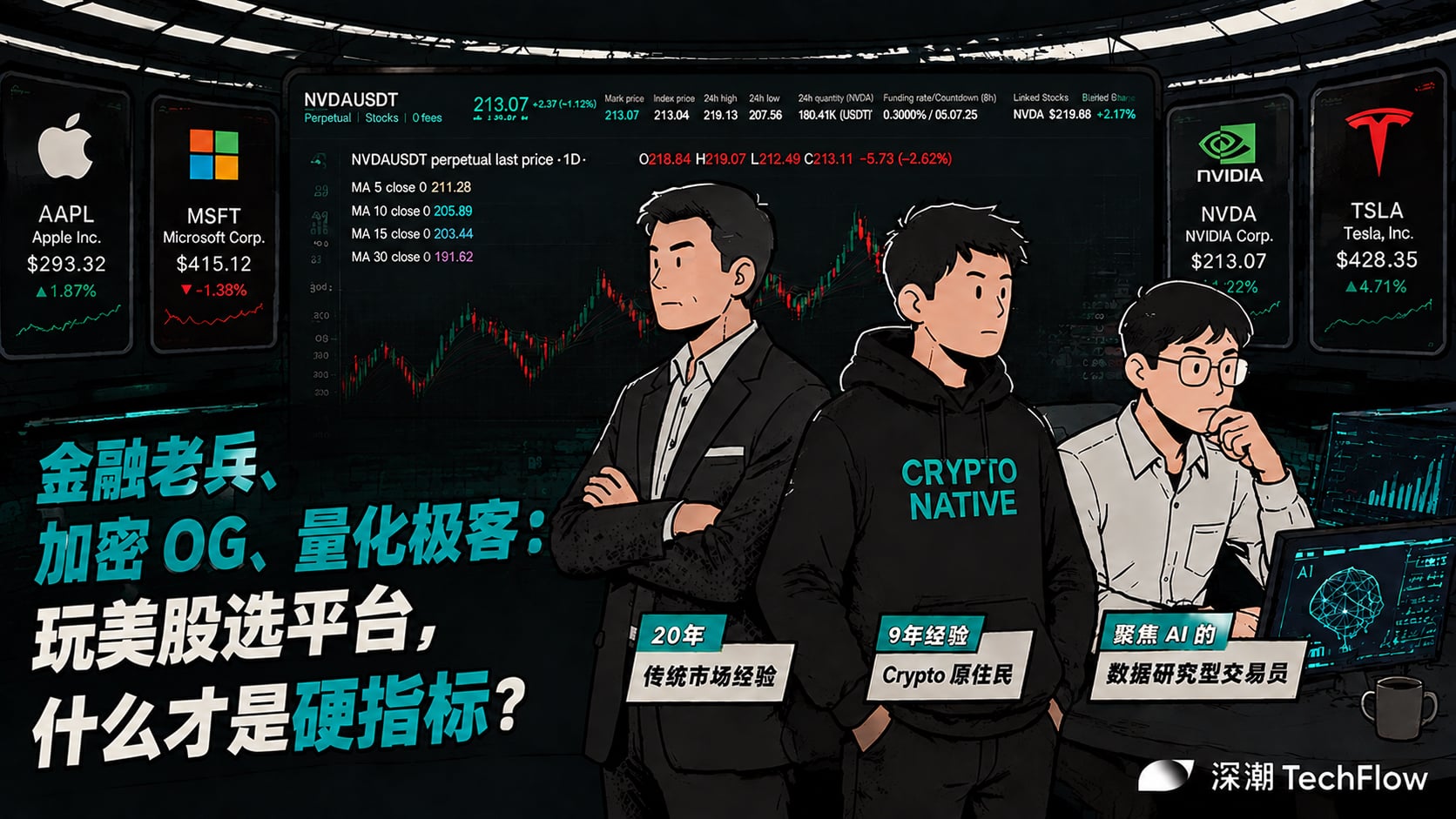
Three veteran traders say speed, liquidity and capital efficiency now define stock trading on crypto platforms

A long-form report by TechFlowPost argues that U.S. stock trading is shifting from legacy broker systems to crypto-native platforms, with little sign of reversal. Based on interviews with three experienced market participants — Rocky, Bean Ge and Xiadie Haida — the piece maps out what traders now treat as hard metrics when choosing a venue for equities: execution speed, order-book depth, total transaction cost, market-hours flexibility, information delivery and capital efficiency. The report says trading on centralized crypto exchanges is moving from a trial experience to a daily habit for some active users, especially during earnings season, when after-hours price moves can define outcomes. Bean Ge focuses on latency, liquidity and news tools; Xiadie Haida highlights 24/7 access, faster reaction to headlines and broader symbol coverage; Rocky looks beyond simple buy-and-sell access to how tokenized stocks can be used for yield, collateral and borrowing. TechFlowPost also reviews current platform positioning. Binance, OKX and Bitget are all expanding stock-related products, but with different emphasis across ecosystem integration, compliance, API access, tokenized products and AI-driven trading tools. The article further notes market projections cited by Rocky, who believes tokenized equities could reach a 10% penetration rate of the global stock market within three years, while regulation, transparency and on-chain composability remain central to broader adoption.

940
Three veteran traders say speed, liquidity and capital efficiency now define stock trading on crypto platforms
Meta
2026-08-11 10:33:11

Meta returns to open-weight AI with Muse Glimmer and plans to release Spark 1.2

Meta has reopened its open-weight AI strategy with the release of Muse Glimmer, a model whose underlying parameters can be downloaded and modified by developers. The company said it will also release the weights for the more capable Muse Spark 1.2 in the coming weeks, marking a clear shift back toward the approach it once used to distinguish itself from rivals. CEO Mark Zuckerberg backed the move in a post on Meta’s website, arguing that powerful and free AI should reach billions of people rather than remain concentrated in large institutions. He also defended model distillation and said people should retain the ability to learn from observable information, a position that cuts against recent complaints from OpenAI and Anthropic over how their closed models’ outputs are used. Muse Glimmer is Meta’s first open-weight model since Llama 4 and its first to ship under the Apache 2.0 license. The model supports text and image input, carries a 128K context window, and is aimed at local agent use on personal devices. Meta’s release also comes with a broader commercial and infrastructure angle, as the company plans to spend as much as $145 billion on AI infrastructure this year while building out related cloud services.

970
Meta returns to open-weight AI with Muse Glimmer and plans to release Spark 1.2
ENS
2026-08-11 16:34:39

ENS Tokenholders Approve Foundation Overhaul and Transfer Endowment Control Onchain

ENS tokenholders have approved and executed a sweeping governance proposal that turns the ENS Foundation into a staffed organization with a full-time executive director, a five-member board, and onchain control over the DAO’s endowment. The vote passed with 1,269,420 ENS in favor and 480,690 against, clearing the 1 million-token quorum, and was executed early Tuesday. At the center of the dispute was custody. The proposal replaces the Endowment Safe’s sole owner with a new timelock contract that carries a nine-day delay, while giving proposal power only to the Foundation’s 3-of-5 multisig. The Security Council can cancel queued transactions with five of eight signatures, but that safeguard expires on Aug. 7, 2028. Critics, including ENS co-founder Alex Van de Sande and governance security firm Blockful, said important constraints such as draw limits and budget caps were written only in the proposal text and not enforced in code. The proposal also transfers 1 million ENS to the Foundation for employee compensation under a published vesting framework, worth about $4.2 million at current prices. The DAO still retains control of roughly 54.6 million ENS and an operational wallet holding about $16 million in ETH and stablecoins. The change lands after months of governance tensions over voting concentration, ENS Labs’ role, and the structure of oversight inside the ENS ecosystem.

220
ENS Tokenholders Approve Foundation Overhaul and Transfer Endowment Control Onchain
Robinhood Cha
2026-08-11 12:47:49

Robinhood Chain DEX Volume Tops $650M in 24 Hours, Ranks 4th Across Chains

On August 11, BlockBeats reported that Robinhood Chain saw more than $650 million in decentralized exchange (DEX) trading volume over the past 24 hours, according to data from DefiLlama. The figure places the network fourth among all blockchain networks, with only Solana, BNB Chain, and Ethereum mainnet ahead. The ranking highlights recent DEX activity on the chain, as tracked by DefiLlama.

870
Robinhood Chain DEX Volume Tops $650M in 24 Hours, Ranks 4th Across Chains
Meta
2026-08-11 11:57:17

Zuckerberg’s open letter lays out Meta’s AI play: free access, partly open models, and auction-priced compute

Meta is shifting how it wants to compete in AI, according to a roughly 6,500-word open letter from Mark Zuckerberg titled The Future is for Everyone. The core pitch is that superintelligence should not sit in the hands of a small number of companies and institutions, but become a tool available to ordinary users. In practice, that means Meta plans to offer a free baseline AI product to billions of people, bring back some open-weight releases, and charge for heavier usage through a dynamic bidding system for additional compute. The article argues that this is more than a product message. It is also a competitive repositioning. If the contest is defined only by who has the strongest frontier model, Meta does not appear to hold a clear edge. But the company still controls major consumer distribution through Facebook, Instagram, WhatsApp, and a newer hardware entry point in AI glasses. On that view, Meta can afford to give ground at the model layer if it retains the user relationship and the right to price scarce compute. The write-up also points to Meta’s release of the 30-billion-parameter Muse Glimmer, its plan to open the weights for Muse Spark 1.2, and a $1 billion Future is for Everyone Fund tied to communities hosting data centers.

890
Zuckerberg’s open letter lays out Meta’s AI play: free access, partly open models, and auction-priced compute