‹ BackMacBook

MacBook

Inco AI
2026-09-19 08:22:59

Inco open-sources Splash for Mac local inference, showing up to 144 token/s

Inco AI has released Splash, an open-source local inference engine for Mac, and said Qwen3.8-27B reached a peak of 144 token/s on an M5 Max MacBook Pro. LM Studio has already added support, with direct access available in version 0.4.25. The project builds on Inco’s earlier DFlash approach, which lets a smaller model guess multiple tokens in parallel before a larger model verifies them in batches, cutting the cost of token-by-token generation. Splash applies that optimization across the full local inference engine rather than as a narrower acceleration layer. For now, support is limited to Qwen3.8-27B and Qwen3.6-35B-A3B, with each model getting its own GPU kernel, memory setup, and DFlash 2 small model. Inco also shared benchmark figures from a 48GB M5 Pro used for side-by-side testing: Qwen3.8-27B hit 74 token/s in a single short-context stream, while aggregate throughput reached 170 token/s under four-way concurrency, or 3.9 times the runner-up. The company said that profile makes Splash better suited to Agent workloads, where total concurrent throughput can matter more than the speed of a single chat response.


300
Inco open-sources Splash for Mac local inference, showing up to 144 token/s
fruit fly bra
2026-09-14 08:54:11

Developer connects a simulated fruit fly brain to ChatGPT and turns neural spikes into language

Developer @chetaslua said he connected a full fruit fly brain simulation to ChatGPT, translating neural spikes into words and then into sentences without manual editing. The setup reportedly ran on a MacBook using NumPy and a connectome, with roughly 138,000 neurons and about 15 million connections processed one spike at a time. Before sending any output to the language model, he tested whether the simulated brain produced results consistent with published findings: the MN9 neuron fired at 78 Hz after sugar was introduced and dropped to 3 Hz when bitter input was added, matching the direction reported in a 2024 Nature paper. He then trained a linear readout to map neural activity patterns to words, reaching 100% accuracy across 16 words and 85% accuracy when using only descending and motor neurons. The work builds on publicly released MaleCNS v1.0 connectome data from HHMI Janelia, the University of Cambridge and Google Research. In a reverse test, ChatGPT-generated commands were fed back into the simulated fly’s auditory neurons; the system followed the command to turn left 37 times exactly, but never found food.

790
Developer connects a simulated fruit fly brain to ChatGPT and turns neural spikes into language
ChainFeeds
2026-09-11 01:58:25

ChainFeeds roundup tracks DeFi registration bill, compute-market pricing and Ethereum’s August EIP progress

ChainFeeds’ Sept. 11 research briefing combined a policy news roundup with five long-form pieces spanning meme launchpads, AI compute markets, post-quantum zk proofs, tokenized equities on Solana, and Ethereum core development. The newsletter highlighted a revised CLARITY Act proposed by Republican lawmakers that would require non-decentralized DeFi protocols to register with the CFTC, Polymarket’s first CFO hire tied to a planned $1 billion fundraising effort, updated tokenomics from FLOP, a reported $100 million investment plan by Nasdaq Ventures into Kraken parent Payward at a $21 billion valuation, and Bitrace’s note that Fulilai Guarantee has started removing money-laundering merchants, possibly due to OFAC sanctions. The research selections then moved across several themes. One focused on Robinhood Chain’s meme launchpad race, where Pons and LONG are pushing fee-sharing and tokenized-stock trading. Another, by Pantera Capital partner Jay Yu, argued that GPU compute could evolve into a commodity market with benchmark pricing similar to power markets. The briefing also covered a16z’s release of Lattice Jolt, a post-quantum zkVM built on lattice cryptography, Pump.fun’s rollout of custom quote assets including tokenized U.S. equities, and Four Pillars’ review of Ethereum’s August EIP pipeline, testnet work, and changing assumptions around Layer 2 networks.

960
ChainFeeds roundup tracks DeFi registration bill, compute-market pricing and Ethereum’s August EIP progress
Hunter Biden
2026-09-10 10:08:46

Hunter Biden says he made no money from LAPTOP as token crash draws scrutiny

Hunter Biden said he did not profit from the Base memecoin LAPTOP after the token lost more than 95% of its value in the first hour of trading, triggering accusations of a rug pull from several X users. Biden said his team’s allocation was locked and that neither he nor anyone on his side had sold tokens. He blamed the launch-day price action on thin liquidity and trading bots known as snipers. The LAPTOP team later defended the rollout, saying there was no presale and no allocations for investors or influencers. It said the contract address, token allocations, Hacken audit and white paper had all been published before trading started. The team also announced 4 million tokens in liquidity incentives for Aerodrome pools and a plan to burn 10 million tokens in the first week through its predictions program. Onchain data added to the controversy. Nansen told Cointelegraph that one wallet was sitting on an unrealized loss of $117,800, while another was down $12,300 on paper. Bubblemaps said 60% of the token’s top-holder wallets were fresh addresses with no prior activity, later defining fresh wallets as those funded within the previous 10 days, with most funded on launch day.

900
Hunter Biden says he made no money from LAPTOP as token crash draws scrutiny
a16z crypto
2026-09-09 15:40:12

a16z crypto releases open-source post-quantum zkVM Lattice Jolt

a16z crypto said on Sept. 9 that it has released Lattice Jolt, a new open-source version of its zero-knowledge virtual machine that shifts its cryptographic foundation from elliptic curves to lattice cryptography. The change gives the system post-quantum resistance and, according to a16z crypto, improves prover and verifier speeds by 2x to 3x. The team also said proof sizes are now below 100KB, which it described as the smallest among post-quantum zkVMs. Lattice Jolt uses a new polynomial commitment scheme called Akita, built on the Module-SIS hard lattice assumption with a target security level of 128 bits. Akita was led by LayerZero’s research and engineering team in collaboration with Carnegie Mellon University, the University of Southern California, and a16z crypto. On performance, the project said the system can prove more than 2 million RISC-V cycles per second on CPU on the same device, and more than 10 million cycles on a MacBook with GPU acceleration through Apple Metal. Memory use for the prover was reduced from about 300 bytes per cycle to 200 bytes per cycle, enabling proofs for millions of computation cycles on phones.

800
a16z crypto releases open-source post-quantum zkVM Lattice Jolt
Apple
2026-09-08 23:15:42

Apple’s first foldable iPhone may launch this week with a starting price as high as $2,199

Apple is expected to unveil its first foldable smartphone on Wednesday, marking what the report describes as the biggest iPhone design change in nearly 20 years. According to Bloomberg, the device carries the internal codename V68 and is also referred to inside the company as the iPhone Ultra, with positioning above Apple’s current lineup. Market chatter cited in the report says the starting price could range from $1,999 to $2,199, with a higher-end version nearing $3,000 as memory and other component costs rise. The launch also comes shortly after John Ternus took over as chief executive officer on Sept. 1, making the debut his first major public test in the role. Apple had reportedly spent years researching foldable displays and related parts, with early discussions centered on a foldable iPad mini before the company shifted focus to a mainstream smartphone. IDC is cited as forecasting 13% growth in the foldable phone market this year to 22.9 million units, while Wall Street estimates Apple’s annual shipments could reach 7 million to 10 million units.

530
Apple’s first foldable iPhone may launch this week with a starting price as high as $2,199
GPT-6 Astra
2026-09-08 12:17:15

Matt Shumer says GPT-6 Astra won him back after a file-deletion fiasco, then used it to build a virtual Manhattan

HyperWrite founder Matt Shumer says OpenAI’s GPT-6 Astra has pulled him back after a damaging break with the company’s earlier model family. In July, he said GPT-5.6 Sol accidentally wiped almost every file on his Mac, including core company documents, leading him to switch his primary workflow to Claude Fable 5. OpenAI Codex engineering lead Thibault Sottiaux later said such incidents usually happened when Full-Access mode was enabled without a sandbox or automatic review, and described the event as an “honest mistake.” Shumer’s latest assessment, published on the day GPT-6 Astra launched, focused less on raw intelligence and more on whether the model could be trusted to handle work without constant supervision. He said Astra is markedly more cautious than its predecessor and described a weekend incident in which he told an agent service from his phone to “fix it,” then learned about an hour later that the issue had been resolved. He also detailed a workflow he calls “Manager Loop,” which splits long-running work between a coordinator and an executor in separate Codex sessions. After lifting system concurrency from 4 to 96, he said Astra used existing tools and assets, including MetaHuman, to build out a virtual Manhattan in Unreal Engine over one week, expanding street by street. Shumer argued that the bigger gap now lies not only in the model layer, but in orchestration, tooling and available parallel compute.

690
Matt Shumer says GPT-6 Astra won him back after a file-deletion fiasco, then used it to build a virtual Manhattan
CXMT
2026-09-08 04:07:58

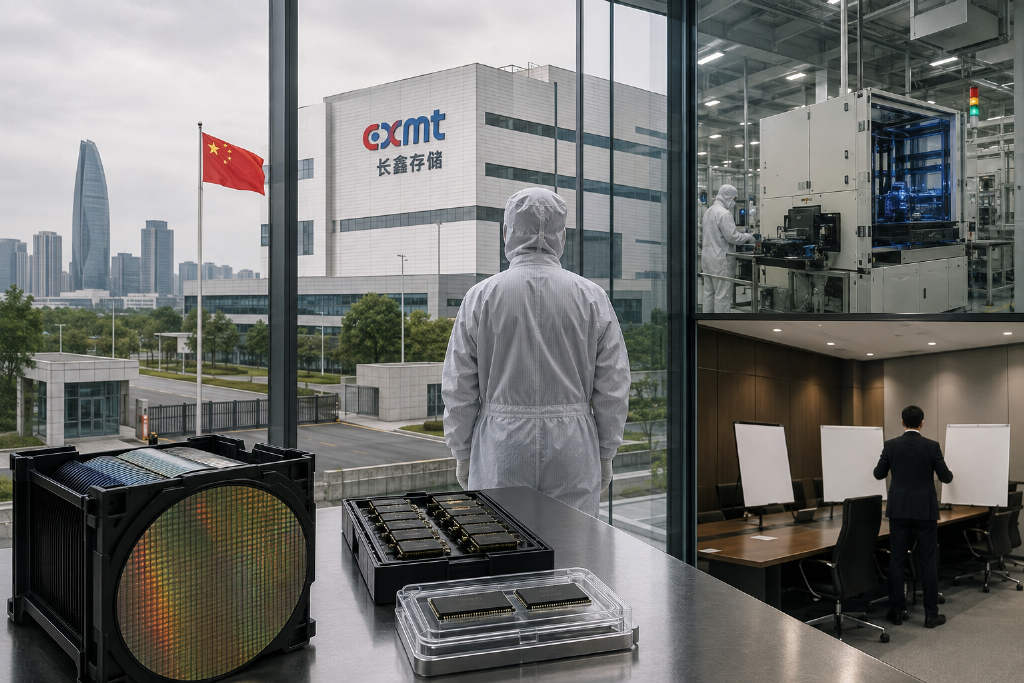
CXMT's LPDDR6 Enters Mass Production, Apple Partnership Awaits US Approval, Domestic DUV Progresses

China's largest DRAM maker CXMT held its H1 2026 earnings call on September 7, revealing a 873.6% revenue surge and 84.8% gross margin. The company announced mass production of its self-developed LPDDR6 memory, debuting on Xiaomi's 18 Fold flagship. On Apple partnership rumors, management neither confirmed nor denied, but industry sources indicate product qualification is complete, pending US government approval. CXMT also disclosed progress in domestic DUV lithography tool validation and outlined its HBM roadmap remains undisclosed. Customer concentration is high but manageable, with IDM flexibility to weather cycles.

1100
CXMT's LPDDR6 Enters Mass Production, Apple Partnership Awaits US Approval, Domestic DUV Progresses