
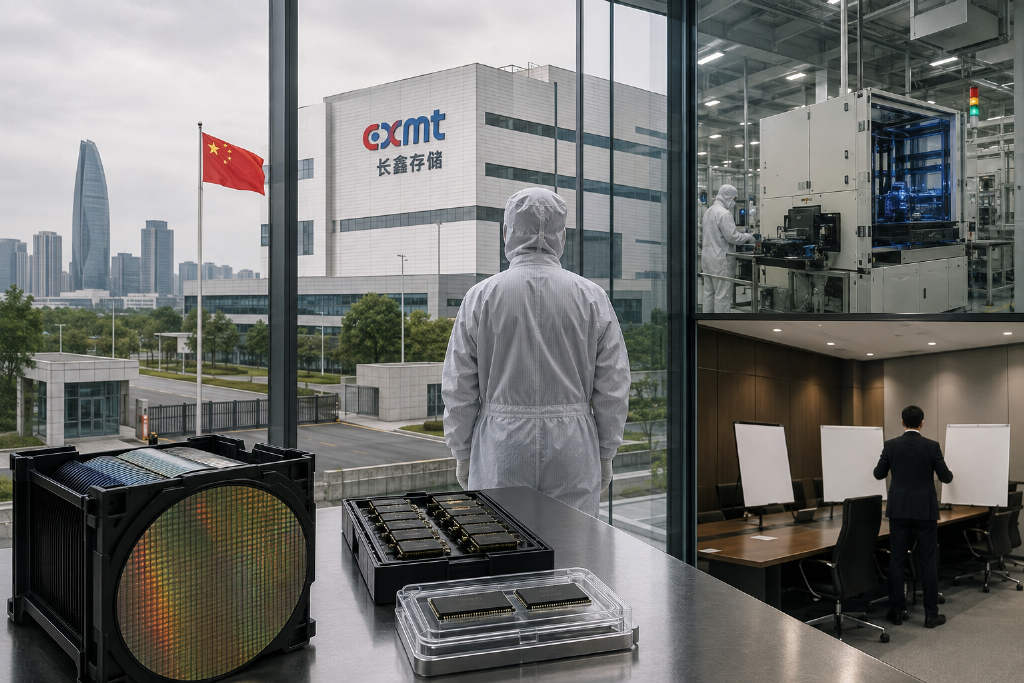
China's largest DRAM manufacturer, ChangXin Memory Technologies (CXMT), held its H1 2026 earnings call on September 7, addressing hot topics including Apple partnership rumors, mass production of LPDDR6, HBM roadmap, and domestic DUV lithography adoption.
Financial Highlights: Revenue Surges 873.6%, Gross Margin 84.8%
For the first half of 2026, CXMT reported revenue of RMB 150.31 billion, up 873.64% year-on-year, with net profit of RMB 77.605 billion and a gross margin of 84.84%. Senior Vice President and CFO Huang Danyang attributed the margin improvement to the DRAM upcycle and enhanced profitability, but cautioned that price volatility could impact margins going forward. He expects the global DRAM supply shortage to persist in the second half.
Notably, CXMT's downstream focus has shifted from consumer electronics to servers. General Manager Zhao Lun revealed that server-related product contributions have increased significantly, driven by AI infrastructure demand. The stock rose 6.7% on September 7, pushing market capitalization close to RMB 4 trillion, making it the most valuable stock on the A-share market.
Apple Partnership: Product Qualification Complete, Awaiting US Nod
Reports earlier indicated Apple is testing CXMT's memory chips for use in iPhones and MacBooks, initially for devices sold in China. When asked, Zhao Lun said: "The company maintains an open attitude to explore cooperation opportunities with global quality customers. Our products are competitive in performance, quality, and supply stability. Please refer to our public disclosures for customer details." The statement neither confirmed nor denied the talks, but is widely seen as indirect confirmation that CXMT meets Apple's standards. Industry sources say both CXMT and YMTC have completed Apple's product qualification, with the only remaining variable being US government approval.
(China memory chip 'origin washing' strategy exposed: YMTC NAND chips resold and assembled for export to North America)
Technology Roadmap: LPDDR6 Mass Production, HBM Unclear, Domestic DUV Progress
CXMT announced that its self-developed LPDDR6 memory chips have entered mass production, debuting globally on Xiaomi's 18 Fold foldable flagship. Zhao called it a milestone for the highest-spec mobile memory standard and a result of collaboration with Chinese tech supply chain partners.
On HBM, Zhao only said the company is progressing according to its technology roadmap, without disclosing timelines or customer details.
Regarding domestic supply chain, CXMT disclosed efforts to validate domestic DUV (deep ultraviolet) lithography tools, which it said will drive the semiconductor equipment ecosystem.
(China's homemade DUV shocks chip stocks; Morgan Stanley says compute demand unchanged, dip is a better entry point)
Customer Base and Risk Management: Concentrated but Manageable, IDM Flexibility
Vice President and Board Secretary Yuan Yuan revealed that CXMT's deep cooperation customers include Alibaba Cloud, ByteDance, Tencent, Lenovo, Xiaomi, Honor, OPPO, and vivo, covering servers, mobile devices, PCs, and smart cars. She acknowledged high customer concentration, noting it reflects the naturally concentrated nature of downstream markets, but stressed there is no over-reliance on any single client.
To mitigate risks during DRAM downturns, Zhao Lun said CXMT's IDM model provides flexibility in capacity adjustment, product mix, and utilization rates, enabling it to navigate cyclical fluctuations.