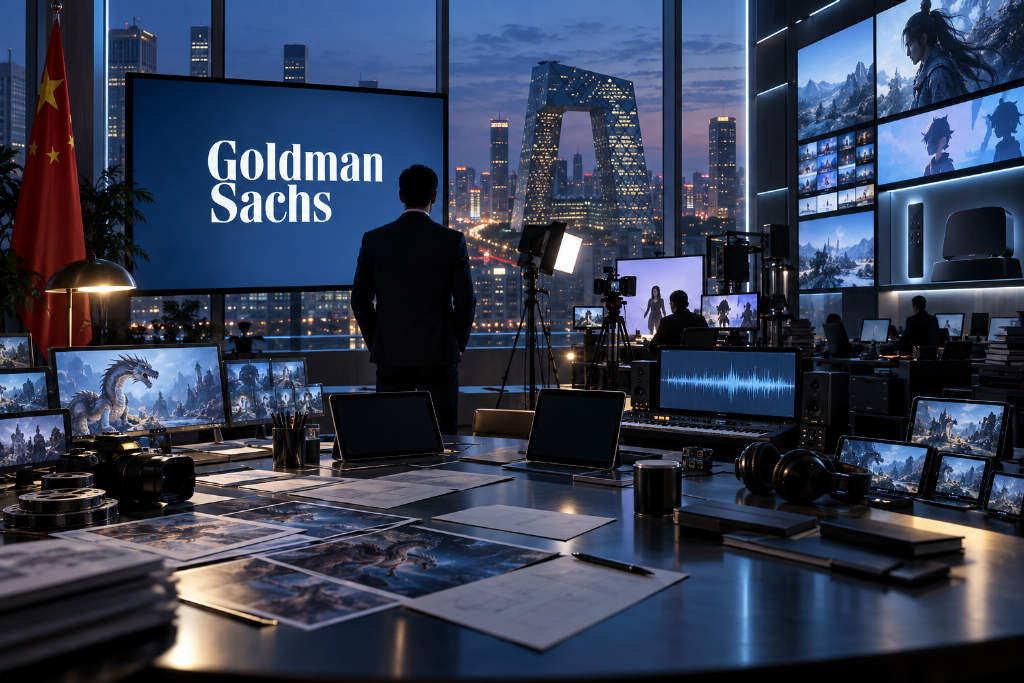
Goldman Sachs2026-09-22 04:05:50Goldman Sachs says AI is reshaping China’s entertainment industry, with gains likely to concentrate in top IP and distribution platformsGoldman Sachs said in a recent research note that AI is reshaping the value chain of China’s entertainment industry as content supply moves closer to abundance while user time and attention remain limited. The bank said that tension is likely to push more industry profit toward leading intellectual property and distribution platforms rather than lifting every part of the chain equally. According to the report, multimodal AI has cut production costs for animation, music, advertising videos and short dramas by 80% to 95%, while lifting production efficiency by 5x to 10x. Goldman Sachs also said output has surged: in the first eight months of 2026, short drama and mini-series production was 13 times the full-year 2025 level, while new game releases rose by more than 8 times. On Hongguo, a leading short-drama platform, more than 90% of series have already used AI-generated content. The bank said traditional production and execution functions are likely to face pressure, while top IP and creative assets may become more valuable. It added that online gaming appears relatively resilient, while long-form video platforms may benefit from lower costs in the near term but still face pressure from weaker user time and AI-driven competition. Goldman Sachs also flagged monetization challenges and tighter regulation as two key risks.390
Artificial In2026-09-01 07:08:58Yi Lihua Says AI Investing Is About Finding Breakout CompaniesYi Lihua said the central task of investing is not to spread capital evenly across assets, but to identify a small number of standout companies capable of producing outsized returns. He cited Duan Yongping’s 2002 investment in NetEase as an example. Duan reportedly used $2 million to buy NetEase shares when the stock traded below $1, held the position for eight years and made more than $260 million, generating a return of more than 100 times the original investment. Yi said each technological revolution creates opportunities for exceptional returns. He pointed to the early crypto industry, where numerous investments produced 100-fold gains, and compared the current artificial intelligence sector with that early expansion phase. In his view, both the Chinese and U.S. markets contain potential targets. The immediate objective for AI investors, he said, is to find the standout companies with the strongest explosive growth potential in the current AI wave.910
AI2026-09-01 06:53:41Liquid Capital's Yili Hua: AI Investing Mirrors Early Crypto, Focus on Explosive StarsYili Hua, founder of Liquid Capital, said on Sept. 1 that AI investing today resembles the early days of crypto a decade ago, when holding BTC or backing quality projects produced a wave of 100x returns. He argued that investing is not about casting a wide net but identifying the few star companies capable of outsized returns. As an example, he cited Duan Yongping's first major trade after moving from entrepreneur to investor: in 2002, Duan put $2 million into NetEase when its share price was below $1, held for eight years, and turned it into a gain of over 100 times — more than $260 million. Hua said every technological revolution carries abundant excess-return opportunities, and AI is still in the early explosive phase, with potential targets across both Chinese and U.S. markets. His core point: the goal of AI investing now is to catch the most explosive star companies of this wave.900
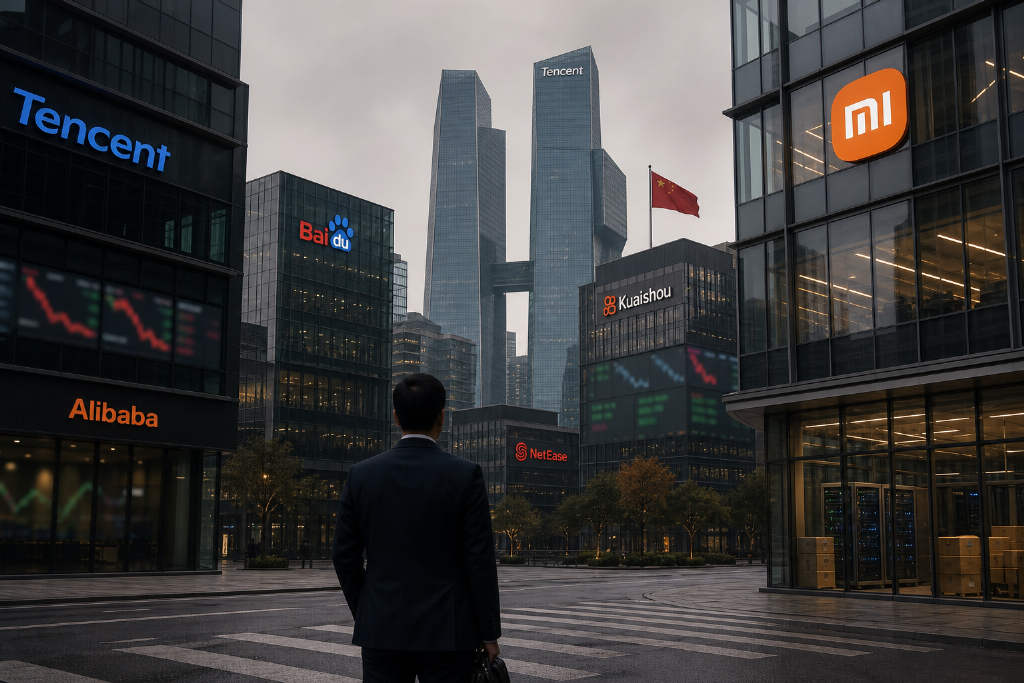
AI2026-08-21 11:25:09AI Is No Longer Enough to Lift Big Tech StocksChina’s major internet companies are all pushing AI, but the latest earnings season showed that AI alone is no longer enough to re-rate their shares. Tencent, Alibaba, Baidu, Kuaishou and NetEase fell after reporting, while Xiaomi stood out as one of the few exceptions. The piece argues that the market is now asking a harder question: not whether these companies have AI, but what AI is actually changing in their businesses. Tencent is using AI on top of a powerful cash machine, with gaming and advertising still generating strong revenue and capital spending rising to 52.8 billion yuan in the second quarter. Alibaba is trying to rebuild part of its empire around AI, while also lifting quarterly capital spending to 67.7 billion yuan. Baidu has a growing AI business, but declining online marketing revenue keeps the old business under pressure. Kuaishou’s Kling AI brought in more than 850 million yuan in the second quarter, up more than 200%, yet that was not enough to offset slow group growth. Xiaomi is treating AI as a layer across phones, cars, home devices and robots, not as a standalone revenue line. NetEase is using AI in game development, but its core growth still comes from games.590
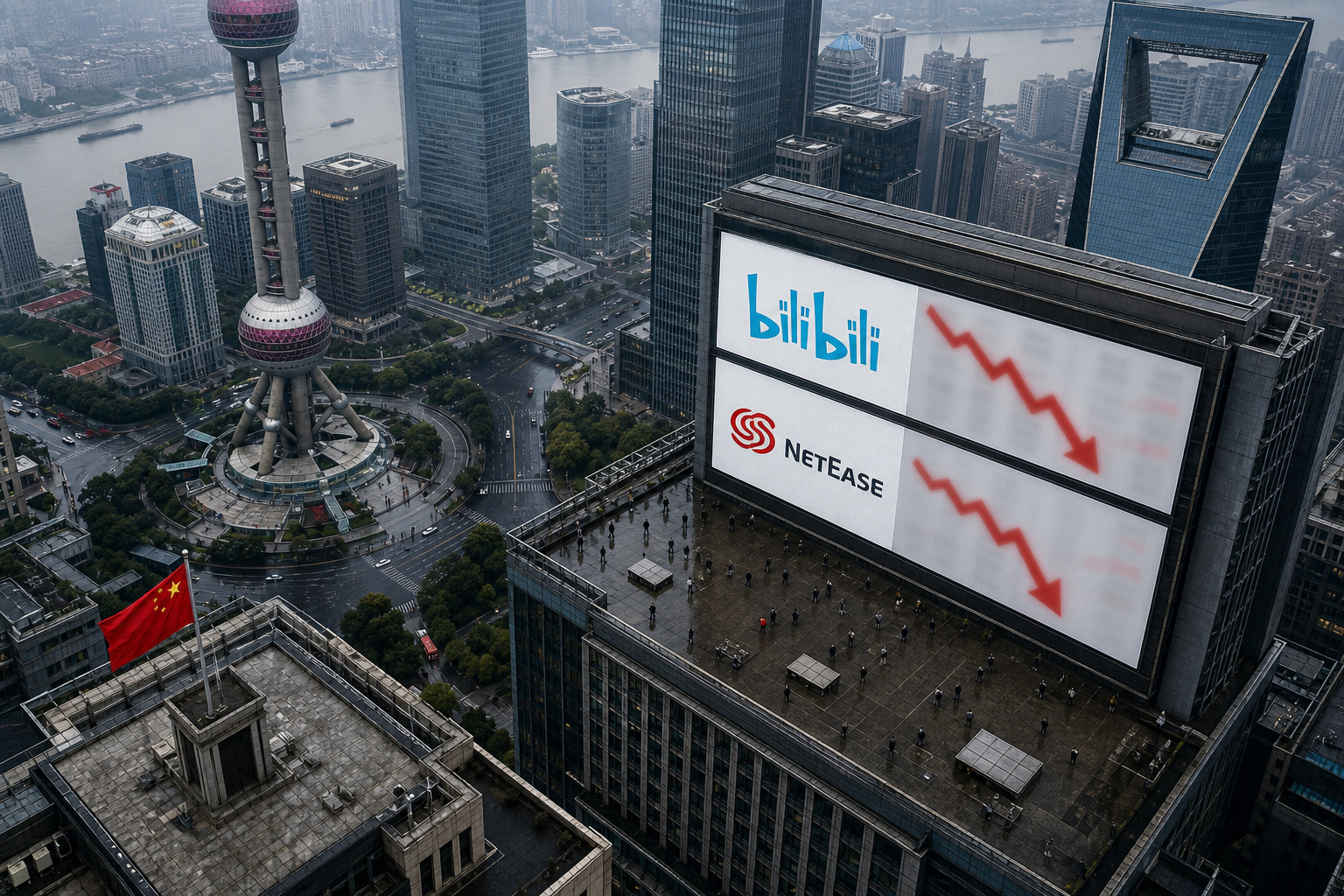
NASDAQ Golden2026-08-11 19:07:42NASDAQ Golden Dragon China Index Slides 3%; Bilibili, NetEase SinkPer Gate market data cited by ChainCatcher, the NASDAQ Golden Dragon China Index fell 3%, with Bilibili down over 5% and NetEase down nearly 4%.1720
US stocks2026-07-27 20:01:44U.S. stocks close mixed Monday as Nvidia falls 5% and Apple gains 1%U.S. stocks finished mixed on Monday, according to market data cited by ChainCatcher from Gate. The Dow Jones Industrial Average was initially up 0.5%, while the S&P 500 edged higher by 0.02%. The Nasdaq slipped 0.18% by the close. Among individual names, Micron Technology fell 2%, Sandisk dropped 11%, Nvidia lost 5%, and SK Hynix declined 7.5%. Apple rose 1%, with its market capitalization approaching $5 trillion. Chinese stocks listed in the U.S. were stronger. The Nasdaq Golden Dragon China Index closed up 2.5%, while NetEase gained 3.5% and Alibaba added 2.5%. The figures were reported by ChainCatcher, citing Gate market data.1460
US stocks2026-07-22 20:02:48U.S. stocks close mixed Wednesday as Nasdaq slips 0.57%U.S. stocks finished mixed on Wednesday, according to market data cited by ChainCatcher from Gate. The Dow Jones Industrial Average was initially down 0.01%, while the S&P 500 fell 0.14% and the Nasdaq declined 0.57% by the close. Among individual names, SpaceX (SPCX.O) dropped 6.7% and set a new closing low. Nvidia (NVDA.O) gained 2.3%, while SK Hynix (SKHY.O) fell 3.8%. Super Micro Computer (SMCI.O) jumped nearly 20%, and Dell (DELL.N) rose 9%. The Nasdaq Golden Dragon China Index closed down 1.8%, with NetEase (NTES.O) falling more than 6%. The move reflected a mixed session across major U.S. benchmarks and several closely watched technology-related stocks.1410