
This article was originally published by Bit.Fan. For more cryptocurrency news and market insights, visit www.bit.fan.
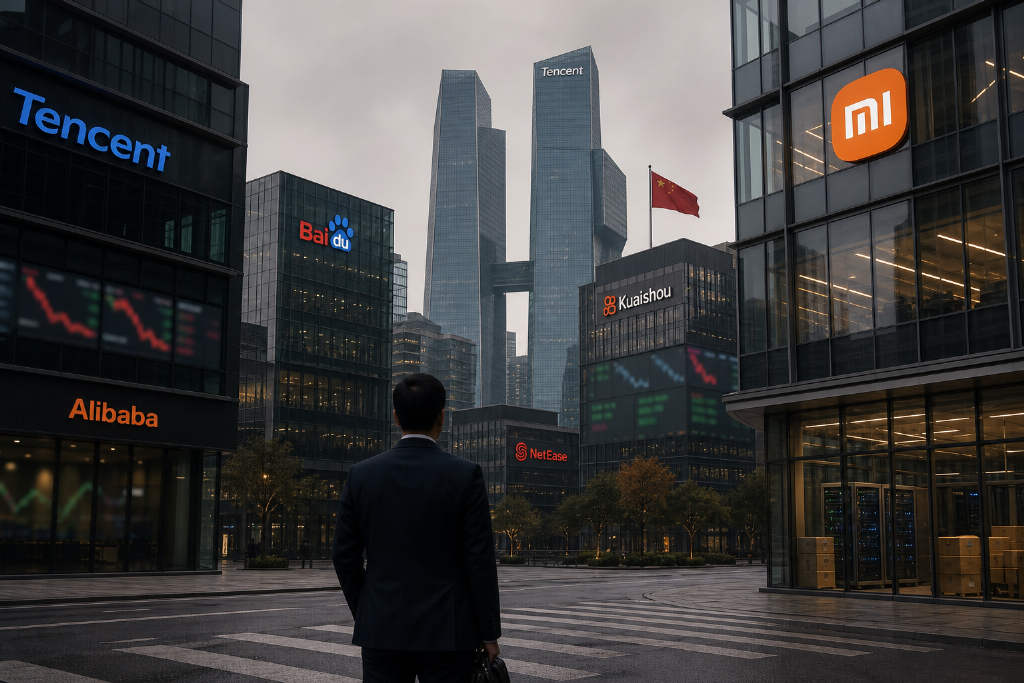
AI Is No Longer Enough to Lift Big Tech Stocks
N
News EditorChina’s major internet companies are all pushing AI, but the latest earnings season showed that AI alone is no longer enough to re-rate their shares. Tencent, Alibaba, Baidu, Kuaishou and NetEase fell after reporting, while Xiaomi stood out as one of the few exceptions. The piece argues that the market is now asking a harder question: not whether these companies have AI, but what AI is actually changing in their businesses.
Tencent is using AI on top of a powerful cash machine, with gaming and advertising still generating strong revenue and capital spending rising to 52.8 billion yuan in the second quarter. Alibaba is trying to rebuild part of its empire around AI, while also lifting quarterly capital spending to 67.7 billion yuan. Baidu has a growing AI business, but declining online marketing revenue keeps the old business under pressure.
Kuaishou’s Kling AI brought in more than 850 million yuan in the second quarter, up more than 200%, yet that was not enough to offset slow group growth. Xiaomi is treating AI as a layer across phones, cars, home devices and robots, not as a standalone revenue line. NetEase is using AI in game development, but its core growth still comes from games.
China’s biggest internet names are all making AI a central part of their pitch, but the latest earnings season showed that AI is no longer enough on its own to lift valuations.
Tencent, Alibaba, Baidu, Kuaishou and NetEase all fell after reporting results. Xiaomi was one of the few exceptions.
The companies are not short on AI narratives. Baidu has Kunlun Core and AI cloud services. Kuaishou has Kling. Alibaba has Qwen and Alibaba Cloud. Tencent has Hunyuan and WorkBuddy. Xiaomi has MiMo. NetEase has already woven AI into game development.
That is exactly the point. China’s internet giants have probably never been more aligned on AI. Yet the stronger the consensus gets, the harder it becomes to get a premium for it.
A few years ago, launching a large model, buying GPUs and declaring an “all-in AI” strategy was enough to create a new valuation story. Investors were mainly trying to answer one question: who gets a ticket to the AI era, and who gets left behind?
That question has mostly been answered. Almost every large platform is already in the AI race. So the market has moved on to a tougher one: what is AI actually changing inside your company?
Tencent is the clearest example of AI layered on top of an already powerful cash engine. In the second quarter, domestic gaming revenue rose 17% and advertising revenue increased 22%, with AI already improving ad recommendation and monetization efficiency. Tencent does not need AI to rescue its old businesses. The opposite is closer to the truth: those businesses are so profitable that investors are now asking whether the extra spending on AI is worth it.
Tencent’s capital expenditure reached 52.8 billion yuan in the second quarter, up 176% from a year earlier. That creates a new tension for a company once admired for its ability to turn gaming, advertising and social products into steady cash flow. Now that cash is being converted into GPUs, servers and data centers. AI is strengthening Tencent’s business model at the same time that it is changing the return model behind that business.
Alibaba is trying a different path. If Tencent is building AI on top of an existing empire, Alibaba is trying to rebuild part of that empire around AI. Qwen, Alibaba Cloud and AI infrastructure are becoming a clearer chain, and AI cloud and compute-related revenue rose 45% in the latest quarter. AI product revenue has now delivered triple-digit growth for 12 straight quarters.
That may be one of the clearest AI commercialization paths among China’s major tech names. But Alibaba’s quarterly capital expenditure also climbed to 67.7 billion yuan, up 75%. The more certain the AI business becomes, the more money the company has to put back into it.
The market used to worry that Alibaba was missing AI. Now it is starting to worry that Alibaba is taking AI too seriously. After years of talking again about profit, shareholder returns and free cash flow, the company is back in a heavy reinvestment cycle.
Baidu faces a more urgent problem. It has the assets: models, AI cloud, autonomous driving and Kunlun Core, which is getting increasing attention from the market. Core AI revenue reached 12.5 billion yuan in the second quarter, up 25% year on year. On its own, that is not a bad number.
The problem is that online marketing revenue fell 19% over the same period, and total revenue declined 4%. Baidu is now in a brutal race of speed: can the new Baidu grow faster than the old Baidu shrinks?
Kunlun Core can command a rich valuation. AI cloud can keep growing. Autonomous driving can support a longer story. But if search ads keep weakening faster than the new businesses expand, the market will still see the company as a whole, not the parts.
For Tencent, AI can be an increment. For Baidu, it is starting to look more like a necessary business replacement. That is why Baidu can have assets the market likes and still see its shares fall after earnings.
Kuaishou tells a different story. Kling may be one of the most surprising AI bets in China’s internet sector. Second-quarter Kling AI revenue topped 850 million yuan, up more than 200%. That means it has crossed one of the hardest thresholds for an AI product: moving from a strong model and active community to something people actually pay for.
Even so, Kuaishou’s stock fell sharply after the report. Group revenue rose only 1.4%, and adjusted net profit also declined. A star AI product growing more than 200% is still not enough, for now, to offset a company growing in the low single digits.
A good new business and a business large enough to change the whole company are not the same thing.
Xiaomi is taking the fifth path. At least for now, its real second growth curve is still cars, not AI. Revenue from smart EVs and other new businesses, including AI, reached 24.9 billion yuan in the second quarter, of which car revenue accounted for 23.9 billion yuan.
That is why comparing Xiaomi’s AI revenue directly with Alibaba Cloud or Kling does not make much sense. For Xiaomi, AI is more of a base layer spreading into phones, cars, home appliances and robots.
The real bet is simpler to state and harder to prove: if phones, cars, home devices and robots all become AI terminals, does the company with the most hardware entry points gain the biggest AI advantage?
That is also why MiMo matters. It does not necessarily need to become a standalone model business. If AI eventually connects phones, cars, IoT devices and robots into one system, Xiaomi’s “human-car-home” ecosystem could become more than device linkage. It could end up with a shared brain.
That path is expensive, though. Xiaomi is pushing ahead on phones, car manufacturing, chip work and AI investment at the same time, which makes the story heavier, not lighter.
NetEase is the most unusual of the six. It is using AI too: for art generation, programming assistance, NPC interaction and lower content production costs. But it has not rushed to rebrand itself as an AI company.
In the second quarter, games and related value-added services brought in 25 billion yuan, up 9.7%. Titles such as Where Winds Meet and Fantasy Westward Journey still do most of the heavy lifting.
That is a useful reminder. Not every internet company needs to be redefined by AI. For a game publisher, AI matters, but the final verdict still comes from gameplay, content, aesthetics and operations.
If AI only helps NetEase improve game-making efficiency by 30%, shorten development cycles by 20% and make NPCs a bit smarter, it may already be worth a great deal. And in a sense, the fact that AI is not the most visible line in NetEase’s earnings may itself be the answer.
Put these six companies side by side, and the phrase “China’s internet sector has entered the AI era” starts to look too broad. They are not entering the same AI era.
Tencent is dealing with return on capital. Alibaba is dealing with reinvestment. Baidu is dealing with the replacement of old business by new business. Kuaishou is dealing with scale. Xiaomi is dealing with ecosystem integration. NetEase is dealing with a deeper question: does it even need to redefine itself because of AI?
Six companies. Six different problems.
What will ultimately decide their value is what happens when AI meets their existing business models. Tencent’s strong cash flow is being amplified by AI and also consumed by it. Alibaba’s cloud infrastructure has regained strategic value because of AI, but it also needs massive investment. Baidu’s dependence on search is becoming more exposed in the AI era. Kuaishou, which lacked a second growth curve, has unexpectedly gained one through Kling. Xiaomi’s large hardware ecosystem may finally be connected by AI. NetEase’s core content strength is a reminder that AI does not always have to be the star.
AI has not pulled China’s internet giants back to the same starting line. The original judgment still holds: the stronger the consensus on AI, the harder it is for AI itself to command a premium.
As models, compute and agents become standard equipment for big tech, the market will return to the oldest questions: is the underlying business good? Can AI be turned into revenue, profit or better efficiency? And what will that cost?
In the end, AI may not be a reshuffling card. It looks more like a magnifying glass, enlarging each company’s cash flow, legacy businesses, organizational strength, historical baggage and real competitive edge.
Same AI era. Six very different outcomes.
5900
Disclaimer:
The market information, project data, and third-party content displayed on this platform are for industry information sharing only and do not constitute any form of investment advice or return commitment.
Cryptocurrency trading carries high risks. Users should fully assess their risk tolerance and make independent decisions. All profits, losses, and legal responsibilities are borne by the users themselves.