SIPC

crypto stocks
2026-08-20 04:51:13

How Major CEXs Are Building Crypto Stock Products Across Brokerage, Tokenized Equities and Perpetuals

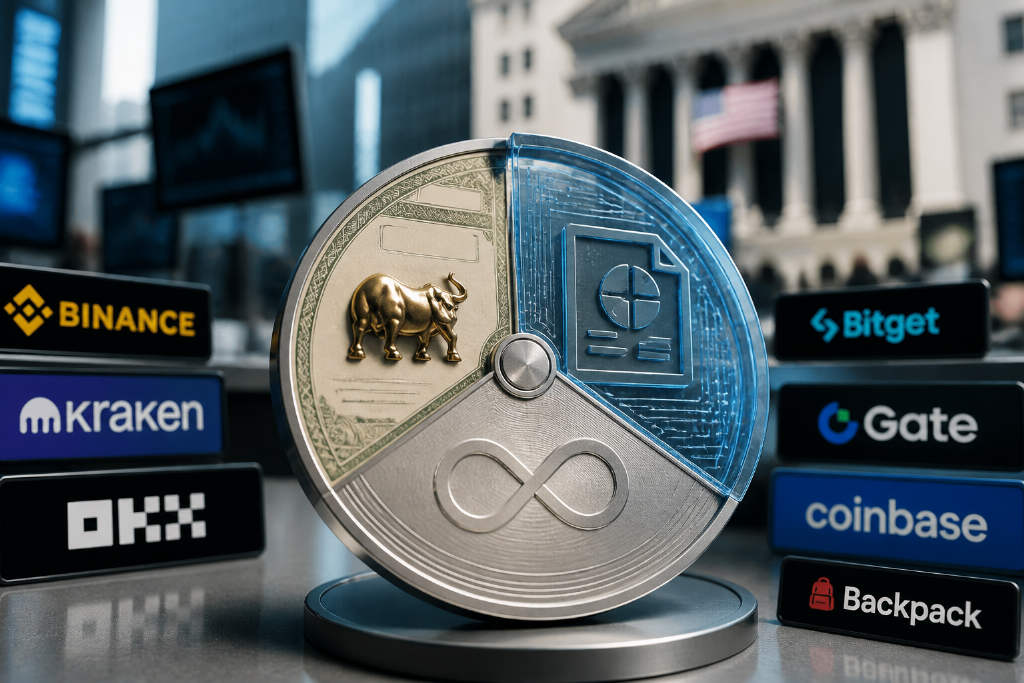
Crypto exchanges are pushing deeper into equities, turning stocks into one of the clearest product expansion paths in this market cycle. CoinGecko data cited in the report shows monthly stock perpetual volume across the top 13 crypto trading platforms climbed from about $831 million in July 2025 to roughly $34 billion in May 2026, a jump of nearly 40 times in less than a year. TradFi and RWA perpetuals spanning stocks, commodities and indexes reached $347.17 billion in May 2026 alone, with year-to-date volume above $1.32 trillion. The landscape is no longer limited to synthetic price exposure. Binance, Kraken, OKX, Bitget, Gate, Coinbase and Backpack are each combining different layers of product infrastructure, including direct access to real U.S. stocks and ETFs, tokenized stocks backed 1:1 by underlying securities, onchain-transferable equity tokens, stock perpetuals, CFDs and pre-IPO contracts. Their structures differ in important ways, especially around custody, investor rights, redemption and whether users actually own shares or only gain economic exposure. The report argues that crypto stocks remain early relative to traditional equity markets, with CoinGecko data indicating activity in crypto stock derivatives is still less than 1% of traditional stock market volume. Even so, the segment is moving from a niche RWA experiment toward a core competitive arena for centralized exchanges that want to extend from crypto into broader financial trading.

990
How Major CEXs Are Building Crypto Stock Products Across Brokerage, Tokenized Equities and Perpetuals
crypto stocks
2026-08-20 05:03:01

How Major CEXs Are Building Crypto Stock Products Across Brokerage, Tokenization and Perpetuals

Crypto stock products are turning into one of the clearest expansion paths for centralized exchanges as they push beyond digital assets and into traditional finance. The competitive set is no longer limited to synthetic price exposure. By 2026, major platforms had rolled out a mix of real stock brokerage, tokenized equities, stock perpetuals, CFDs and pre-IPO products, often inside a single account system. According to CoinGecko figures cited in the source article, monthly trading volume for stock perpetuals across the top 13 crypto trading platforms climbed from about $831 million in July 2025 to roughly $34 billion in May 2026, an increase of nearly 40 times in less than a year. The article also notes that cumulative stock-perpetual volume in the first five months of 2026 had already surpassed the whole of 2025. On the tokenized spot side, xStocks had logged more than $35 billion in cumulative trading volume by July 2026 and nearly 200,000 holders globally, while expanding beyond U.S. stocks and ETFs into Hong Kong, the U.K., Europe and South Korea. The report reviews how Binance, OKX, Bitget, Gate, Kraken, Coinbase and Backpack approach the market through different legal and product structures. It argues that the category now spans four distinct models: traditional brokerage access to real shares, tokenized securities backed by underlying stocks, total-return or synthetic equity tokens, and stock perpetuals or CFDs that do not require 1:1 share backing. The result is a market that is still early by global equity standards, yet increasingly central to how exchanges compete for the next phase of user growth.

510
How Major CEXs Are Building Crypto Stock Products Across Brokerage, Tokenization and Perpetuals
tokenized sto
2026-08-13 12:50:25

Tokenized stocks are turning into a three-front contest across issuance, distribution and settlement

The tokenized stock market has expanded quickly over the past few months, but the fight is no longer just about attracting users who want equity exposure on-chain. The sharper contest is happening across three separate functions: issuance, distribution and clearing. According to RWA.xyz data cited in the report, the market stood at about $2.5 billion as of Aug. 12, with Ondo leading at roughly $866 million, Binance’s bStocks at about $614 million, and xStocks at around $560 million. Together, the top three accounted for about 80% of the market. The report argues that early independent issuers built an initial lead, but exchanges that control traffic and liquidity are now moving upstream by launching their own issuance brands. Binance’s bStocks rose to the No. 2 spot in less than two months, while Bitget and Gate have also built in-house products. At the same time, broker-connected stock access is gaining traction because users receive direct ownership of real shares, along with dividends, corporate actions and SIPC protection. Binance’s cash equities offering, for example, averaged about $143 million in daily trading over its first nine days, versus a peak weekday range of roughly $35 million to $40 million in the tokenized spot market during the same period. The piece also notes that new models, including directly registered shares on-chain, could reshape today’s structure again.

270
Tokenized stocks are turning into a three-front contest across issuance, distribution and settlement
Charles Schwa
2026-08-13 09:01:55

Charles Schwab Opens Bitcoin and Ethereum Spot Trading to Retail Clients

Charles Schwab, the U.S. financial services firm, has begun offering spot bitcoin and ethereum trading to its retail clients in phases since May 13, 2026, charging 75 basis points per trade. The company disclosed $13.1 trillion in client assets and 39.8 million brokerage accounts. Paxos is responsible for execution and sub-custody. On a July earnings call, Schwab said that the business is progressing according to plan, that it has started a pilot for crypto asset transfers, and that it has taken an equity stake in Paxos. The initial service supports only bitcoin and ethereum. It does not allow deposits or withdrawals, and it does not provide SIPC protection, except in New York and Louisiana. Schwab clients already hold roughly $25 billion in crypto ETPs. E*Trade, Morgan Stanley's brokerage arm, began trading bitcoin, ethereum, and solana on July 16 through Zerohash, with a fee of 50 basis points. Fidelity charges 1%. Coinbase's implied consumer trading fee is about 1.75%. The information comes from Forbes Digital Assets.

570
Charles Schwab Opens Bitcoin and Ethereum Spot Trading to Retail Clients
Reality
2026-08-12 12:42:23

Reality expands Network Firm partnership with daily reserve verification for tokenized RWA products

Reality, a compliant real-world asset issuance platform backed by Bitget, said it has expanded its work with The Network Firm to introduce daily third-party proof-of-reserves verification reports for more than 500 tokenized stocks and exchange-traded products. The platform had previously provided daily PoR data, but the new structure adds an independent report designed to let investors check each day whether every issued rToken remains matched 1:1 with the underlying assets held in custody. Reality said the move fits its plan to build a more transparent framework for cross-ecosystem tokenized equities. The company said the underlying stocks and ETFs remain custodied by Alpaca Securities LLC, a FINRA-registered broker-dealer protected by SIPC. Reality also said its rToken assets under management have passed $100 million, while its lineup now spans more than 500 tokenized U.S. stocks and ETFs across sectors including technology, AI, semiconductors, commodities, leveraged products, and broad market indices. Executives from both The Network Firm and Bitget framed the change as a response to a 24/7 market that no longer fits monthly or occasional reserve disclosures. The source article also included corporate background on Reality, Bitget, and Bitget Wallet, along with a disclaimer stating that the tokenized assets discussed have not been registered under the U.S. Securities Act of 1933 and that The Network Firm’s reports do not constitute an audit, review, opinion, or conclusion on whether rTokens are fully backed.

970
Reality expands Network Firm partnership with daily reserve verification for tokenized RWA products
Bitget
2026-08-05 08:14:04

Reality expands work with The Network Firm for daily PoR audits of rToken

Reality, Bitget’s licensed real-world asset issuance platform, said it has expanded its partnership with U.S. audit firm The Network Firm. Under the upgraded arrangement, The Network Firm will issue daily proof-of-reserves audit reports for Reality’s U.S. stock token product, rToken, using attestation standards set by the American Institute of Certified Public Accountants, or AICPA. The stated purpose is to verify that every issued rToken is matched by the corresponding stock or ETF held in a custodial account. The underlying equities and ETFs will continue to be held by Alpaca Securities LLC, a U.S. securities broker registered with FINRA and protected by SIPC, creating a three-party structure that separates issuance, verification, and custody. Reality said rToken currently supports 634 tokenized stocks and ETFs and is deeply integrated with the Bitget ecosystem, including use cases such as unified account margin and staking-backed lending. Earlier data showed Bitget’s stock token rToken exceeded $100 million in assets under management one month after launch.

1050
Reality expands work with The Network Firm for daily PoR audits of rToken
Ondo Finance
2026-07-23 13:53:44

Ondo’s Oasis Pro Markets gets FINRA authorization to offer tokenized stocks and funds in the US

Ondo Finance said its SEC-registered broker-dealer subsidiary, Oasis Pro Markets, has received US regulatory authorization to offer compliant tokenized corporate stocks and fund products to financial institutions and retail investors under SEC and FINRA oversight. The framework covers retail OTC trading, underwritten primary offerings, private placements and secondary-market activity. According to the announcement, the platform will allow US issuers to launch tokenized securities and let both institutional and retail investors trade them. Eligible assets include NMS stocks, fund interests such as ETFs, mutual funds and index funds, as well as securities issued through IPOs and traded in secondary markets. Settlement can take place in fiat or supported stablecoins, including direct settlement between blockchain-based wallets. Ondo said the authorization builds on its acquisition of Oasis Pro, which holds SEC registrations for a broker-dealer, an alternative trading system and a transfer agent. The company also said the approvals support omnibus account structures through integrations with existing broker-dealer and adviser channels.

1140
Ondo’s Oasis Pro Markets gets FINRA authorization to offer tokenized stocks and funds in the US