SPCXB

Gate Research
2026-09-04 05:04:39

Gate Research: Crypto Market Sees Phased Recovery in July, DeFi and Long-Tail Assets Lead Gains

In July 2026, the crypto market staged a phased recovery after June's sharp correction. Total market cap rose from $2.11T to $2.28T, up 8.31%. ETH outperformed with 22.13% gains, driving DeFi blue chips like UNI and AAVE higher. However, the median return of +0.02% highlights structural divergence. Meme coins, AI/InfoFi tokens, and long-tail assets dominated the leaderboard, with AKE surging over 1,000%. Volume analysis shows 28 tokens had volume spikes above 3x, but high-volume signals were mixed. The recovery remains tepid rather than a broad bull run.

170
Gate Research: Crypto Market Sees Phased Recovery in July, DeFi and Long-Tail Assets Lead Gains
MARSCOIN
2026-09-03 07:32:59

Trader BonkGuy Says MARSCOIN Reminds Him of 2021's SAFEMOON, With $1.54M Unrealized Profit

Trader BonkGuy (Unipcs) compares MARSCOIN to SAFEMOON on BNB Chain from 2021, citing stronger narrative tied to Elon Musk, CZ, Mars, and SpaceX. He notes MARSCOIN holders get SPCXB rewards linked to SpaceX tokenized assets. His position: ~24.9 million MARSCOIN worth $2.51 million, with an unrealized profit of $1.5479 million (157% return).

70
Trader BonkGuy Says MARSCOIN Reminds Him of 2021's SAFEMOON, With $1.54M Unrealized Profit
Binance
2026-09-01 08:47:12

Binance to list MARSCOINUSDT perpetual contract with up to 20x leverage

BlockBeats reported that Binance Futures will list the MARSCOINUSDT perpetual contract on Sept. 1, 2026 at 09:45 UTC, with leverage of up to 20x. The contract will have a minimum order size of 1 MARSCOIN and a minimum notional value of 5 USDT. Funding rates will be capped at +2%/-2%, settled every four hours, and the product will support multi-asset margin mode and 24/7 trading. Copy trading for the contract will be available within 24 hours of launch. MarsCoin is described as a meme token built on BNB Chain that distributes SPCXB, a tokenized stock asset, to holders.

110
Binance to list MARSCOINUSDT perpetual contract with up to 20x leverage
Binance
2026-08-29 10:19:27

WuBlockchain repost says Binance may chase after-hours stock pricing power with Perps, while bStocks serve as inventory and correction rails

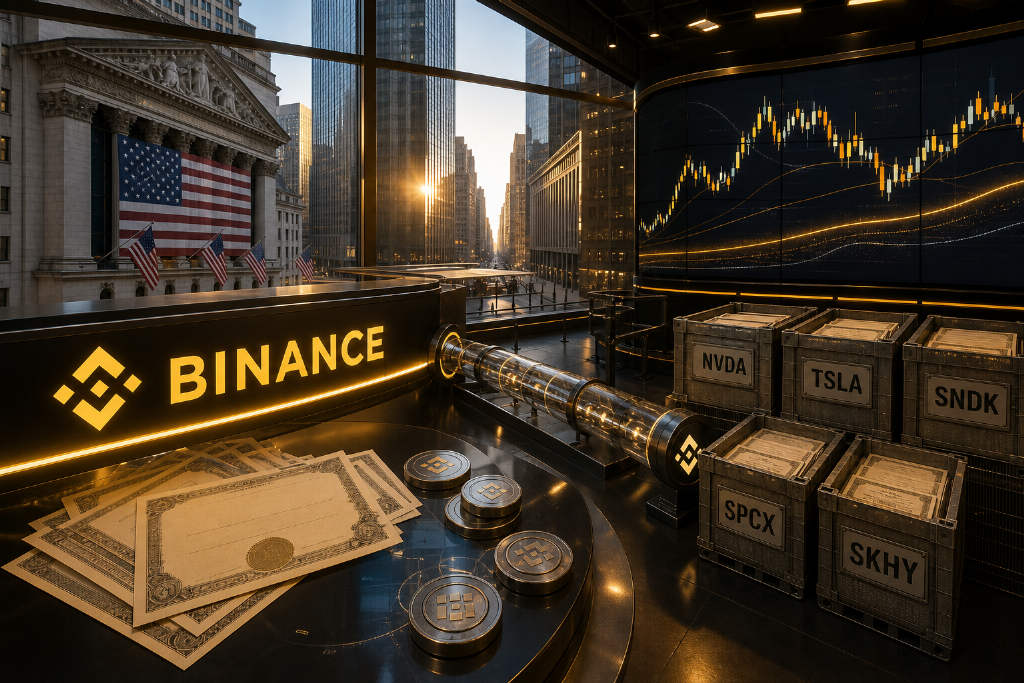
A reposted WuBlockchain article argues that Binance’s stock-product strategy is not about building a better Nasdaq. The thesis is narrower and more structural: if the exchange wants influence over post-close stock pricing, the front line is perpetual futures, not tokenized spot stocks. In this framework, Perps absorb directional views, leverage and rapid trading during market closures, while bStocks act as the inventory layer that can be held, transferred, converted, posted as collateral and used for hedging. The article compares weekend and reopening data for NVDA, TSLA, SNDK, SPCX and SKHY-related contracts, and repeatedly returns to one point: heavy trading alone does not prove price discovery. In a 25-sample set covering U.S. market close-to-reopen windows, Sunday direction matched the next cash open only 13 times, or 52%. SNDK and SPCX posted large weekend turnover and high fill rates, yet those figures, the author says, likely reflect market making, arbitrage and systematic flow as much as independent investor conviction. The piece also argues that bStocks should not be judged mainly by ticker count, AUM or headline volume. Their strategic role lies in inventory, borrowing, conversion and balance-sheet mobility. Perps can produce a candidate price, but bStocks are meant to turn that price into an asset that can be financed, transported, hedged and, if wrong, arbitraged back into line.


190
WuBlockchain repost says Binance may chase after-hours stock pricing power with Perps, while bStocks serve as inventory and correction rails
Binance
2026-08-24 10:06:47

Binance Alpha revises stock meme holding reward rules, with new calculation method starting in September

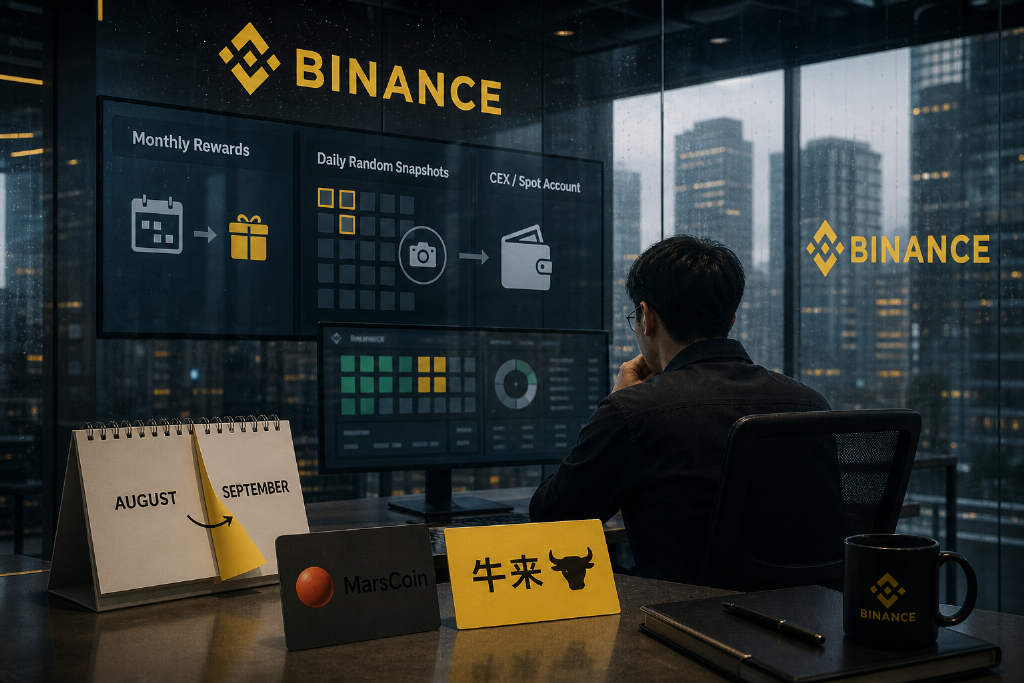
Binance Chinese-language social media announced that Binance Alpha is changing how rewards tied to stock meme token holdings are calculated and distributed. Under the current setup, rewards for users holding assets in Binance Wallet will still be automatically sent by Flap to users’ on-chain Binance Wallet addresses based on Flap’s own distribution rules. For Alpha 2.0 holders on the centralized exchange side, Binance Alpha will continue to use daily random snapshots to count token balances and distribute rewards on a monthly basis, with eligible users receiving the prior month’s rewards in their spot accounts at the beginning of the following month. For the August holding period, MarsCoin and Niulai will remain under the previous reward mechanism, and those rewards are scheduled to be distributed in early September. Binance said Niulai was listed on Alpha 2.0 on Aug. 18, so its August holding calculation will only cover Aug. 18 through Aug. 31, a 14-day period. MarsCoin rewards will be issued in SPCXB, while Niulai rewards will be issued in QQQB. Starting in September, a new rule will apply: a user must hold more than 10,000 tokens in a single day for that day to count as valid holdings. Monthly rewards will then be allocated separately for each token based on each user’s share of total valid holdings among qualified users.

840
Binance Alpha revises stock meme holding reward rules, with new calculation method starting in September
crypto stocks
2026-08-20 04:51:13

How Major CEXs Are Building Crypto Stock Products Across Brokerage, Tokenized Equities and Perpetuals

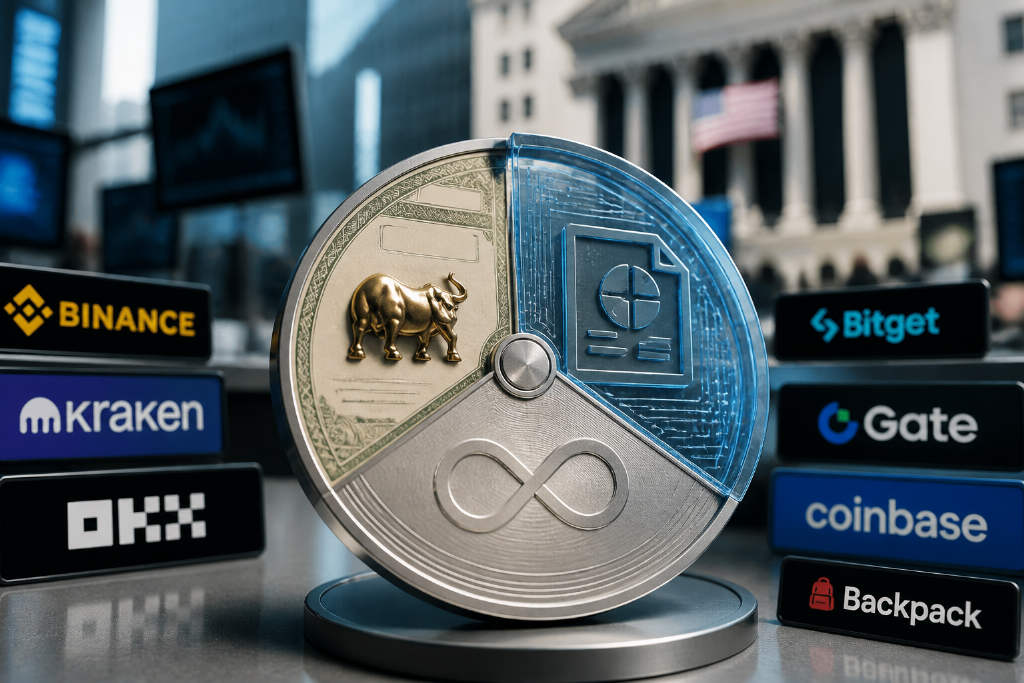
Crypto exchanges are pushing deeper into equities, turning stocks into one of the clearest product expansion paths in this market cycle. CoinGecko data cited in the report shows monthly stock perpetual volume across the top 13 crypto trading platforms climbed from about $831 million in July 2025 to roughly $34 billion in May 2026, a jump of nearly 40 times in less than a year. TradFi and RWA perpetuals spanning stocks, commodities and indexes reached $347.17 billion in May 2026 alone, with year-to-date volume above $1.32 trillion. The landscape is no longer limited to synthetic price exposure. Binance, Kraken, OKX, Bitget, Gate, Coinbase and Backpack are each combining different layers of product infrastructure, including direct access to real U.S. stocks and ETFs, tokenized stocks backed 1:1 by underlying securities, onchain-transferable equity tokens, stock perpetuals, CFDs and pre-IPO contracts. Their structures differ in important ways, especially around custody, investor rights, redemption and whether users actually own shares or only gain economic exposure. The report argues that crypto stocks remain early relative to traditional equity markets, with CoinGecko data indicating activity in crypto stock derivatives is still less than 1% of traditional stock market volume. Even so, the segment is moving from a niche RWA experiment toward a core competitive arena for centralized exchanges that want to extend from crypto into broader financial trading.

1370
How Major CEXs Are Building Crypto Stock Products Across Brokerage, Tokenized Equities and Perpetuals
crypto stocks
2026-08-20 05:03:01

How Major CEXs Are Building Crypto Stock Products Across Brokerage, Tokenization and Perpetuals

Crypto stock products are turning into one of the clearest expansion paths for centralized exchanges as they push beyond digital assets and into traditional finance. The competitive set is no longer limited to synthetic price exposure. By 2026, major platforms had rolled out a mix of real stock brokerage, tokenized equities, stock perpetuals, CFDs and pre-IPO products, often inside a single account system. According to CoinGecko figures cited in the source article, monthly trading volume for stock perpetuals across the top 13 crypto trading platforms climbed from about $831 million in July 2025 to roughly $34 billion in May 2026, an increase of nearly 40 times in less than a year. The article also notes that cumulative stock-perpetual volume in the first five months of 2026 had already surpassed the whole of 2025. On the tokenized spot side, xStocks had logged more than $35 billion in cumulative trading volume by July 2026 and nearly 200,000 holders globally, while expanding beyond U.S. stocks and ETFs into Hong Kong, the U.K., Europe and South Korea. The report reviews how Binance, OKX, Bitget, Gate, Kraken, Coinbase and Backpack approach the market through different legal and product structures. It argues that the category now spans four distinct models: traditional brokerage access to real shares, tokenized securities backed by underlying stocks, total-return or synthetic equity tokens, and stock perpetuals or CFDs that do not require 1:1 share backing. The result is a market that is still early by global equity standards, yet increasingly central to how exchanges compete for the next phase of user growth.

550
How Major CEXs Are Building Crypto Stock Products Across Brokerage, Tokenization and Perpetuals
Binance
2026-08-15 13:51:00

Binance’s Weekend Stock Push Centers on Perps for Price Formation and bStocks for Inventory

A PANews analysis argues that Binance is not simply trying to extend stock trading hours into weekends. The bigger goal, the article says, is to compete for price formation after traditional equity markets close, using perpetual contracts as the first venue for directional expression and bStocks as the inventory and correction layer behind them. The piece compares weekend and reopening data across NVDA, TSLA, SNDK, SPCX and SKHY-related products, and finds that large volume alone does not prove durable price leadership. In one August 2026 weekend example, four stock perpetuals on Binance traded about $461 million in total and all priced above the prior cash close on Sunday, only for all four to open lower when the U.S. cash market returned on Monday. In a separate SNDK case during the U.S. Independence Day long weekend, Binance’s weekend market captured most of an eventual 4.8% opening gap, but overshot the move. Across 25 U.S. market close-to-reopen samples, Sunday direction matched the next cash open 13 times, or 52%. The article’s conclusion is that Perps may be efficient at generating a candidate price, but bStocks, stock conversion, borrow depth and on-chain circulation are what could determine whether that price can be held, financed, hedged, challenged and ultimately validated as a market price.

720
Binance’s Weekend Stock Push Centers on Perps for Price Formation and bStocks for Inventory