US software s2026-09-01 03:14:09Wall Street’s ‘AI eats software’ trade shows cracks after Salesforce earningsWall Street’s long-running bearish case on software stocks is starting to weaken after a strong set of earnings from Salesforce reignited debate over whether artificial intelligence is really eroding the traditional SaaS model. For much of the past year, investors argued that AI tools would let companies do more with fewer workers, cutting demand for software seats, while “vibe coding” would lower the cost of building custom applications and pressure packaged software vendors. That narrative helped drag down many U.S. software names. The tone shifted last week after Salesforce reported second-quarter revenue and profit above Wall Street expectations and raised its full-year guidance. The company also posted 14% year-over-year growth in current remaining performance obligations, while net new annual contract value reached a four-year high. Shares jumped 22.6% in a single session, and the iShares Expanded Tech-Software Sector ETF returned to positive territory for the year. Workday, CrowdStrike Holdings and ServiceNow also advanced, adding weight to the view that investors are beginning to separate software companies by business model and data assets rather than treating the sector as one AI casualty trade. Still, some strategists say the rally is also being fueled by positioning, with underweight institutional investors rotating back into software after favoring semiconductors and AI hardware.920
Salesforce2026-08-27 05:44:20Salesforce beats on Q2 revenue as Benioff pushes back on claims AI will replace SaaSSalesforce reported second-quarter revenue of $11.35 billion on Aug. 26, topping market expectations, while net income got a lift from a $2.6 billion gain tied to its Anthropic stake. On the earnings call, CEO Marc Benioff rejected the idea that AI will replace software-as-a-service, arguing that enterprise customer data remains the foundation for how AI models operate. Benioff pointed to the company’s expanded partnership with Anthropic as part of that argument. The two companies launched Claudeforce, a product that lets sales teams use Salesforce data inside Claude to draft emails and update records. He said the move shows AI systems still depend on enterprise software and the data layers those systems manage. Salesforce also noted that this is the first time it has used the “force” brand on another company’s product. The company said Agentforce has passed $1.5 billion in annual recurring revenue, up more than 240% year over year. Agentforce and Data 360 together generated nearly $3.9 billion in revenue, up more than 210%. Benioff also said net new deal growth was the strongest in four years and churn was near a historic low. Salesforce shares rose 14% in after-hours trading.830
Outbid2026-08-26 06:53:17Outbid drew 1.14 million visitors in three days and topped $200,000 in revenueGerman indie developer Jonathan Wilke built Outbid in about three hours and launched it on Aug. 20. The site runs on a blunt rule: ranking is determined by how much users pay. People can submit a website or X account, pay through Stripe, and move up the leaderboard by bidding more, with later payments added to the same entry. Within three days, the site drew more than 1.14 million visitors and generated over $200,000 in revenue, according to BlockTempo. One bid reached $17,000, and Wilke also turned down a $100,000 acquisition offer because it was lower than what the site had already made at the time. The report said traffic was so heavy in the first 24 hours that Wilke had to switch analytics providers overnight. By Aug. 22, the site had logged 1,147,442 visitors and $132,000 in revenue. By hour 131, total revenue had climbed past $207,000. The viral launch also triggered a wave of copycats. BlockTempo said at least 10 clones appeared on the first day, and more than 170 similar auction-style leaderboards had surfaced by Aug. 23, showing how easy the format is to replicate and how much the original benefited from first-mover attention.4780
a16z2026-08-22 08:08:00a16z’s Julie Yoo Says the Next AI Companies Will Sell Accountability, Not IntelligenceAs frontier models from OpenAI, Anthropic, and Google keep improving, AI startups face a harder question: what remains defensible if a model can commoditize the core feature set? a16z General Partner Julie Yoo argues that the most durable companies will be both AI-native and AI-proof. In her view, the scarce product in AI-era healthcare is no longer intelligence or automation alone, but accountability — the ability to own outcomes, carry regulatory and legal burden, and deliver results in the real world. Yoo breaks that idea into three company types. The first is AI-native clinical services, where a company directly provides care instead of merely selling software. AI can lower labor and administrative costs, but licensing, credentialing, malpractice insurance, referral relationships, and operating workflows remain human and regulated. The second is a risk-bearing entity, where a company assumes the financial downside of failed cost control. That can apply to healthcare or even software businesses that charge only when a transaction closes or a customer gets paid. The third is a company that turns AI into an FDA-regulated product, such as diagnostics or drugs, where years of trials, manufacturing, and approval still stand between a model and a marketable therapy. Yoo’s core point is simple: as models get better, intelligence gets cheaper. What becomes valuable is the responsibility that models cannot take on themselves.1220
Appier2026-08-15 02:34:31Appier hits daily limit after raising full-year forecast as Q2 revenue and profit reach record highsAppier, the AI software company founded by a Taiwanese team and listed on the Tokyo Stock Exchange Prime market, reported a strong second quarter for fiscal 2026 and lifted its full-year guidance. Quarterly revenue came in at JPY 12.9 billion, up 24.6% year over year, while gross margin rose to 60.1%, the first time it has moved above 60%. Operating profit, or EBIT, climbed 82.8% to JPY 1.5 billion, with operating margin reaching 11.5%. The company said the improvement was tied to the broad rollout of agentic AI across its operations. According to the report, those tools shortened research and development cycles, improved workflows, and helped lift quarterly gross profit per employee by 38% from a year earlier. CEO and co-founder Chih-Han Yu said the second-quarter results show AI is already making a concrete and measurable contribution to the profit and loss statement, adding that the company remains focused on delivering measurable return on investment for customers. Appier also revised up its full-year fiscal 2026 outlook. It now expects revenue of JPY 54.38 billion, operating profit of JPY 5.03 billion, up 69.1% year over year, and net profit of JPY 4.12 billion. Following the earnings release and guidance upgrade, Appier shares rose by the daily limit of JPY 150 to close at JPY 1,132 on Aug. 14.1620
a16z2026-08-14 02:17:26a16z interview with YC chief Garry Tan argues trend-chasing is a founder’s costliest mistakeAndreessen Horowitz’s latest conversation with Y Combinator president Garry Tan centered on a blunt lesson from his own career: founders lose more by chasing what looks hot than by making a single bad product call. Tan revisited two decisions he now sees as defining mistakes — moving away from web programming after the Web 1.0 crash in 2003 and turning down an offer to join Palantir, which he said may have cost him roughly $2 billion to $4 billion in hindsight. In both cases, he said he was reading the map instead of the terrain, paying too much attention to what looked impressive and too little to what the smartest people around him were actually building. The discussion then turned to AI’s effect on startups, software and management. Tan said coding has become far less scarce, which shifts the bottleneck toward judgment, initiative, data and network effects. He argued that a pure per-seat SaaS business without defensible data or user lock-in may not hold up over the next five to 10 years. He also described how AI agents, reusable workflow files and long-context systems could change how founders operate, and pointed to a Brex example to show how agents may alter the role of middle management. On the longer horizon, Tan said AI’s full organizational impact may take 20 years to play out, while the next consumer battleground could center on voice, memory and what he called the 2027 “harness wars.”690
Goldman Sachs2026-08-12 06:58:46Goldman Sachs' Peter Callahan Says Software AI Narrative Is ShiftingGoldman Sachs' TMT trading specialist Peter Callahan said on August 12 that the AI narrative within the software sector is shifting after the latest earnings season. While the market previously feared generative AI would erode traditional software companies' moats, data infrastructure and developer tools companies are now seeing the pendulum swing from "AI headwinds" to "AI tailwinds." Firms including Cloudflare, Palantir, Datadog, Twilio, and Atlassian have drawn more attention, while traditional SaaS application vendors still need to prove they can establish a similarly clear AI-beneficiary logic. Callahan attributed the change to AI commercialization extending from model training into inference, agents, and automation applications. Cloudflare disclosed that non-human traffic has surpassed human traffic and projected that machine-generated web requests will keep growing rapidly if current trends hold. The implication is that AI is not necessarily just a replacement for software companies; platforms carrying data, APIs, web traffic, security, and developer tools may see growing agent counts and call frequencies become new demand sources. The software sector is now showing clear divergence: whether AI is a tailwind increasingly depends on whether a company sits in the application or infrastructure layer, and whether it can directly monetize AI-related traffic growth. (Source: BlockBeats, Jinshi)2070
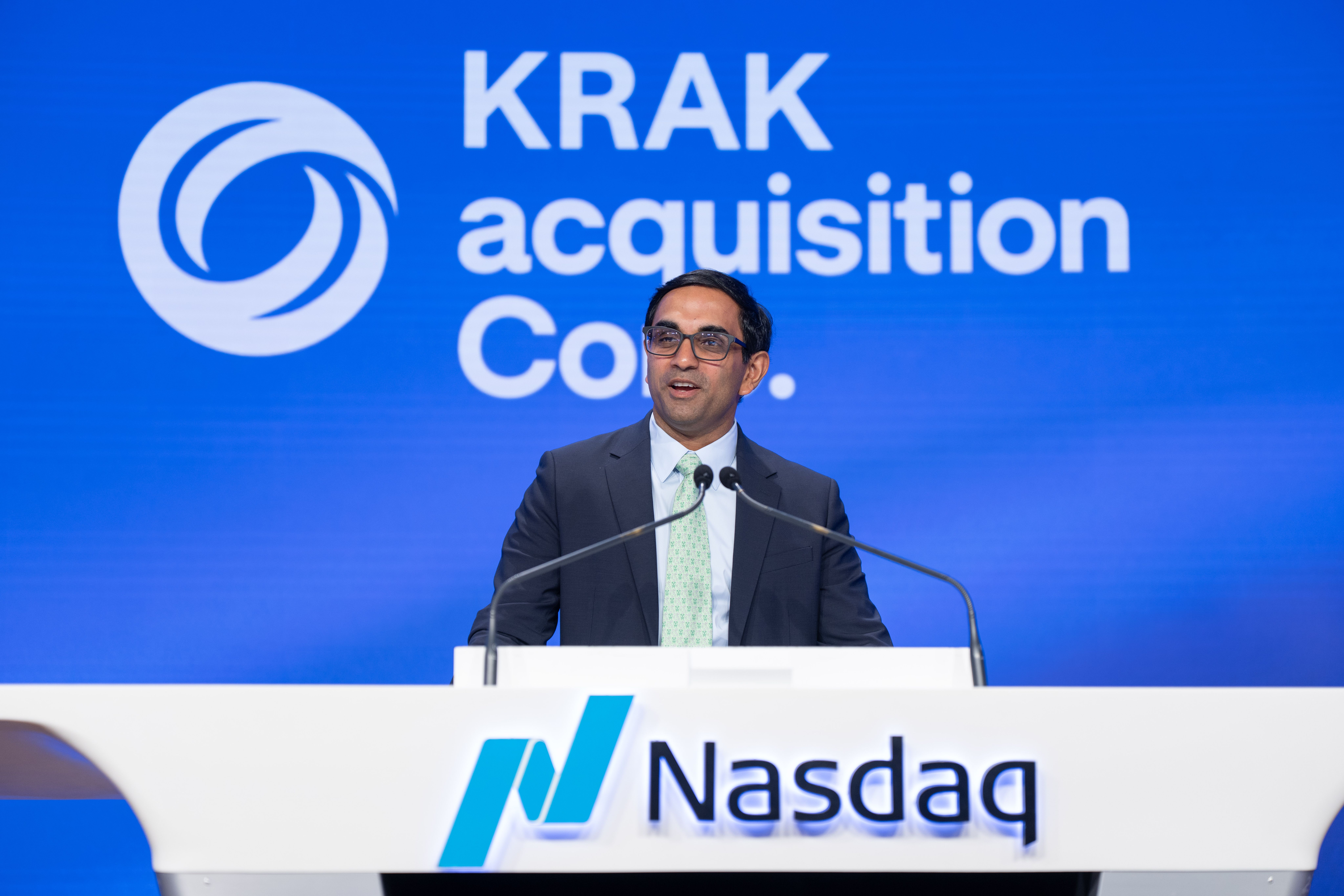
Kraken2026-07-24 04:05:16Kraken-Backed SPAC CEO: Crypto Will Outlast SaaS Under AI OnslaughtRavi Tanuku, CEO of Kraken-backed SPAC KRAQ, said crypto remains a safer investment than SaaS amid AI disruption, with focus on stablecoins, AI agent commerce, and tokenization.190