Standard Char2026-09-12 03:48:08Standard Chartered Starts Coverage on Sky, Sets $0.325 Target for SKY by End-2028Standard Chartered’s head of digital asset research, Geoffrey Kendrick, initiated coverage on Sky, formerly MakerDAO, on Sept. 11 and set a $0.325 price target for SKY by the end of 2028, roughly five times its current $0.065 price. The report frames Sky as a "federal bank for DeFi," arguing that the token’s valuation should be tied to the value returned to SKY holders through staking rewards and buybacks rather than to stablecoin supply alone. The thesis rests on two linked steps. First, Kendrick expects Sky’s reserve buffer, now around $90 million, to reach $150 million in about eight months. If that also equals 1.5% of USDS supply, the amount available for SKY rewards and buybacks could double. Second, the combined borrowing of Sky’s three Agents — Spark, Grove and Obex — is currently about $5.9 billion against a $17.5 billion ceiling. If utilization moves toward that limit with spreads unchanged, protocol revenue could rise another two to three times. The report also highlights the main risks: whether borrowing demand can actually scale to the cap, whether the roughly 3.8% base rate can hold in a more competitive stablecoin market, and whether governance will keep directing surplus revenue to SKY holders after having paused buybacks in March 2026.380
Spark2026-09-11 14:50:50Spark opens its USDT savings vault to OKX users through X LayerSpark has opened its USDT savings vault to OKX users, allowing eligible customers to earn onchain yield on stablecoin balances from inside the OKX app without setting up a wallet or bridging funds themselves. Under the arrangement, OKX aggregates customer deposits and routes them into Spark Savings USDT on X Layer, OKX’s Ethereum Layer 2, while the funds enter the same vault contract used by other X Layer participants rather than a separate exchange-only pool. The vault currently pays 3.5%, according to the rate stored in the contract, while Spark said its total USDT savings stood at about $361 million, with nearly all of that on Ethereum. Governance previously set the X Layer vault’s supply cap at 750 million USDT and its maximum yield at 6%. Spark also disclosed how losses would be absorbed inside the Sky ecosystem and pointed to risk controls tied to X Layer, including a $5 million outbound transaction limit and a 100% capital requirement ratio for the chain buffer until further review. The product is available to eligible OKX users outside the European Union and, according to Spark, excludes countries in the European Economic Area and other jurisdictions restricted by OKX.930
Standard Char2026-09-11 10:57:41Standard Chartered initiates coverage on SKY, sets $0.325 price target for end-2028Standard Chartered has initiated coverage of Sky’s SKY token and set an end-2028 price target of $0.325, compared with the $0.065 reference price cited in the report. The bank said Sky could deliver more than five times the current level of value to token holders by 2028 as USDS adoption rises and lending capacity expands. Geoff Kendrick, the bank’s global head of digital assets research, described Sky — formerly MakerDAO — as a decentralized finance platform that can issue stablecoins, build governance structures and charge borrowers a wholesale rate, making it similar to a “federal bank.” He also said value is returned to SKY holders mainly through staking rewards, while buybacks make up a smaller share. Standard Chartered said Sky is the world’s third-largest stablecoin issuer after Tether and Circle, and the largest issuer of yield-bearing stablecoins. The bank expects SKY to broadly track Ether and outperform Bitcoin through 2028, while its price forecasts for ETH and BTC over the same period stand at $18,000 and $300,000. DeFiLlama data cited in the report showed Sky’s yield-bearing sUSDS token had $4.5 billion in total value locked and a 3.6% annualized yield.1140
Standard Char2026-09-11 11:01:49Standard Chartered starts coverage on SKY with a $0.325 price target for end-2028Standard Chartered has initiated coverage of SKY, the token of Sky, and set a year-end 2028 price target of $0.325. Based on the $0.065 reference price cited in the report, the target implies roughly 5x upside. The bank said the value passed on to token holders could rise to more than five times current levels by 2028 as USDS adoption expands and lending capacity grows. Geoff Kendrick, the bank’s global head of digital assets research, described Sky — formerly MakerDAO — as a decentralized finance platform that can issue a stablecoin, build a governance framework, and charge wholesale rates to borrowers, making it similar to a “federal bank.” The report also said Sky mainly returns value to SKY holders through staking rewards, while token buybacks account for a smaller share. BlockBeats added that Standard Chartered has started coverage on several crypto projects this year, and its call on UNI’s price target has been seen as one of its standout notes.910
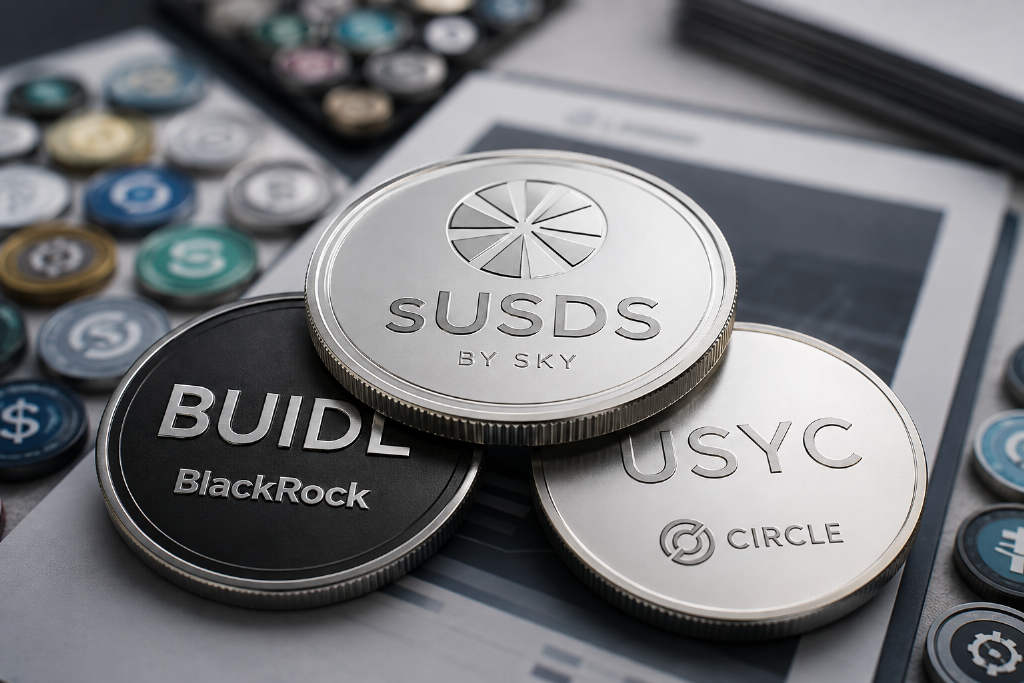
yield-bearing2026-09-03 09:23:59Alea Research: Sky, BlackRock, and Circle Control Half of Yield-Bearing Stablecoin MarketAlea Research reports that Sky, BlackRock, and Circle collectively command half of the yield-bearing stablecoin market. The market comprises 26 products with a total size of $21.43 billion, with the top three — sUSDS (23.8%), BUIDL (16.7%), and USYC (12.7%) — accounting for 53.1% of the share.860
altcoins2026-09-02 03:47:03Altcoins See Modest Rally: FIL Up 14.6%, CRV Rises 9.36% in 24 HoursOn September 2, as Bitcoin and Ethereum retreat amid geopolitical tensions, several altcoins posted modest gains. FIL led with a 14.6% increase, followed by UNI, CRV, PYTH, AR, SKY, and ENA, with 24-hour gains ranging from 6.52% to 14.6%.980
Spark2026-08-03 03:09:17Spark shuts its retail app and pivots to powering yield products for Robinhood and PayPalDeFi lending platform Spark is moving away from the retail-facing playbook that has defined much of the sector. The company has indefinitely shut down its consumer app and is now positioning itself as the yield and liquidity layer behind large fintech brands including Robinhood and PayPal. Spark is part of Sky, formerly MakerDAO, and its lending and liquidity operations are developed by Phoenix Labs. The shift centers on a B2B2C model. Instead of competing head-on for retail users, Spark wants to supply fintech platforms with yield and liquidity infrastructure so those companies can offer stronger returns to their own customers without building the system from scratch. Robinhood’s Earn vault drew $200 million in deposits within 24 days of launch, while Spark’s partnership with PayPal was announced in September 2025. Company figures cited in the report show Spark has about $260 million in OTC loans outstanding and aims to reach $1 billion by year-end. On Uniswap v4, it has moved roughly $150 million into liquidity pools, accounting for about 30% of stablecoin trading volume on the platform. At the same time, Spark’s revenue has fallen from about $80 million during the bull market to around $20 million now.1840
Spark2026-08-03 03:04:43Spark Drops Consumer App Plan to Build Stablecoin Infrastructure Behind the ScenesSpark, the lending and liquidity arm tied to Sky, formerly MakerDAO, has shelved its consumer app indefinitely and is now focusing on business-facing stablecoin infrastructure. CEO Sam MacPherson told CoinDesk that the stablecoin market is heading toward deeper fragmentation, with issuers and platforms spreading liquidity across more tokens and networks. Spark’s bet is that this trend creates demand for an intermediary layer that moves liquidity between those systems. Two products are being used to make that case. Robinhood Earn, which offers roughly 7% APY on USDG deposits, drew more than $200 million in 24 days through an on-chain vault structure involving Morpho, Steakhouse Financial, Ethena, Maple and Spark. On Uniswap v4, Spark said its stablecoin foreign-exchange layer handled about $1.5 billion over 30 days and accounted for around 30% of stablecoin-to-stablecoin swap volume after deploying roughly $150 million into USDS-USDT and USDS-PYUSD pools. Spark is pushing this strategy during a weaker DeFi market, with annual revenue down from about $80 million in the bull market to roughly $20 million now. MacPherson also said on-chain payments could reach $3 trillion by 2030, citing expected regulatory developments including the GENIUS Act and the possible advance of the Clarity Act.1940