Sky

Crypto Market
2026-08-03 03:02:22

Crypto market posts third straight quarterly drop as capital exits in an orderly retreat

CoinGecko’s crypto industry report for the second quarter of 2026 points to a broad, coordinated slowdown across the market rather than a single-point shock. Total crypto market capitalization fell 12.6% in the quarter, dropping from $2.4 trillion to $2.1 trillion, the lowest level since September 2024 and roughly 52% below the peak recorded in October 2025. It was the third consecutive quarterly decline. TechFlowPost highlighted three main signs of outflows. Stablecoin market capitalization slipped 1.6% to $305.1 billion, the first quarterly contraction since the third quarter of 2023, while trading activity also weakened sharply: spot volume on centralized exchanges fell 27.9% to $1.95 trillion and DeFi total value locked dropped 23.4%. Ethereum was hit especially hard, with TVL down 28.7% after the KelpDAO exploit. Bitcoin and Ether also lagged behind the rebound in U.S. equities during the quarter, with BTC down 14.2% and ETH down 25.4%. At the same time, a few corners of the market still expanded, including prediction markets, Hyperliquid’s HYPE token, and tokenized collectibles. Even after Bitcoin rebounded in July, the report said ETF inflows had not returned at scale and long-term holder accumulation had slowed, leaving the broader downtrend unresolved.

111670
Crypto market posts third straight quarterly drop as capital exits in an orderly retreat
Castle Labs
2026-07-30 03:33:26

Why token prices still lag even as top crypto protocols post strong revenue

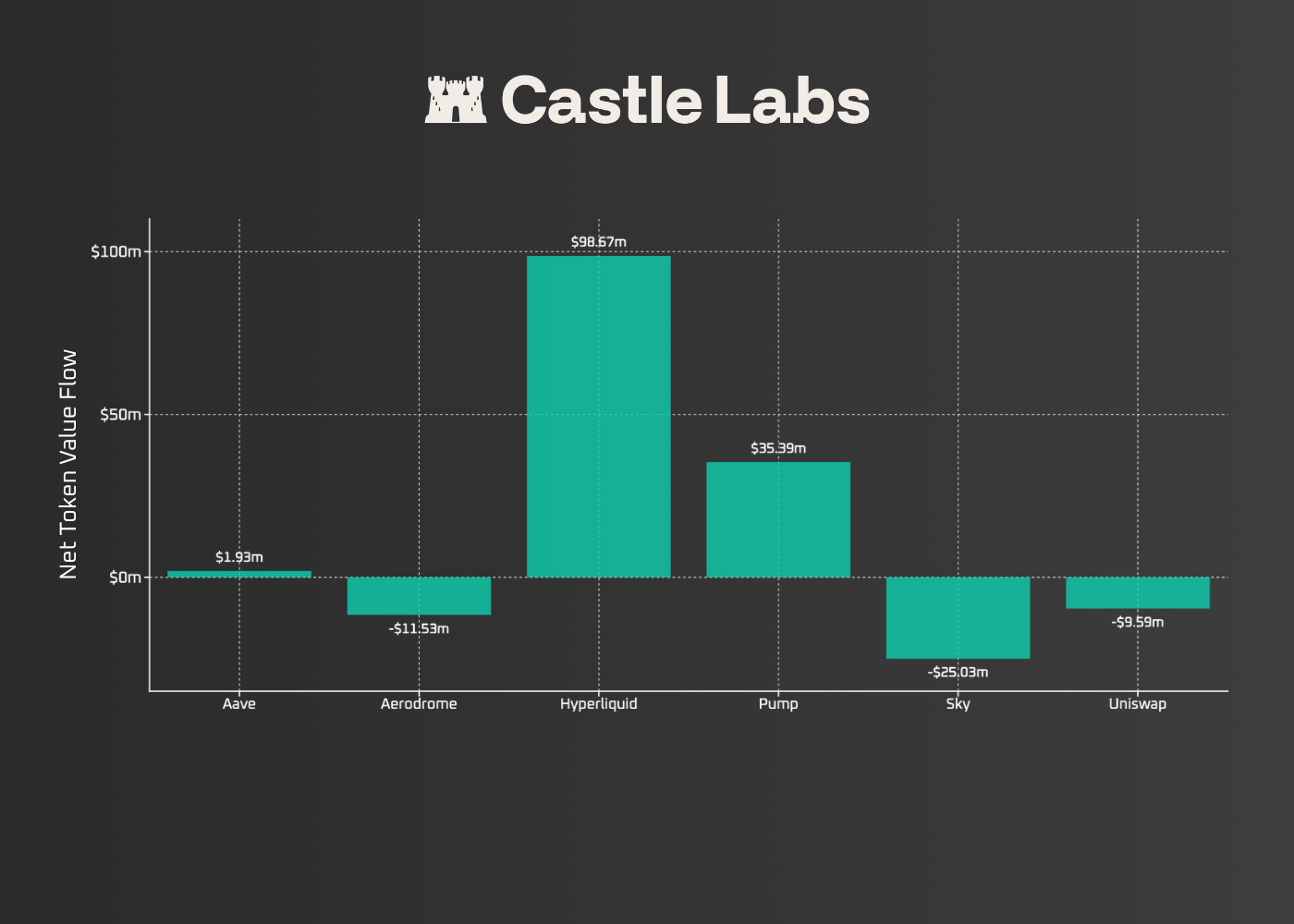
A new analysis from Castle Labs argues that strong protocol revenue alone has not been enough to lift many crypto tokens, because the real driver for holders is the link — or lack of link — between revenue, distribution and token supply expansion. The report reviews six major protocols, Aave, Aerodrome, Hyperliquid, Pump, Sky and Uniswap, which together generated $726 million in revenue in the first half of 2026. Even so, many of their tokens failed to match the strength of the underlying businesses. Castle Labs says investors are now asking harder questions than they did in earlier market cycles: How durable is a protocol’s revenue? How much of that revenue reaches token holders? How much value is offset by inflation, unlocks and incentives? And do equity holders capture economics that token holders do not? The report points to examples across buybacks, burns, fee-sharing and ve-token models, while also showing how fast unlock schedules, treasury discretion and weak value capture can overwhelm otherwise healthy revenue. Its core conclusion is plain: a good protocol does not automatically make a good token.

740
Why token prices still lag even as top crypto protocols post strong revenue
Fake World As
2026-07-28 16:09:40

Fake World Assets ranks second on Ethereum revenue after brief lead over Collector Crypt

Ethereum NFT gacha protocol Fake World Assets briefly moved ahead of Solana-based Collector Crypt in daily revenue after its July 20 relaunch, according to DefiLlama data cited by The Defiant. The protocol, built by the two-person team Token Works, posted $447,604 in revenue on July 25, its highest day so far, while total fees reached $1.6 million that day. Over the first four days after relaunch, it processed roughly 2,000 ETH in volume across about 90,000 transactions, including around 35,000 individual pulls. The lead did not last. In the most recent 24-hour window referenced in the report, Collector Crypt returned to the top with $270,186 in revenue, versus $167,869 for Fake World Assets. Even so, Fake World Assets remained the second-highest revenue-generating protocol on Ethereum, behind Sky at $464,303 and ahead of Aave, Uniswap, Lido, and even the amount of ETH burned by the network over the same period. The report also outlined the protocol’s mechanics, including ETH-backed NFT deposits, randomized pulls using Chainlink VRF, an 85% buyback option, and a 15-day token emission schedule for purchasers and depositors. It contrasted that early traction with Collector Crypt’s much larger June figures, including more than $209 million spent on packs and over $50 million in cumulative revenue by mid-June.

960
Fake World Assets ranks second on Ethereum revenue after brief lead over Collector Crypt
US stocks
2026-07-28 03:57:00

Semiconductor and memory stocks drag on Nasdaq as Apple retakes the top market-cap spot

U.S. stocks split on Monday as weakness in semiconductors, memory names and optical networking shares weighed on the Nasdaq, while the Dow edged higher. Oil fell after Donald Trump said the U.S. had paused strikes on Iran to leave room for talks, easing immediate fears around a wider Middle East disruption. That also helped pull the 10-year Treasury yield down to 4.63%, even as markets kept their attention on this week’s Federal Reserve meeting and the possibility, however contested, of a surprise 25-basis-point rate hike. Trading within the AI complex showed a sharper divide. Investors favored software and lighter-capex companies such as Shopify, Palantir, SAP, ServiceNow, Salesforce and Adobe, while AI hardware names came under broad pressure. UBS said credit markets are re-pricing the long-term monetization risk tied to AI capital spending, with projected combined fiscal 2026 capex by Alphabet, Amazon, Microsoft, Meta, Oracle and CoreWeave reaching about $849 billion and potentially topping $1 trillion in 2027. China-related developments added to the pressure. ChangXin Technology surged more than 465% in its market debut, pushing investors to reassess the long-term DRAM supply picture, while a report from The Information said a Chinese company has started small-batch production of immersion DUV lithography machines. Apple rose 1.17% and overtook Nvidia as the world’s most valuable listed company for the first time since April 2025, while Nvidia, SanDisk, SK Hynix and ASML all posted notable declines.

760
Semiconductor and memory stocks drag on Nasdaq as Apple retakes the top market-cap spot
HTX Research
2026-07-27 09:05:30

HTX Research says RWA and DeFi are moving into the next phase of programmable finance

HTX Research argues in a new report that the tokenized real-world asset, or RWA, market has moved past basic proof of concept and is now being judged on whether on-chain assets can actually be used inside financial systems. The report says the non-stablecoin tokenized asset market grew from under $3 billion in mid-2024 to more than $30 billion in April 2026 before stabilizing around $34 billion in the second quarter of 2026. In its view, that rise shows that traditional assets can be issued, settled and managed on-chain, but it does not yet prove large-scale financialization. The report pairs that argument with a similar shift in decentralized finance. HTX Research says DeFi is moving away from valuation frameworks centered on TVL and headline scale, and toward models based on revenue quality, risk costs, treasury allocation and how value is transmitted to tokens. It uses Aave as a case study, describing the lending protocol as a key meeting point between stablecoins, tokenized collateral and on-chain credit markets. HTX Research also says stablecoins, RWA products and DeFi protocols are forming a three-layer structure for on-chain finance: stablecoins as the cash leg, tokenized assets as collateral and yield-bearing instruments, and DeFi protocols as the layer for trading, lending, leverage and risk transfer. The report closes by tying these themes to HTX’s own products, including Earn, Structured Products, On-chain Earn and margin-based coin exchange, which it says translate institutional narratives into products retail users can actually use.

210
HTX Research says RWA and DeFi are moving into the next phase of programmable finance
TRON
2026-07-27 08:01:41

USDD supply on TRON rose by about $145 million over the past week

Data compiled by CertiK Skynet shows that USDD supply on the TRON network increased by about $145 million over the past week, pushing the total on-chain supply on TRON above $1.23 billion. That figure now accounts for roughly 81.6% of USDD’s total circulating supply across all networks. As of now, USDD’s total supply stands at $1.55 billion, while its total value locked has exceeded $2.33 billion. The update also points to stronger liquidity activity across the TRON ecosystem during the recent TRON DeFi Summer campaign. Within that trend, USDD’s TVL on JustLend has climbed past $450 million. USDD’s official Chinese account said the token’s growth on TRON remains strong. The latest increase was also described as reinforcing USDD’s position within the TRON ecosystem and among leading stablecoins.

720
USDD supply on TRON rose by about $145 million over the past week
Stablecoins
2026-07-26 04:40:11

Crystal Foresight says stablecoin supply fell by $11.5 billion in 90 days after May peak

A new Crystal Foresight report says the stablecoin market contracted for the first time in nearly three years after reaching a record level close to $320 billion in May 2026. By July 14, total supply had dropped to $306.5 billion, down $11.5 billion over 90 days, or 3.6%. The report argues this was not a case of tokens moving between wallets or chains, and not a depeg event, but real redemption-driven destruction that sent dollars back off-chain. The decline was also highly concentrated. USDC, USDe, USDS, USDT and PYUSD accounted for nearly all of the drop, while each token fell for a different reason. Crystal Foresight links USDe and USDS weakness to lower yields, USDC weakness to softer DeFi collateral demand, and USDT’s small decline to strategic positioning outside MiCA and the GENIUS Act framework. PYUSD, meanwhile, was described as vulnerable to incentive changes. The report also separates gold-backed tokens from dollar stablecoins, saying the roughly $900 million decline in PAXG and XAUt reflected a pullback in gold prices rather than changes in stablecoin adoption. On the growth side, USDG, USD1, DAI and RLUSD expanded through subsidies, distribution, or infrastructure channels, though Crystal Foresight said not all of that growth should be read as organic demand.

300
Crystal Foresight says stablecoin supply fell by $11.5 billion in 90 days after May peak