Polymarket2026-09-08 15:08:12Polymarket rolls out Squads, merging group chats with prediction market tradingPolymarket said it is launching a new social feature called Squads for the U.S. version of its app, adding private group functionality to its prediction market platform. The feature lets users create invite-only groups where they can discuss markets with friends, share positions and portfolios, and place trades around events they are watching together. Members can also see other participants’ trading activity and follow trades directly from shared positions or portfolios. Polymarket said each person will still execute trades independently through their own account. The company described Squads as an effort to bring market discussion and trading activity that would usually happen in separate group chats onto a single platform. The launch is being paired with “Polymarket HQ,” the company’s first football season marketing campaign, directed by Peter Berg and featuring LeBron James, Eli Manning, Derek Jeter and Spike Lee. Before this, Polymarket had already introduced Polymarket Perps, which supports trading on the price movements of cryptocurrencies, stocks, commodities and indexes, according to PRNewswire.670
Fomo2026-09-07 08:50:21Fomo posts $1.76 million in daily revenue, topping Pump.fun for the first timeFomo, a social trading platform on Solana, generated $1.76 million in revenue on Friday, overtaking meme coin launchpad Pump.fun’s $1.10 million for the day, according to DefiLlama data. It marks the first time Fomo has moved ahead of Pump.fun on a single-day basis. Over a longer stretch, though, Pump.fun remains well in front: the platform brought in more than $57 million over the past 30 days, versus $17.6 million for Fomo. The report says Fomo’s recent revenue acceleration came alongside a broader product push this year. In June, the company raised $75 million in a Series B led by Index Ventures at a $550 million valuation. It also rolled out Apple Pay crypto purchases, which the article says were used by more than 68,000 first-time buyers for roughly $25 million in volume, and launched perpetual futures for non-U.S. users through a partnership with Hyperliquid on June 11. Fomo also said it has paid users more than $2 million in referral rewards. The article frames the comparison as a clash between two revenue models on Solana: meme coin issuance and trading fees on one side, and social trading, copy trading, and integrated trading tools on the other.800
Fomo2026-09-07 07:45:39Fomo tops Pump.fun in daily revenue on Solana, but trails over 30 daysSocial trading app Fomo posted higher daily revenue than Pump.fun on Friday, according to DefiLlama, marking a short-term lead over one of Solana’s best-known memecoin launchpads. Fomo generated $1.76 million for the day, compared with $1.1 million for Pump.fun. The gap flips over longer periods: in the past 30 days, Pump.fun brought in more than $57 million, while Fomo recorded $17.6 million. Fomo blends crypto trading with social features that resemble a social media feed, letting users view other users’ trades. The company has also been expanding quickly this year. In June, it closed a $75 million Series B led by Index Ventures at a $550 million valuation. It also said more than 68,000 users made their first crypto purchase on the app through Apple Pay, representing about $25 million in transaction volume. Beyond spot trading, Fomo launched perpetual futures powered by Hyperliquid on June 11 for users outside the US. Earlier, on June 2, the company said it had paid users more than $2 million in referral fees.180
Gate2026-09-07 07:57:48Gate Launches 'Da Jin Gou' Meme Trading Zone with Zero Gas Fees on Robinhood ChainGate has launched a one-stop on-chain trading product called 'Da Jin Gou' that aggregates meme assets across multiple blockchains. It charges a flat 0.5% fee and offers zero gas fees on Robinhood Chain for a limited time. Users can trade directly from their Gate account without a wallet, search by token name or contract address, and access social features like callout rankings, lowering the barrier for on-chain meme trading.1020
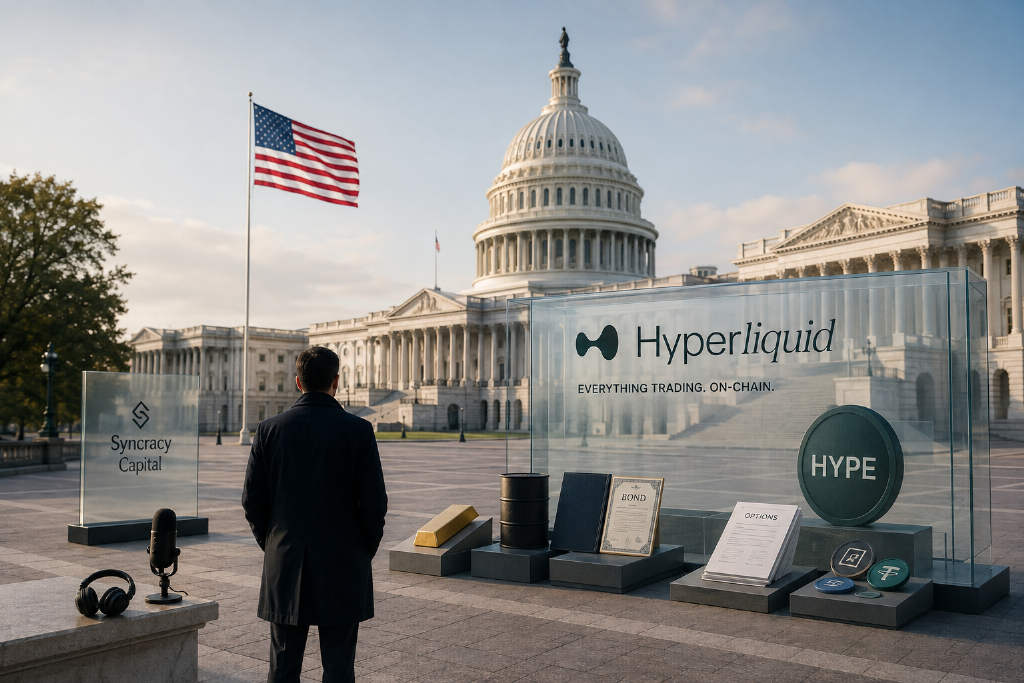
Hyperliquid2026-09-07 06:39:00Syncracy Capital co-founder says HYPE rally is only the start as Hyperliquid pushes toward an onchain market for everythingRyan Watkin, co-founder of Syncracy Capital, used a recent appearance on The Rollup to lay out why he believes Hyperliquid and its token HYPE are still in the early innings. He said one of the biggest overhangs on the project had long been the question of U.S. regulation: strong growth was visible, but investors kept asking what would happen if access to the American market were constrained. In his view, that concern has started to ease after political attention turned directly to Hyperliquid and after Stars-related features had already appeared on public testnet months earlier. Watkin retraced Syncracy’s early thesis, pointing to Hyperliquid’s roughly $3 billion valuation at launch, about $200 million in annualized revenue, and a token acquisition path that required users to bridge funds onto the platform itself. He said the more important benchmark was never just share against onchain rivals, but share captured from centralized exchanges such as BN, Coinbase and Bybit, with the longer-term target extending even to incumbent financial venues like CME. He also argued that Hyperliquid’s roadmap now points beyond perpetuals. With portfolio margin, spot markets, HIP-3 and regulated frameworks around HIP-3 and HIP-4, he described the platform as moving toward a unified venue where users can post mainstream assets as collateral and trade a wide range of financial products on a single permissionless ledger.780
Hyperliquid2026-09-07 06:41:08Syncracy Capital co-founder says HYPE’s rally is only the start as Hyperliquid pushes toward an onchain market for everythingRyan Watkin, co-founder of Syncracy Capital, used a long-form appearance on The Rollup to lay out why he still sees Hyperliquid and HYPE in the early innings, even after a sharp run-up that followed Donald Trump’s public mention of the project. Watkin said HYPE moved from about $59 to near $70 while he was on a call with co-founder Dan, before the team realized the move had coincided with Trump referencing Hyperliquid on live television. He argued that the larger story is not a one-off price spike, but the removal of what many investors had treated as the platform’s biggest overhang: uncertainty around U.S. regulatory access. Watkin walked through how his thesis evolved from a relatively simple valuation case — roughly a $3 billion valuation against about $200 million in annualized revenue — into a broader bet on Hyperliquid becoming a permissionless venue where users can post nearly any major asset as collateral and trade nearly any financial instrument. He said the indicators that matter most are share gains against Binance, Coinbase and Bybit, penetration into global CFD, futures and options volume, growth in net protocol income, and trends in net deposits and average onchain account equity. He also argued that crypto investing is splitting between cash-flow-producing onchain businesses and winner-take-most stores of value, while transparent ledgers and creator incentives are turning social trading into a native product category rather than a passing speculative fad.810
Hyperliquid2026-09-07 03:04:13Ryan Watkins says Hyperliquid is evolving toward an exchange for everythingIn a wide-ranging interview published by TechFlowPost and sourced from The Rollup, Ryan Watkins laid out why he sees Hyperliquid as more than a successful on-chain perpetuals venue. He described it as an early version of an “exchange for everything,” built around a permissionless ledger, cross-asset collateral, expanding product lines, and a path into the U.S. market through HIP-3 and related compliance structures. Watkins recalled the moment HYPE surged from about $59 to near $70 after Donald Trump mentioned Hyperliquid on live television, saying the team only realized the trigger after the move was already underway. He argued that the project’s key question had long been U.S. regulatory access, and that the market is now beginning to reassess Hyperliquid with that overhang easing. He also discussed the metrics he watches most closely, including share gains against major centralized exchanges, penetration into global CFD, futures and options flow, net revenue growth, deposits, and average on-chain account equity. Beyond Hyperliquid, Watkins addressed barbell portfolio construction, the divide between cash-flow-generating crypto businesses and store-of-value assets, the relative position of Bitcoin and Zcash, and why social trading and creator incentives may become a major commercial layer of on-chain finance.780
Syncracy Capi2026-09-06 05:22:10Syncracy Capital co-founder says this crypto bull market could be the biggest on recordRyan, co-founder of Syncracy Capital, laid out a long-form case for why he believes the current digital-asset cycle could become the largest bull market the industry has seen. In a conversation published by The Rollup and translated by Baihua Blockchain, Ryan said Hyperliquid has moved well beyond the market’s early framing of it as just an on-chain perpetuals venue. In his view, the project is building toward a broader "exchange everything" model, with U.S. market access, compliance rails, spot markets, portfolio margin, and HIP-3 and HIP-4 infrastructure all expanding its addressable market. Ryan said one of the biggest historical overhangs for Hyperliquid had been uncertainty around U.S. regulation. He argued that this obstacle is now easing, pointing to the strategic significance of the U.S. as the world’s deepest capital and liquidity center. He also revisited the original investment case: a roughly $3 billion valuation against about $200 million in annualized revenue, limited token float outside airdrop recipients, and a user-acquisition design that required would-be buyers to bridge assets onto the platform itself. Beyond Hyperliquid, Ryan contrasted cash-flow-generating on-chain businesses with store-of-value assets such as Bitcoin and gold, arguing that crypto valuation is shifting toward real economic output. He also described social trading as a native on-chain product category rather than a passing speculative fad, saying transparent ledgers, verifiable PnL, and creator incentives are reshaping how financial influence and reputation are built online.840