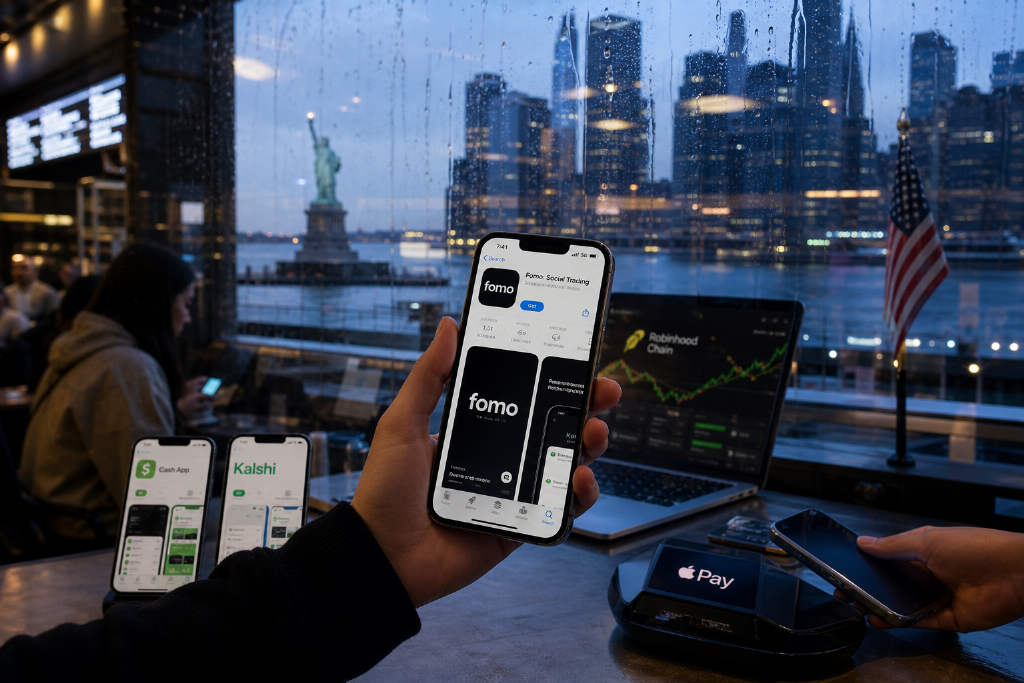
Fomo2026-08-31 11:34:32Fomo breaks into top five U.S. finance apps, briefly overtaking Cash App and KalshiFomo, a social crypto trading app built for Robinhood Chain and other networks, entered the top five finance apps in the U.S. on Aug. 21 and at one point climbed to No. 3, ahead of Cash App and prediction market platform Kalshi. The app is now ranked within the top 15. Founded by Paul Erlanger and Se Yong Park, Fomo launched its public beta in May 2025. The company later raised $17 million in a Series A round in November 2025, led by Benchmark with participation from 140 angel investors, and then completed a $75 million Series B. Its disclosed equity financing totals about $94 million. Fomo supports Solana, Base, BNB Chain, Monad and Robinhood Chain. Users can view real-time trades from accounts they follow, track leaderboards, and copy trading signals. The app also allows instant deposits through Apple Pay. According to Bitcoin.com News, Fomo has recorded more than 1 million cumulative installs on Google Play, over 600,000 users, and more than $4 billion in trading volume.720
Fomo2026-08-31 11:43:28Fomo breaks into top U.S. finance app rankings, with disclosed equity funding nearing $94 millionFomo, a social crypto trading app built for Robinhood Chain and other networks, entered the top five finance apps in the U.S. on Aug. 21, according to Bitcoin.com. The app briefly climbed to No. 3, ahead of Cash App and prediction market Kalshi, and is now ranked within the top 15. Founded by Paul Erlanger and Se Yong Park, Fomo launched its public beta in May 2025. The company later raised $17 million in a Series A round in November 2025, led by Benchmark with participation from 140 angel investors. It then completed a $75 million Series B round, bringing its disclosed equity financing to about $94 million. Fomo supports Solana, Base, BNB Chain, Monad and Robinhood Chain. Users can view real-time trades from accounts they follow, track leaderboards and copy trading signals. The app also allows instant deposits through Apple Pay. Bitcoin.com said Fomo has surpassed 1 million installs on Google Play, with more than 600,000 users and over $4 billion in trading volume.710
DWF Ventures2026-08-28 13:23:27DWF Ventures says social trading is gaining ground as platform competition shifts beyond executionDWF Ventures said in a report released on Aug. 28 that social trading is becoming a new battleground for financial trading platforms as trading fees continue to move closer to zero. The report traces the model’s development from early broker copy-trading products to investor communities such as Reddit and Stocktwits, and then to newer platforms that combine verified positions, trading signals, and social graphs. According to the report, as trade execution becomes increasingly commoditized, future platform advantages may come less from the transaction itself and more from network effects, access to well-known traders, and control over exclusive information and distribution. DWF Ventures said leading platforms are building a growth flywheel in which star traders attract followers, public trades build reputation, and follower activity amplifies both trader influence and user growth. The report also flags structural risks. It cites data from Fomo showing that of about 292,000 wallets analyzed over the past three months, only 6.16% were profitable based on realized gains. DWF Ventures added that herd behavior, conflicts of interest between traders and followers, and undisclosed positions held through other wallets remain key challenges for the sector.750
Vector2026-08-27 07:30:57Former Vector executive says Fomo found the larger social trading market outside crypto-native usersPhil Jacobson, a former executive at Vector and now chief business officer at Altitude, used Fomo’s rise to revisit the path Vector took before it was sold to Coinbase at the end of 2025. In his account, Vector was built as a mobile social trading app for onchain assets, reached daily volume above $20 million, and generated about $1 billion in cumulative trading volume. Early retention, he wrote, looked more like a strong social app than a trading product. Jacobson argues that Vector correctly identified social trading as the larger opportunity, but eventually focused on the professional trader segment because a small share of users drove most of the volume. He said about 5% of Vector users accounted for roughly 95% of trading activity, which pushed the team toward a desktop product aimed at high-frequency, multi-screen traders. That strategy, in his view, was rational, though the desktop product never launched publicly. What stands out to him about Fomo is a different market choice. Rather than fighting for the same mature onchain traders, Fomo targeted users from channels such as TikTok and Instagram and brought many of them into their first onchain trades. Jacobson said that move showed a much larger consumer market existed beyond the industry’s usual audience. He added that Fomo’s recent daily spot volume has exceeded $100 million, reinforcing his view that social trading can become a far bigger onchain distribution layer as more assets move onto blockchain rails.400
Market Analys2026-08-27 07:08:10Phil Jacobson on Vector, fomo, and why a similar crypto trading idea scaled much furtherPhil Jacobson, writing about his experience building Vector, said the mobile social trading app for onchain assets once grew from zero to more than $20 million in peak daily volume and about $1 billion in cumulative trading volume before the company was sold to Coinbase at the end of 2025. Looking back, he said Vector found strong product-market fit early, with retention that resembled a social network more than a standard trading app, but later shifted its focus toward professional traders because that segment generated the vast majority of volume. In Jacobson’s account, that is where fomo took a different turn. Instead of competing mainly for veteran onchain traders, fomo went after users outside Crypto Twitter, including people who had never traded onchain before. He argued that the company paired distribution with a product experience tailored to that audience and, in doing so, opened a much larger market. Jacobson said fomo has recently pushed daily trading volume above $100 million. The broader takeaway, in his view, is that social trading is not limited to meme coins. As more assets move onchain, he expects the social layer around trading, trust, and execution to matter across crypto, prediction markets, stocks, options, and real-world assets.920
Fomo2026-08-16 04:02:28Fomo Raises $94 Million in a Bear Market as Social Trading Turns Into an On-Chain Entry PointFomo, a social trading startup built for on-chain users, has emerged as one of the faster-growing crypto consumer products during a weak market cycle. According to figures cited from Dune, the platform had processed about 28.644 million trades, more than $4.69 billion in cumulative volume, and over $31.79 million in fees as of Aug. 12. Its sharpest growth came in late Q2 2026 and accelerated in July, when weekly volume climbed from the millions into the hundreds of millions, with the latest week topping $550 million. The report ties much of that surge to the launch of Robinhood Chain’s mainnet, which brought a wave of new traffic. Fomo co-founder Se Yong Park said one in every two active wallets on Robinhood Chain came from Fomo. At one point, the chain accounted for 64.8% of Fomo’s volume, while Dune data showed Fomo represented 35% of trading bot volume on Robinhood Chain and more than 92.9% of the chain’s daily active wallets. More recently, Solana regained the top spot, contributing about 51.2% of trading volume. Fomo’s founders came from dYdX and built the product around lower-friction onboarding, dollar-denominated balances, and social discovery features designed to make trading feel like content. The company, which the report said has a team of about 17 people, completed a $75 million Series B in June led by Index Ventures at a $550 million valuation.1490
fomo2026-08-14 10:19:28fomo co-founder Se Yong says platform has 1.3 million users and is betting on mobile social tradingfomo co-founder Se Yong said in an Aug. 12 interview that the social meme trading platform has reached about 1.3 million users and is adding roughly 30,000 new users a day. He said the company is not trying to become a traditional pro-grade meme trading terminal. Instead, it wants to simplify cross-chain trading, make trust visible through public rankings, and turn trading into a social product that can reach users beyond crypto-native circles. In the interview, Se Yong also described how he first entered crypto through trading on Avalanche in 2021, how painful cross-chain flows on Base helped shape the product idea behind fomo, and why he sees mobile trading and social trading as the two core directions for the platform. He said the team wants users to think less about whether funds sit on SOL, ETH, or BNB and more about having a single usable balance. Se Yong added that fomo recently launched Clans, a new social feature that lets users join groups, view holdings, and compete on public leaderboards. Over time, he said, the feature could expand into internal chat, recruiting, subscriptions, shared treasuries, and even public clan addresses for airdrops. On competition, he said rival products are healthy and that fomo’s goal is to grow the overall market rather than protect a narrow slice of existing crypto users.1500
FOMO2026-08-13 12:21:00FOMO co-founder Se Yong says traders are becoming the next generation of internet celebritiesFOMO co-founder Se Yong used a 43-minute interview with host Maurits to lay out what the mobile social trading app is trying to build, why it took longer than outsiders think to find product-market fit, and why he believes public trading records can turn traders into public figures. He said FOMO has grown to more than 1.3 million users in 18 months, is adding about 30,000 users a day recently, generated more than $2 million in fees this week, and is now valued at $550 million. Se Yong described FOMO not as another crypto terminal but as “a trading app for the rest of us,” built around a broader ambition to become the social graph of finance. He linked that vision to a product design philosophy centered on trust, simple cash-denominated balances, fast cross-chain execution, and social transparency through leaderboards and public P&L. The interview also covered his own trading background, the missed Base memecoin trade that helped spark the idea for FOMO, his list of top traders and creators, the early beta rollout of Clans, and his view that crypto onboarding is shifting away from Crypto Twitter toward TikTok, Instagram, and word of mouth. Across the conversation, Se Yong returned to the same point: users, influence, and public transparency matter more to FOMO than status metrics alone.12730