StarkWare2026-09-26 16:54:17StarkWare challenge cuts estimate for quantum-safe Bitcoin compute by 79%TheDefiant reported that an AI-assisted challenge run by StarkWare reduced an estimate tied to quantum-safe Bitcoin computation by 79%. The report drew a clear line around what the result does and does not cover. It said the contest focused on offchain GPU work rather than Bitcoin transaction fees, meaning the revised estimate applies to a computing task outside the fee market on the Bitcoin network. The article also noted that the method remains experimental and still requires a direct path to a miner, which leaves an important practical condition attached to the approach. Beyond those points, the source did not provide additional technical details in the supplied text. The publication also stated that its articles are stored on Filecoin.290
Bitcoin2026-09-27 15:01:03Bitcoin’s quantum risk is drawing fresh attention as researchers push three lines of defenseBitcoin’s long-discussed quantum vulnerability returned to the spotlight this week as three separate developments landed at once: a drop in the estimated cost of building quantum-resistant Bitcoin transactions, a renewed focus on protocol-level post-quantum upgrades, and a custody framework from Coinbase aimed at adapting to whatever signature standard Bitcoin may eventually choose. The core concern is unchanged. Bitcoin wallets rely on elliptic-curve cryptography, and a sufficiently powerful quantum computer running Shor’s algorithm could theoretically recover a private key from an exposed public key, forge signatures, and empty a wallet. No such machine exists today, and the industry’s so-called “Q-Day” remains hypothetical, but timelines are widely debated and many observers see the window for preparation narrowing. StarkWare said an open competition, with AI models leading the leaderboard, cut the estimated cost of a quantum-safe Bitcoin transaction from about $320 to roughly $67 in one week, though the company said the method is only a workaround. Decrypt’s report said the week’s developments did not make Bitcoin quantum-safe on their own. What they did show was a shift from theory toward implementation, with researchers and companies now testing how cheaply defenses can be built and how quickly the threat may be approaching.320
Bitcoin2026-09-26 15:01:05Quantum-safe Bitcoin transaction costs drop nearly 80% in a week as AI-led coders push optimizationThe estimated cost of building a quantum-resistant Bitcoin transaction fell from about $320 to roughly $67 in GPU compute within a week, according to StarkWare, which ran the Quantum-Safe Bitcoin Optimization Challenge with Yukon Research and Eigen Labs. The figure comes from the contest dashboard and reflects stated hardware assumptions rather than a market price. StarkWare said the first quantum-safe Bitcoin transaction was mined on mainnet last month. That initial construction took roughly 3,100 GPU-hours and cost around $320 to build. The biggest expense sits in a brute-force search performed on a user’s own hardware before the transaction reaches the blockchain, so the burden appears as GPU compute rather than a Bitcoin network fee. Contest participants improved performance sharply. One benchmark rose from 146 million verified candidates per second to more than 820 million per second on a standard RTX 4090, with 62 promoted improvements across two tracks. StarkWare said the top records were held by developers running AI models, led by Anthropic’s Opus 5 and Fable 5.1, with OpenAI’s GPT-6 Astra, Grok 4.6, and Kimi close behind. The company also cautioned that the work does not make Bitcoin quantum-safe by itself. These transactions remain nonstandard, must be sent directly to a miner, and only protect coins whose public key has not already been exposed. StarkWare said a soft fork remains the better long-term fix.380
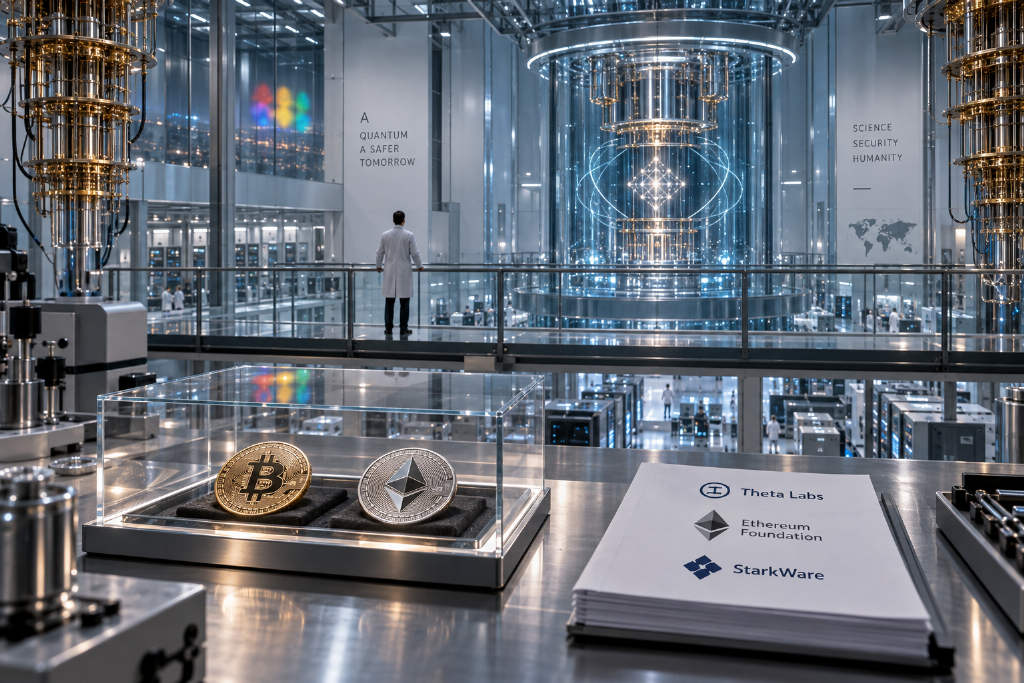
Bitcoin2026-09-12 08:25:34Researchers Cut Quantum Attack Estimate for BTC and ETH to Below Google’s March BaselineA research group involving the Ethereum Foundation, Theta Labs, and StarkWare has lowered the resource estimate for a key step in a quantum attack on Bitcoin and Ethereum, pushing the figure to below the baseline published by Google Quantum AI in March. The work emerged from the open ECDSA.Fail challenge and focuses on optimizing elliptic curve point addition inside Shor’s algorithm, the quantum algorithm widely associated with breaking elliptic curve cryptography such as secp256k1. According to the paper obtained by CoinDesk, one circuit design uses 1,151 logical qubits and about 1.3 million Toffoli gates. The team combined those metrics into a score of roughly 1.5 billion, down from Google’s 3 billion benchmark. A second version, closer to the way Shor’s algorithm would run in practice, scored about 1.96 billion. The paper also notes that the accounting methods are not identical, which limits direct comparisons, though the gap remains large. The authors stressed that no existing quantum computer can break Bitcoin or Ethereum today. Still, lead author and Theta Labs co-founder and CTO Jieyi Long said the issue is urgent because protocol-level fixes take years and cannot protect addresses whose public keys have already been exposed.920
Quantum Compu2026-09-11 10:45:56Open challenge cuts estimated cost of a key quantum attack step on Bitcoin and EthereumA public optimization challenge focused on one building block of a quantum attack on Bitcoin and Ethereum produced a secp256k1 point-addition circuit with a much lower reported cost than earlier public figures. A paper posted to arXiv on Thursday said the design requires 1,151 logical qubits and about 1.30 million Toffoli gates. Using a spacetime benchmark that multiplies qubits by gates, the score dropped 86% over roughly two months of submissions, from 10.75 billion to about 1.496 billion. The paper said that level is more than 50% below the result Google Quantum AI reported in March. At the same time, co-author Jieyi Long, chief technology officer at Theta Technology, said the challenge outcome should not be treated as strictly better than Google’s because the two efforts use different interfaces and accounting conventions. The work does not amount to a live attack, and the authors stressed that cheaper circuits do not create the fault-tolerant quantum computer needed to run Shor’s algorithm. Still, the paper narrows the margin for exposed holders. Coinbase’s quantum advisory board estimated in June that about 7 million BTC are held in addresses with visible public keys, while the Ethereum Foundation has set December 2029 as its deadline for post-quantum security across execution, consensus, and data layers.1080
Ethereum Foun2026-09-10 13:41:47Researchers say AI-assisted optimization cuts quantum attack resources for BTC and ETH by more than 50%Researchers from the Ethereum Foundation, Theta Labs and StarkWare have released a paper saying AI coding agents were used to deeply optimize core operations in Shor’s algorithm, cutting the computing resources needed for a potential quantum attack on the secp256k1 cryptography used by Bitcoin and Ethereum by more than 50% versus Google’s March benchmark this year. The paper says the circuit’s logical qubit requirement has been reduced to 1,151, with a later version pushing that figure down to 813. The researchers said current quantum hardware still cannot directly break public blockchains, but argued that algorithmic gains alone are materially shortening the timeline of the quantum threat. They also warned that post-quantum upgrades take a long time and cannot be applied retroactively, calling on the industry to prepare defenses in advance. The report was cited by Coindesk.800
Bitcoin2026-09-10 13:22:16Paper says estimated cost of quantum attacks on BTC and ETH has fallen by more than 50%A new paper from researchers affiliated with Theta Labs, the Ethereum Foundation and StarkWare says the resources needed for a key computational stage in potential quantum attacks on Bitcoin and Ethereum are now estimated at more than 50% below an earlier figure published by Google Quantum AI. The proposed quantum circuit design would require about 1,151 logical qubits and roughly 1.3 million Toffoli gate operations, with a combined score of around 1.5 billion, compared with Google’s earlier estimate of about 3 billion. The work focuses on improving point addition within Shor’s algorithm, which in theory could let a sufficiently powerful quantum computer derive a private key from a public key. Jieyi Long, CTO of Theta Labs and one of the paper’s lead authors, said quantum attacks are not imminent at this stage, but migration to quantum-resistant systems would take years and could not be completed only after an attack begins.800
Bitcoin2026-09-10 13:25:04Paper says quantum resources for potential BTC and ETH attacks are more than 50% below Google’s prior estimateA new paper from researchers affiliated with Theta Labs, the Ethereum Foundation, StarkWare and other institutions says the resources needed for a key computational stage in potential quantum attacks on Bitcoin and Ethereum are now estimated at more than 50% below a figure previously published by Google Quantum AI. According to CoinDesk, the proposed quantum circuit design would require about 1,151 logical qubits and roughly 1.3 million Toffoli gate operations, for a combined score of around 1.5 billion. That compares with Google’s earlier figure of about 3 billion. The paper focuses on improving the point-addition component within Shor’s algorithm, which in theory could allow a sufficiently powerful quantum computer to derive a private key from a public key. Jieyi Long, CTO of Theta Labs and one of the paper’s main authors, said quantum attacks are not an immediate threat, but migration to quantum-resistant systems would take years and could not be left until after an attack occurs.760