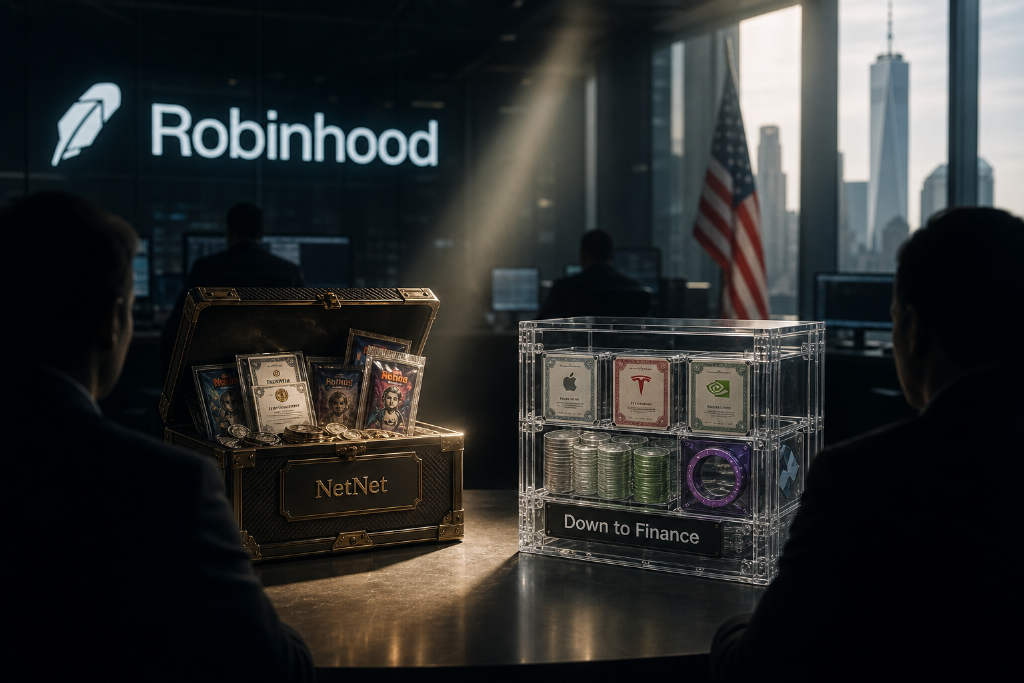
Tokenized U.S. Stocks Move Past Memes as NetNet and Down to Finance Draw Attention
Discussion around tokenized U.S. equities is starting to move beyond the first wave of “stock memes.” The article argues that meme-driven trading may have been the earliest form of onchain U.S. stock speculation, but the bigger opportunity lies in making equity exposure composable inside DeFi. Against that backdrop, two Robinhood-chain projects stand out for different reasons. NetNet is presented as a high-premium treasury trade. Its token, $NET, was described as trading at about $1,030 with a reported NAV of about $60, implying a 17.16x premium, while treasury reserves were listed at roughly $3.35 million. The model uses treasury income, a 5% trading fee, staking through $sNET, and supply adjustments tied to premium levels. It also layers in tokenized-stock features such as Real World Bonds and game-like products tied to assets including $SPCX and $MSFT. Still, the article says much of the recent price move was driven by Ansem’s public endorsement rather than by deep DeFi innovation around U.S. equities. The second project, Down to Finance, is framed as closer to a true onchain RWA and DeFi infrastructure play. It lets users package tokenized stocks, stablecoins, Uniswap V4 LP positions, Morpho lending positions, and other vault assets into DETFs, or decentralized ETFs. Each DETF can function like its own Olympus-style treasury system, with mint-and-burn policy controls and single-sided liquidity features. The article also notes support from bonkguy, the involvement of original Olympus developer @NCyotee, and contract audit risk that has not yet been resolved.