
BlockBeats has been talking about the idea of U.S. stock memes for a while. It previously pitched this as the big story Robinhood chain had been hunting for: "U.S. stock memes: Robinhood chain has finally found its big narrative" ("Meigu meme, Robinhood lian zhongyu zhaodaole ziji de da xushi"). In that setup, stock memes look less like the final form and more like the first wave of speculation around tokenized U.S. equities onchain.
A few experiments are already out there. One copied the logic of onchain Pokemon-style card packs and slapped it onto tokenized stocks, so opening a pack could hand you higher-value equity-linked assets. Another setup had users hold a token or NFT while protocol fees were spent on buying tokenized U.S. stocks, which were then airdropped to holders.
But the article says those ideas still don't go far enough. They don't really show what composability looks like once equities live onchain. Meme tokens pumping volume in tokenized stocks might be fun. Maybe that trade still has room. Still, the actual target is much bigger: make stocks into global onchain assets that can pull in users everywhere and keep U.S. equities trading 24/7.
Under that logic, every chain can turn into a fresh stock trading venue. The article argues DeFi rails for stocks and RWA assets are still thin across chains, and that NetNet's sharp move higher was an early hint of RWAfi momentum on Robinhood chain.
NetNet: a treasury premium trade on Robinhood chain
The piece presents NetNet as a kind of OlympusDAO reborn on Robinhood. But instead of getting stuck on the OlympusDAO v1 comparison, it begins with what the project is actually doing right now.
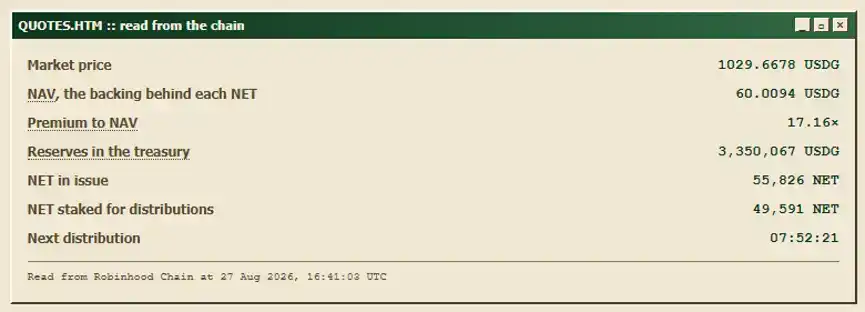
Based on data displayed on NetNet's website, the market price of $NET was about $1,030 per token, while NAV, the asset backing per token, sat around $60. The dashboard also showed a 17.16x premium against treasury assets and total treasury reserves of about $3.35 million.
So that brings up the obvious question in the article: why would anyone pay as much as a 17x premium for $NET? The answer it gives is pretty plain. Buyers think the treasury will earn more over time, so that premium is basically what they are paying for expected future growth.
The article names two main income channels for NetNet right now:
- Yield on USDG. Part of the protocol's idle cash can be parked in the onchain lending market Morpho to earn yield. Up to 70% of treasury USDG can be deployed, and at least 30% has to stay liquid. That income flows back into the treasury.
- $NET trading fees. The project charges a 5% fee on both buys and sells. Once the project has been live for 30 days, the entire 5% goes to the treasury. Before that, part of the fee covers operating expenses.
The article says the project also has other products, though some of them are not included in NAV right now.
On valuation, the piece argues that $NET runs opposite to a lot of other protocol tokens. It uses Pons, a Robinhood launchpad, as an example of a token that has to justify itself through present revenue and market share. $NET is framed differently. It's a bet that the treasury behind the project keeps growing.
NetNet also tries to shape those expectations through supply controls. If panic selling or a violent market move drives NAV especially low, the protocol can buy back and burn $NET. If the token runs too high and NAV gets very elevated, the protocol can mint more $NET and sell it into the market, adding USDG to the treasury.
Holders can stake $NET and receive $sNET. The article says $sNET is distributed every eight hours through a rules-based system. Staking returns move with NAV conditions: the bigger the premium of market price over NAV, the more new $NET gets distributed. If market price drops to NAV or below it, minting stops so dilution does not get worse.
The piece says this staking setup can magnify both sides of the reflexive loop. If the staking ratio is high and liquid $NET is hard to find, the token can rip upward fast. But if revenue misses expectations and sentiment flips bearish, fast unstaking can speed up the drop just as quickly.
How tokenized stocks fit into NetNet's product mix
Beyond the basic treasury mechanics, NetNet also has several products tied to tokenized U.S. equities.
One is Real World Bonds. Users can subscribe to $NET at a discount and receive the purchased amount linearly over two days, while the project uses that capital to buy U.S. stocks. The discount was described as roughly 11.2% to the market price of $NET. The article says the best-case scenario for buyers would be a two-day stretch where $NET rises and the stock assets fall.
There is also a batch of game-like products built around tokenized stocks. SpaceX Invaders and MSFT Flight Simulator are described as probability-based arcade-style games where both the stake and the reward are $SPCX or $MSFT. Users start with USDG, which is then automatically used to buy the matching stock asset. TURBO and TURBO BLACKJACK work off similar logic, turning tokenized stocks into more playable onchain mini-games.
The article also explains why those products are not counted in NAV. Right now, the stock assets involved are held separately by the team instead of inside a permissionless treasury, and there is no automatic or contract-enforced route sending stock value into $NET buybacks, redemptions, or floor support. The rules are not hard-coded. They do not self-execute. So the article says that revenue has no direct link to NAV.
As for NetNet's recent price action, the article says a lot of it came from a direct endorsement by Ansem. At its core, it describes the project as an "optimized OHM plus tokenized-stock gambling mini-game platform." It also says parts of the current story seem to have formed after the rally, including the idea of "not trading stocks, but playing them in gamified form." In the article's view, the main driver is still a reflexive flywheel and celebrity promotion, not a deep wave of real DeFi invention around tokenized U.S. equities.
Down to Finance: packaging strategies into onchain treasury units
The article then shifts to Down to Finance, a newer project whose price performance has trailed NetNet so far. It argues this one is closer to the kind of DeFi framework tokenized stock markets may actually need.
Its mechanics are described as complicated. Some people have called it a "decentralized index fund launchpad," which the article says is intuitive, but not the full picture.
Down to Finance lets users bundle different kinds of assets into a strategy token called a DETF, short for decentralized ETF. Those baskets can include tokenized U.S. stocks, stablecoins, Uniswap V4 LP positions, Morpho lending positions, and other vaults or assets.
That means anyone can build an index-style product on the platform, but the basket goes beyond tokenized equities. It can also hold assets that already contain strategy, such as Uniswap V4 LP positions, Morpho lending positions, and vault structures. Put simply: onchain strategies themselves can be turned into stackable assets, creating layered exposure inside one package.
Each DETF can also be treated as its own OlympusDAO. Earlier, the article framed NetNet as a "one protocol, one treasury, one token" structure. Down to Finance stretches that into "one protocol, countless DETFs, and each treasury carrying its own reserves and strategies." That's why the piece calls it a decentralized OlympusDAO launchpad.
Policy mode, mint-burn controls, and single-sided liquidity
For each DETF, the default issuance mode is called "Policy." The article describes it like this: if price moves clearly above the target price, the protocol mints; if price falls clearly below the target, it burns. If price is near the target, minting and burning stop, while users can still trade in the Uniswap V4 pool.
It says that mechanism follows the same basic logic as the supply regulation discussed earlier for NetNet.
Each fund can be traded. But it can also accept single-sided liquidity. In that arrangement, the protocol automatically mints DETF shares matching the one-sided deposit and places them into the fund reserve. A user who provides single-sided liquidity gets an NFT receipt. Whenever the fund later expands supply, holders of that NFT receive part of the newly minted allocation.
The article reduces the whole model to one sentence: it is an asset-combination launchpad where each basket, or fund, acts like an OlympusDAO, while protocol revenue is used to buy back $DTF.
Support, development background, and risk
The article notes that $NET is backed by Ansem, while $DTF is backed by bonkguy. It also says Down to Finance's developer lineup includes original Olympus developer @NCyotee, which is one reason some market participants are watching it.
Risk is still part of the story. The article says the contracts are still under audit and that only the frontend is live at this stage. It also warns that, historically, protocols built around mixed-asset structures have been more vulnerable to security problems.
Even so, the article argues Down to Finance may have a higher ceiling than NetNet if the team can ship the full feature set without major issues. That loops back to the opening point: if blockchains are going to become new trading venues for RWA assets, the surrounding infrastructure has to be there too. Users will not just trade stocks directly. They will also buy funds and borrow from other high-yield strategy structures.
The article closes on a simple point. The upside of putting RWA assets onchain only really shows up once those assets become truly composable.