
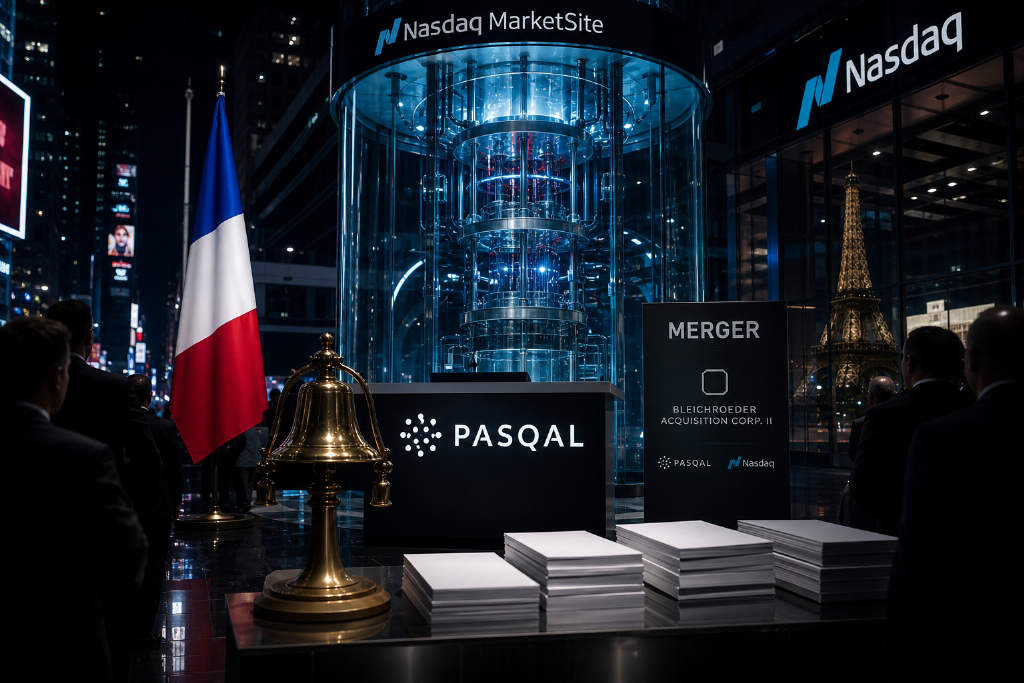
Pasqal, a French quantum computing company focused on neutral-atom systems, started trading on Nasdaq on Aug. 28 after completing its merger with Bleichroeder Acquisition Corp. II. The transaction was completed at an implied pre-money valuation of about $2 billion and brought in roughly $360 million in cash. By midday in New York, the stock had risen 52% from its $9.79 reference price to $14.84. The gain widened in afternoon trading, and shares closed at $19.11, up about 95% on the day.

Pasqal’s debut comes as quantum computing companies have been reaching public markets at an unusually fast pace. The article places the move in a sequence that began with IonQ’s SPAC listing in 2021, continued with Quantinuum’s June IPO, described as the largest in the sector, and extended to IQM’s July listing. Leading companies across superconducting, trapped-ion, and neutral-atom architectures have moved from private to public markets in nearly the same window.
This is still an industry where annual revenue is generally measured in the tens of millions of dollars. Valuations are not being set on current sales alone. They are being set on the assumption that fault-tolerant quantum computing will one day become commercially meaningful. That frames the central question around Pasqal’s listing: whether investors are buying a company that has already solved commercialization, or a company they believe can solve it later.
Roughly 100 times sales
Pasqal remains a thinly monetized business by conventional standards. The company reported revenue of 16.5 million euros for 2025, up from 3.5 million euros in 2024. Including government subsidies, total revenue was about 23.7 million euros. On an implied pre-money valuation of about $2 billion, the company is valued at roughly 100 times 2025 revenue.
Within the quantum computing sector, that multiple does not look extreme. Quantinuum listed in June at a $15.6 billion valuation, equal to about 500 times its 2025 revenue of $30.9 million. IonQ’s market capitalization is currently about $15 billion, while Rigetti stands at about $5 billion. The comparison shows how the market is valuing quantum companies today: not on what their machines earn now, but on what investors think they could earn in the future. In that framing, a 100x revenue multiple is less a valuation of an operating business than a price on an option.
The company’s revenue trajectory gives that argument some support. Revenue in 2025 was nearly five times the 2024 level, which the article describes as a sign that commercialization may be moving from pilot projects toward broader deployment. Still, only sustained growth would make a triple-digit revenue multiple hold up.
A first-day surge shaped by liquidity
The article argues that the 52% intraday jump fits a pattern often seen in SPAC listings. In moves of this size, the immediate driver is often constrained float rather than a rapid reassessment of fundamentals. A limited supply of shares can collide with pent-up demand from thematic funds, especially when there are few pure-play ways to gain exposure to neutral-atom hardware.
Pasqal’s first-day turnover was about 1.5%, with trading volume of 3.67 million shares. In a SPAC listing structure, freely tradable shares are already limited, which means moderate buying pressure can produce outsized percentage moves. Under that reading, the opening session was a liquidity event first and a verdict on discounted cash flow much later, if at all.
History offers reasons for caution. IonQ went public through a SPAC in October 2021 at an implied valuation of about $2 billion, and its shares later swung between single digits and multiples of that level. Rigetti, which listed in 2022, later faced harsher financial pressure, including layoffs. The 2021 SPAC wave also produced failures such as Babylon and Lilium, companies that had once been treated as promising public-market stories.
That is why a sharp first-day rise says little by itself about a company’s ability to convert booked and awarded business into recurring revenue. The article says investors chasing the move are often buying opening momentum rather than Pasqal’s technology, and that kind of position is measured in days, not quarters.
A deeper structural shift: European quantum companies turning to U.S. capital
Beneath the noise of the first trading day, the article identifies a longer-lasting development. Pasqal’s listing is presented as part of a broader migration by European deep-tech hardware companies toward U.S. public markets, driven by the depth of American growth capital. Finland’s IQM made a similar move in July at an implied pre-money valuation of about $1.8 billion. Pasqal executives have previously said European investors systematically undervalue long-cycle hardware stories and that the company chose the United States because the capital pool is deeper.
The roughly $360 million cash position created by the transaction marks a fundamental change for Pasqal. As a private company, each step in hardware upgrades required a new financing round at a negotiated valuation, with dilution for founders and early backers each time. Pasqal has raised more than $300 million in total, including a package of at least 340 million euros in March 2026: a private round of 170 million euros plus about 170 million euros, or $200 million, in committed convertible financing. That package also carried a $2 billion valuation.
As a public company, Pasqal can issue stock for acquisitions, use liquid equity to attract talent, and finance multi-year deployment cycles without repeatedly returning to venture investors. Compared with private rivals that still depend on private funding windows, that is a structural advantage.
Commercial footprint and technology roadmap
The company’s operating profile is part of the case being presented to public investors. Pasqal has deployed seven quantum processing units, with another three in production. Those systems are accessible through the cloud and support more than 25 commercial and research applications across energy, financial services, and materials science.
Its customer and partner roster includes Saudi Aramco, LG Electronics, Credit Agricole CIB, CMA CGM, OVHcloud, Thales, IBM through the IBM Quantum Network, as well as Nvidia and Sumitomo Corporation. The company has more than 275 employees and deployment facilities in European high-performance computing centers and in Saudi Arabia.
On the technical side, Pasqal is betting on neutral atoms, trapping individual atoms with lasers and manipulating them with lasers for computation. The specific appeal of that approach, according to the article, is that the systems can run in standard data-center environments, without the near-absolute-zero cooling required by superconducting qubits.
The roadmap begins with the current Orion family, including Orion Gamma with more than 140 physical qubits. It extends to the planned Vela processor in 2027 with more than 200 physical qubits, then to Centaurus in 2028, which the company positions as a step into early fault-tolerant quantum computing.
The article does not dismiss these assets. It describes them as real infrastructure and a real roadmap. But it also says that, at this stage, they still form a thin base for a $2 billion valuation. Management’s pricing logic rests on what it calls platform optionality: one architecture spanning the path from analog workloads to fault-tolerant capability.
"Today is not the finish line, but an acceleration point," Pasqal CEO Wasiq Bokhari said. He added that the company was founded to push neutral-atom quantum computing from basic science into industrial-scale deployment.
The French approval requirement that could shape the stock
Pasqal’s capital structure carries a constraint that the article says deserves more attention. Because the company operates in a field treated by France as strategic technology, its filing states that non-French or non-EU investors seeking significant ownership must obtain authorization from the French Ministry of Economy.
In practical terms, Paris retains a degree of control over the shareholder register. For a company that has already attracted backing from Temasek, Saudi Aramco Ventures, Quanta Computer, and the European Innovation Council Fund, that provision introduces complexity. It narrows the range of possible strategic buyers and large holders, reduces free float, and can magnify both upside and downside stock moves.
The article presents this as a broader contradiction inside Europe’s strategic-technology agenda: governments want to build champion companies while keeping control over them. The same instinct sits behind France’s wider push for technological sovereignty, from semiconductor ambitions to cloud initiatives. For Pasqal, this "kill switch" works as a national security safeguard, but it can also create friction in capital formation.
The second-order effects are subtle but important. A tighter free float means Pasqal’s shares may react more sharply than broadly held peers to both positive and negative catalysts. Index inclusion, analyst coverage initiations, and lockup expirations could all trigger moves that are larger than fundamentals alone would justify. In that sense, France’s veto power does not only limit who can own Pasqal. It also influences how the stock trades.
Where the valuation case could break
The strongest argument against a rerating, the article says, is not technological. It is historical and financial. Quantum SPACs have a mixed record. IonQ, Rigetti, and D-Wave generated volatility but did not deliver durable profitability, while the broader 2021 SPAC cohort that included Babylon and Lilium ended in collapse.
Pasqal’s own filing is described as unusually direct on this point: progress in commercializing quantum computing may never materialize, and the machines may fail to deliver what they promise. At about 100 times sales, the company’s valuation already assumes a future where hardware scales, the software platform becomes a standard, and booked and awarded pipeline converts into recurring revenue. If any one of those pieces breaks, the multiple becomes difficult to defend.
The bullish response is that Pasqal is not being valued in isolation. Compared with peers trading at several hundred times sales, 100x implies that the market has recognized risk and applied a discount. The open question is whether the discount is large enough to offset execution risk. The answer depends on how investors judge the durability of the neutral-atom approach against trapped-ion systems at IonQ and Quantinuum, and against superconducting and annealing approaches elsewhere.
The article offers specific signals that would challenge the rerating thesis. If Pasqal’s next reported revenue period fails to show meaningful growth from the 16.5 million euro base, or if the company returns to dilutive financing within 12 months of the transaction despite having $360 million in cash, then the case weakens sharply. A company that burns through $360 million without converting its pipeline into revenue has not solved commercialization. It has only delayed the reckoning.
Three time frames for investors
Short term: sentiment and liquidity
In the short term, the focus is on sentiment and liquidity. The article expects volatility to intensify as the float normalizes. The base case is a pullback once first-day momentum traders exit. The upside case is continued thematic buying if quantum peers keep rising and if early trading volume points to genuine accumulation rather than a temporary liquidity spike. The trigger to watch is sustained heavy volume in the first week without price weakness.
Medium term: the first quarterly report
In the medium term, fundamentals take over. The first quarterly earnings report will be the first real test. Investors will be looking at conversion of booked and awarded pipeline into revenue, gross margins on hardware deployments, and the pace of cash burn against the $360 million balance. The base case is steady growth with ongoing losses, which the article describes as normal for a hardware company at this stage. The upside case is faster commercial deployment with improving unit economics. The downside case is weak conversion and a burn rate that forces an earlier-than-expected return to capital markets.
Long term: fault tolerance decides the story
Over the long run, the fault-tolerance roadmap is the final judge. If Pasqal’s single-platform architecture can deliver both strong analog computing capability now and a credible route to fault tolerance later, then a $2 billion valuation may look cheap in hindsight. If the technology stalls at the analog stage, the company could join the list of quantum promises that never became commercial businesses.
The article points to early warning signs that would weaken the structural bull case: no meaningful progress on published fault-tolerance milestones over the next 18 to 24 months, or the loss of key enterprise deployments such as Saudi Aramco or European high-performance computing centers.
There is also a risk entirely outside the company. If European policymakers tighten state-influence rules, or if transatlantic tensions over technology transfer rise, Pasqal’s ownership structure could turn from safeguard into liability. France’s "kill switch" may protect national security, but it does not shield shareholders from the political risk that can come with it.
The article concludes that Pasqal’s market debut is not a final verdict on quantum computing. It is a referendum on whether investors are willing to pay for the gap between current technical capability and future promise, and on whether a French company can build a global champion while the French state keeps a hand on the steering wheel. The 52% intraday jump and roughly 95% closing gain show that the market is willing to pay for that story. The next four quarters will show whether the pricing is backed by real revenue conversion.