BackPasqal

Pasqal

Pasqal
2026-08-29 02:43:19

Pasqal jumps 95% in Nasdaq debut as investors price a $2 billion bet on neutral-atom quantum computing

Pasqal, the French neutral-atom quantum computing company, began trading on Nasdaq on Aug. 28 after completing its merger with Bleichroeder Acquisition Corp. II at an implied pre-money valuation of about $2 billion. The deal delivered roughly $360 million in cash, and the stock surged from its $9.79 reference price to close at $19.11, up about 95% on the first trading day after rising 52% by midday in New York. The debut lands in a period when major quantum computing companies across superconducting, trapped-ion, and neutral-atom approaches are reaching public markets in quick succession, following IonQ’s 2021 SPAC listing, Quantinuum’s June IPO, and IQM’s July listing. Pasqal’s valuation stands out because the company reported 2025 revenue of 16.5 million euros, up from 3.5 million euros in 2024, with total revenue of about 23.7 million euros including government subsidies. At that level, the company trades at roughly 100 times 2025 revenue. The market reaction has sharpened a familiar question in quantum investing: whether buyers are paying for a business that has already solved commercialization, or for the possibility that it eventually will. The company’s cloud-accessible quantum processing units, customer roster, and neutral-atom roadmap support that case, but its filing also lays out execution and commercialization risks, along with a French approval requirement for significant ownership by non-French or non-EU investors.

100
Pasqal jumps 95% in Nasdaq debut as investors price a $2 billion bet on neutral-atom quantum computing
Quantum Compu
2026-07-16 03:30:34

Quantum computers are not about to break Bitcoin, and the article’s timeline points no earlier than 2035

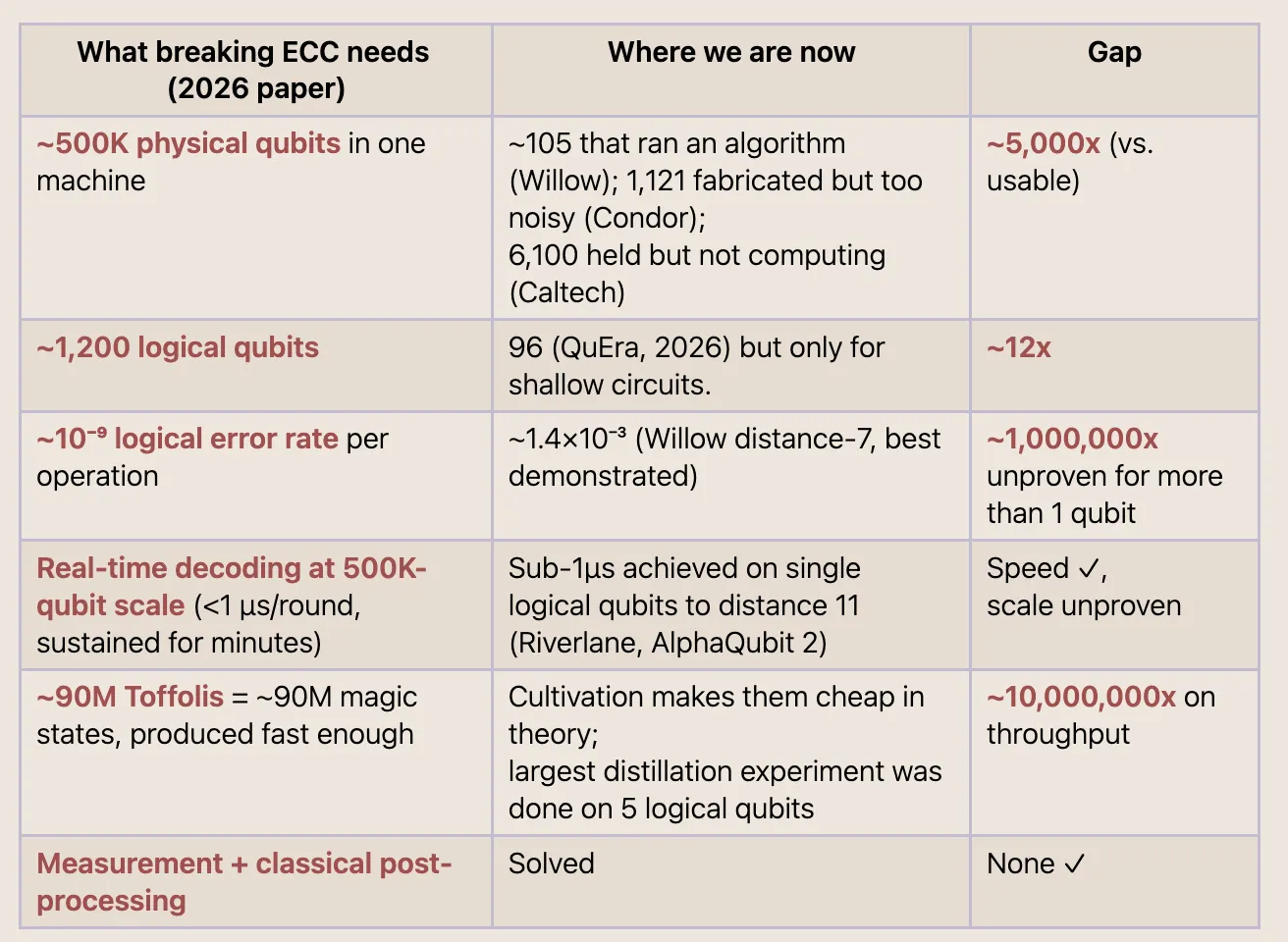
Fears that quantum computers could soon crack Bitcoin keep resurfacing, but the source article argues the gap between theory and practical attack capability remains vast. In theory, the hardware required to break elliptic curve cryptography, or ECC, has fallen sharply, from about 317 million physical qubits in 2022 to fewer than 500,000 in a 2026 paper. That is a major change on paper. The problem is that current machines can only run real algorithms with about 105 usable qubits, leaving several orders of magnitude still missing. The article walks through what would actually be needed to run Shor’s algorithm against ECC, including logical qubits, error correction, decoding speed, and the production of magic states needed for non-Clifford gates such as Toffoli gates. It says the 2026 design would require around 1,200 logical qubits, about 90 million sequential Toffoli gates, roughly 500,000 physical qubits under current error-correction assumptions, and a runtime measured in minutes. It also separates abstract cryptographic risk from actual wallet exposure. For Bitcoin, addresses only become vulnerable once a public key is revealed on-chain, which is why the article highlights roughly 6.7 million BTC as already exposed. Ethereum faces a related issue because it uses the same secp256k1 curve and ECDSA signatures, while its persistent account model makes repeated address use more common.

1030
Quantum computers are not about to break Bitcoin, and the article’s timeline points no earlier than 2035
Quantum Compu
2026-07-16 03:04:03

Quantum computing is still far from breaking ECC, despite sharp gains in theory

A TechFlowPost article translated from Derrick Cui argues that practical quantum attacks on elliptic curve cryptography, or ECC, are still several orders of magnitude away even after major theoretical advances. The piece says recent research has cut the estimated hardware needed to break ECC from about 317 million physical qubits in 2022 to fewer than 500,000 in 2026, but today’s machines can run real algorithms on only about 105 qubits. It walks through what would actually be required to attack ECC with Shor’s algorithm, including logical qubits, error correction, decoding, Toffoli gates and magic-state distillation, then compares those requirements with current hardware. The article also discusses what a quantum break would mean for Bitcoin and Ethereum. In Bitcoin, the main risk is tied to addresses whose public keys have already been revealed on-chain, while Ethereum’s persistent account model would leave any wallet that has sent a transaction exposed if quantum attacks were available today. The piece concludes that the gap between theory and deployable machines remains enormous, and that no reliable timeline can be inferred from current progress alone.

210
Quantum computing is still far from breaking ECC, despite sharp gains in theory