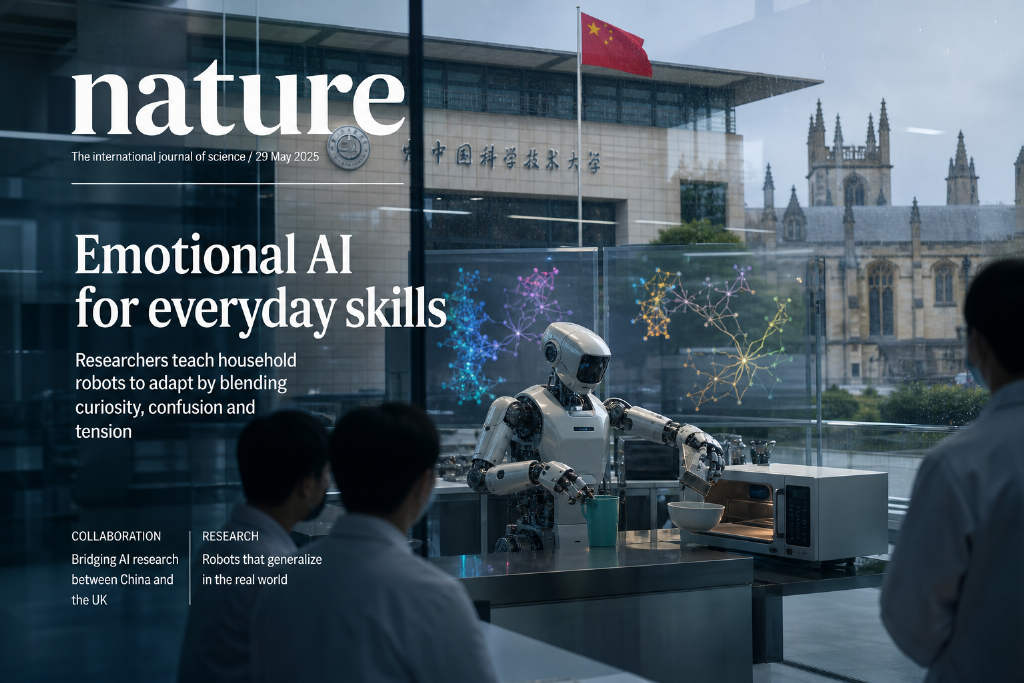
AI2026-08-16 07:28:10Researchers Say Emotion Signals Can Improve How AI Agents Choose ActionsResearchers from the University of Science and Technology of China and Oxford, as cited in the source article, tested whether AI agents perform better when they use internal emotion-like representations to choose skills instead of relying only on text and external feedback. The report says the models showed consistent pairings between states such as curiosity, confusion, tension, optimism, disappointment, and the actions they took during tasks. In a shopping experiment, those pairings mapped to behaviors including product search, query reformulation, purchase confirmation, and price comparison. To check whether the pattern was more than coincidence, the researchers sampled 200 skill-selection events and found a 76.5% semantic consistency rate. The article also says emotion-driven skill selection, named EMOTION2SKILL, lifted success rates in difficult household tasks that often require recovery after mistakes. In the experiments described, success in "heating objects" rose from 9.6% to 56.9%, while "picking up two objects" increased from 4.4% to 31.3%. Separately, a Tianjin University team embedded emotion into a world model called Large Emotional World Model, or LEWM, and reported accuracy gains of as much as 45.72% on its self-built dataset. The piece links both studies to Anthropic’s April experiment on Claude Sonnet 4.5, which reportedly identified fine-grained emotion directions aligned with the Go Emotions taxonomy.520
USTC2026-08-06 08:25:09USTC study tests whether AI can run a real chemistry labA new University of Science and Technology of China study pushed AI agents beyond text-based planning and into a real machine-catalysis lab. The setup includes 45 modular automated workstations covering synthesis, characterization, and catalytic testing, wrapped as machine-readable skills that agents can call under real equipment constraints. Researchers evaluated 48 configurations across six agent frameworks and nine large language models, running 4,608 trials on 32 expert-defined research tasks. Only 151 workflows, or 3.3%, could execute without manual repair. The best result came from Claude Code with Claude Opus 4.7, at 28.1%, followed by Codex with GPT 5.5 at 19.8%. In a five-round closed loop, Codex/GPT 5.5 could adjust formulations and operating conditions, but it did not redesign analysis methods or fix persistent omissions such as missing electrode binders and assay-specific color reagents. The paper separates three different abilities often lumped together in the “AI scientist” debate: writing an experimental plan, producing a workflow that can actually run in a physical lab, and changing the broader research strategy after seeing experimental results.1890
LUNA 2.02026-07-09 04:50:42LUNA 2.0 Surges More Than 200% as Terra Trading Activity and DeFi TVL ExpandLUNA 2.0 posted a sharp rally of more than 200% in a single day, rising from $1.90 to $6.87 before easing. The move came alongside heavy trading volume, gains in related Terra assets, and a notable jump in Terra 2.0 DeFi total value locked.580
LUNA 2.02026-07-09 04:44:15LUNA 2.0 Surges Over 200% as Terra Trading Volume and DeFi Activity SpikeLUNA 2.0 soared from $1.90 to $6.87 in 24 hours, briefly gaining more than 200% before easing back. The rally was accompanied by heavy trading volume and a sharp rise in Terra’s DeFi total value locked.470