
Researchers from the University of Science and Technology of China and Oxford have reported that AI agents can complete tasks more effectively when they are allowed to read internal emotion-like states and use them to decide what to do next, according to the source article.
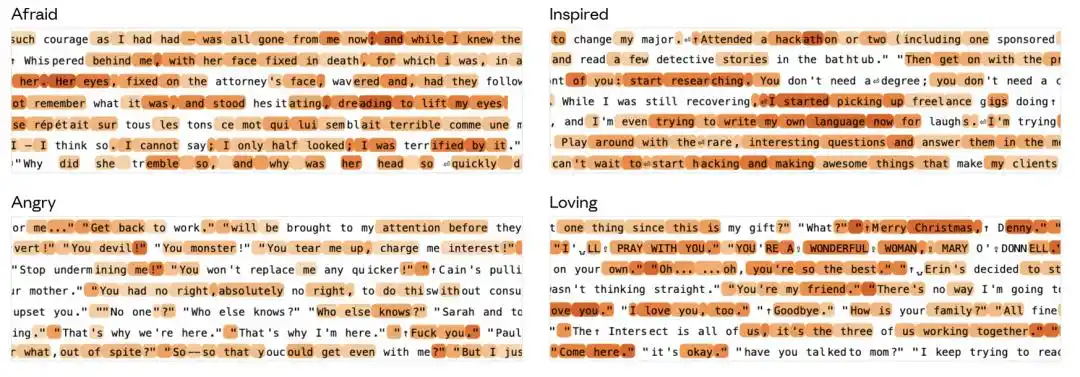
The work starts from an earlier line of research that argues large language models contain computational patterns that line up closely with human emotion labels, including curiosity, desire, optimism, confusion, tension, and anger.
Stable links between emotion states and skill choices
The researchers said specific emotion states inside the model were consistently matched with specific skill choices. Instead of acting only on external text instructions or explicit task feedback, the agent could use those internal signals as part of its action routing.
In a shopping task, the agent formed four interpretable pairings:
- When it felt curious and desirous, it searched for products on its own.
- When it felt confused and tense, it reformulated queries and tried new keywords after poor search results.
- When it felt approval and optimism, it moved to confirm the purchase.
- When it became disappointed and angry, it shifted to price comparison.
To test whether those pairings were statistical noise, the researchers sampled 200 skill-selection events and asked AI to judge whether each pairing was semantically coherent. The consistency rate reached 76.5%, the article said.
Negative emotions helped in tasks that require recovery from failure
The report says traditional system design usually treats AI errors as anomalies that should be suppressed or removed. This study argues that in tasks where an agent must recover from failure again and again, so-called negative emotions such as tension, confusion, and disappointment can serve as useful metacognitive signals.
Those states may indicate a mismatch between the current strategy and the outside environment. Rather than forcing an agent to stay emotionally flat and ignore that mismatch, the system can let the agent register it and trigger a recovery routine.

The researchers assigned the AI six categories of household work. Among them, the baseline success rates for "heating objects" and "picking up two objects" were especially low at 9.6% and 4.4%. After applying emotion-driven skill selection, or EMOTION2SKILL, the success rate for heating objects rose to 56.9%, while picking up two objects climbed to 31.3%.
According to the article, both task types share a common trait: once the agent starts, mistakes are very likely, and final success depends largely on whether it can adjust strategy quickly after an error.
One example in the paper asks the agent to heat a cup and place it on a countertop. In a standard workflow, the agent navigates to the microwave and executes the heating step, only to receive feedback later that the microwave was off and the task failed. The failure signal arrives after the wrong action has already happened.
With emotion-driven skill selection, the emotion encoder detects a tense state as the agent approaches a closed microwave. That state routes the agent into a sub-sequence of checking first, opening the microwave, and only then heating the cup, which allows the task to finish successfully.

The paper argues that when an agent relies only on external text and failure feedback, it often does not change strategy until after a mistake becomes explicit. Emotion signals may catch a change in internal state earlier than that.
An ablation study in the paper pointed in the same direction. Across all task types, the most frequently activated emotion templates for heating and picking up two objects were frustration and confusion at 41% and 39%.
Tianjin University added emotion to a world model
The article also cites a separate study from Tianjin University that embedded emotion directly into a world model called Large Emotional World Model, or LEWM.
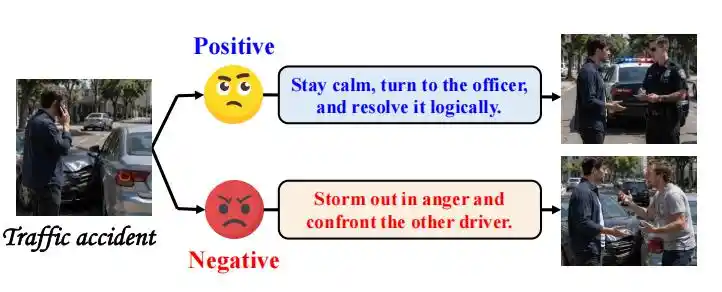
A world model is generally used to predict what will happen next and then guide action. The report argues that in human-centered environments, predicting only the positions, poses, and physical states of objects is not enough to model what follows, because emotion itself can drive human action and shape later changes in the environment.
LEWM splits prediction into two stages. First, it predicts future emotional states. Second, it uses those predicted emotions as conditional signals to guide prediction of future world states.
On the team’s self-built dataset, the method improved accuracy by as much as 45.72%, according to the article. An ablation study also found that removing emotional data hurt not only emotion-understanding tasks but also logical reasoning and general question answering.
Anthropic’s April experiment is part of the backdrop
The source article places both studies in the context of an earlier finding: internal emotion representations in large language models may be extractable.

It says Anthropic ran an experiment in April and extracted fine-grained emotion directions from the internal activations of Claude Sonnet 4.5. Those directions were aligned with the 27-category Go Emotions taxonomy and were said to causally influence agent-related behavioral outputs.
The article gives one example, saying sadness was most pronounced in a "dog died" scenario, while Loving appeared across all events.
According to the source piece, discussion around whether models "have emotions" used to sit mostly inside alignment safety debates or philosophical reflection. Now, internal model states are increasingly being treated as functional signals that can be extracted, used, and folded into system design.
Reference links
[1] https://arxiv.org/pdf/2608.09248
[2] https://arxiv.org/abs/2512.24149
[3] https://transformer-circuits.pub/2026/emotions/index.html