VRA

MarsBit
2026-09-10 04:44:09

MarsBit piece argues modern IT is still stacked on a fragile von Neumann foundation

MarsBit has published a long-form commentary that uses a single diagram to dissect the structure of modern IT infrastructure, arguing that the industry keeps adding new layers while leaving its oldest bottlenecks largely untouched. The article centers on the von Neumann bottleneck, describing it as the thin support column under today’s computing stack: CPUs keep getting faster, but memory and bus bandwidth remain limiting factors, and growing software complexity only increases data movement between memory and processors. The commentary walks from electricity and semiconductor fabs up through operating systems, high-bandwidth memory, CPUs and GPUs, C projects, JVM-based software, web tooling, and end-user applications. Its core claim is that each layer may look well engineered on its own, yet the full stack is less a unified design than an accumulation of temporary fixes, compatibility compromises, and maintenance patches. It also frames the current AI boom as a source of additional strain rather than a fix for the base layer. According to the article, AI training and inference sharply increase power demand, GPU usage, and data retrieval pressure, while AI-generated code and content can introduce quality and security problems into open-source and web ecosystems. The author extends that criticism to large tech companies, which are portrayed as repeatedly disrupting existing frameworks and standards, and to independent developers, whose fragmented projects can add flexibility but also disorder and maintenance risk.

100
MarsBit piece argues modern IT is still stacked on a fragile von Neumann foundation
Tencent Hunyu
2026-09-01 04:22:52

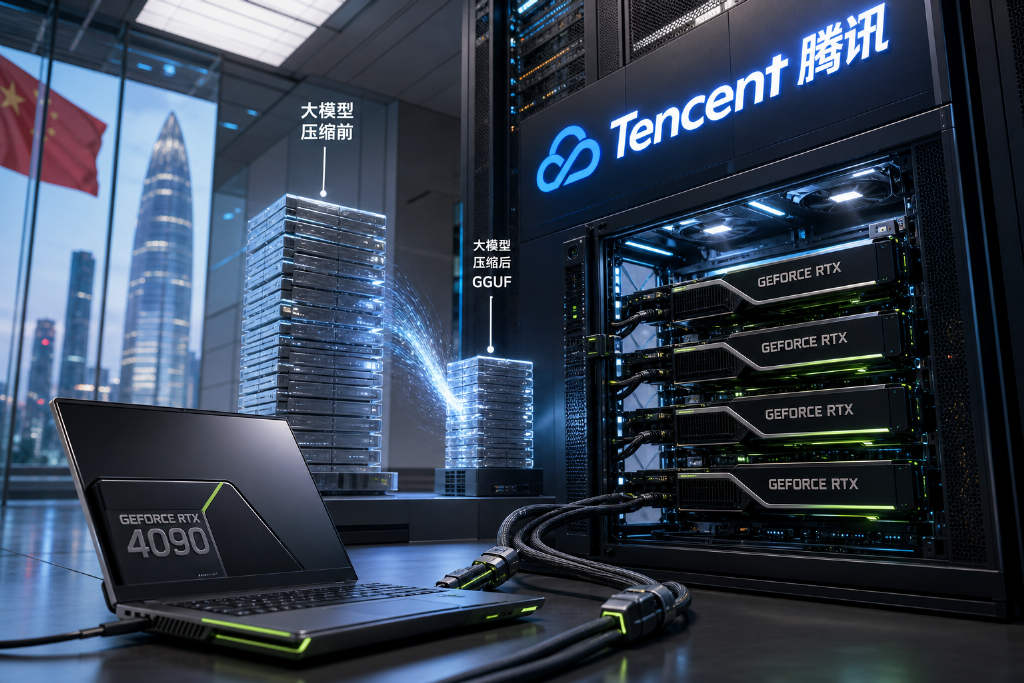
Tencent Hunyuan Releases Extreme Quantization of Hy4 Preview: 1.5TB Shrunk to 214GB, Heterogeneous Inference 6x Faster

Tencent's Hunyuan team has released an extreme quantization version of the Hy4 preview model, compressing the original 1.5TB weights to about 214GB in GGUF format. Using a layer-wise quantization strategy, the average bit-width is 2.38 bpw, with performance loss of only 0.2-1.6 points on benchmarks. The team also tested heterogeneous joint inference with prima.cpp, achieving 1.02 token/s on a setup combining an RTX 4090 laptop and a quad-RTX A4000 server, 6x faster than laptop-only offloading.

220
Tencent Hunyuan Releases Extreme Quantization of Hy4 Preview: 1.5TB Shrunk to 214GB, Heterogeneous Inference 6x Faster
Perplexity
2026-08-25 19:23:25

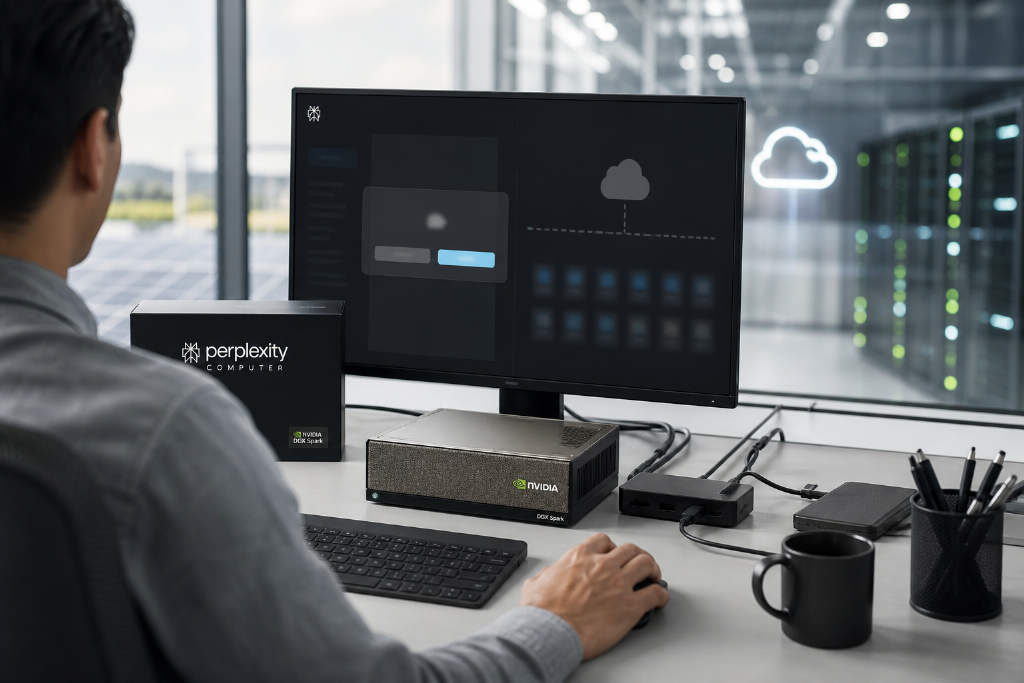
Perplexity unveils a portable AI computer built on NVIDIA DGX Spark with local-first processing

Perplexity has introduced a portable AI computer as a local-first version of its agent platform, Computer, designed to run directly on NVIDIA DGX Spark. The system packages local models, an inference engine, a tool sandbox, and application connectors so that tasks can begin on-device, with work handled by local models generating no token-based charges. When a step needs live internet access or stronger frontier reasoning, the orchestrator pauses, asks the user, and then sends only that single step to one of more than 15 cloud models. Deployment requires GB10-class hardware or an RTX GPU with 24 GB of VRAM. Perplexity is targeting enterprises that already have NVIDIA workstations, mid-sized teams, and well-funded AI-native startups. The company says the setup fits sectors such as finance, legal, healthcare, government, and defense, where data residency or contractual confidentiality requirements are strict. In a 53-task local knowledge-work benchmark, Computer running Qwen 3.8 27B scored 82.6% on DGX Spark, ahead of the open-source Pi toolchain at 77.6% and Hermes at 74.0%. Using the PPLX 27B model pushed the score to 85.4%. In hybrid mode, fully local execution carries zero marginal cost, while an advisor upgrade can improve performance at about $0.415 per run.

250
Perplexity unveils a portable AI computer built on NVIDIA DGX Spark with local-first processing
UC Berkeley
2026-08-23 10:55:51

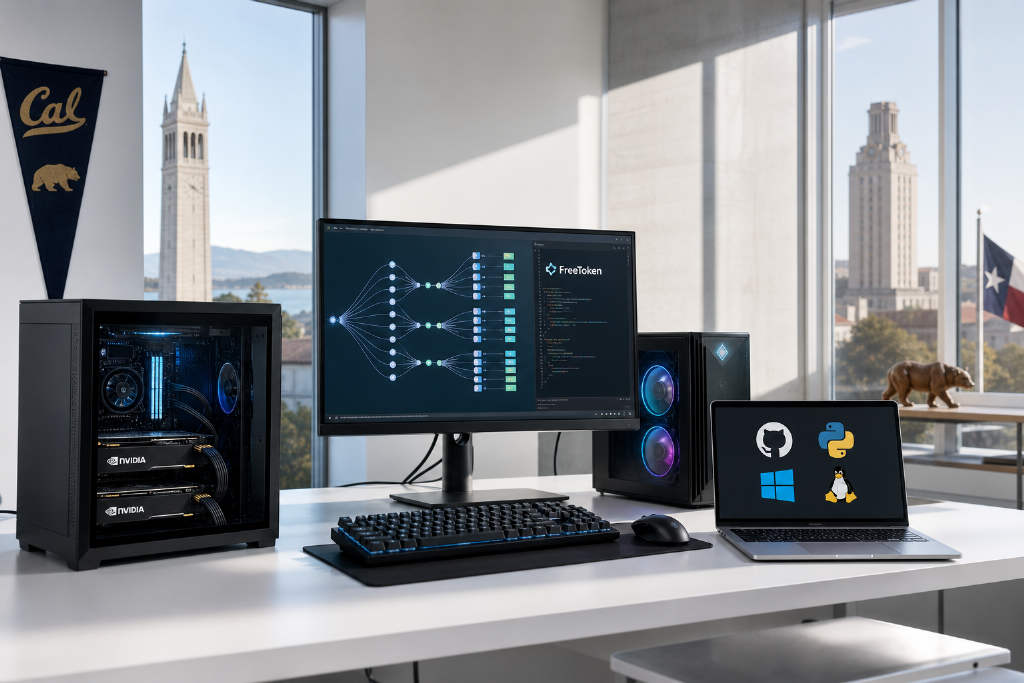
UC Berkeley and UT Austin researchers release edge-native MoE inference engine FreeToken

Researchers from the University of California, Berkeley and the University of Texas at Austin have introduced FreeToken, an edge-native mixture-of-experts inference engine designed to turn personal computers into a unified elastic inference platform. According to the release cited by Techub, the system can run the 753B-parameter GLM-5.2 model on a single workstation GPU, a 284B model on a gaming desktop, and a 35B model at interactive speed on a laptop GPU with 8GB of VRAM. FreeToken has been open-sourced under the Apache-2.0 license on GitHub and published on PyPI. The team also provides one-click desktop applications for Windows and Linux. Its command-line interface supports Linux x86_64 systems and NVIDIA GPUs, and the ft serve command can expose an API endpoint on port 1919 that is compatible with OpenAI and Anthropic. The project is aimed at individual developers, startups, and engineering teams at small and medium-sized businesses, with a focus on privacy-sensitive use cases such as healthcare, legal work, defense, finance, and intellectual-property-heavy R&D. Example applications include local coding agents, private code review, offline contract analysis, and synthetic data generation.

650
UC Berkeley and UT Austin researchers release edge-native MoE inference engine FreeToken
Alibaba
2026-08-15 09:03:32

Alibaba open-sources Qwen3.8-27B, with 9 wins over Claude Opus 4.6 Max in its own benchmark card

Alibaba on Aug. 14 open-sourced Qwen3.8-27B, a 27-billion-parameter dense native multimodal model released under Apache 2.0, with no monthly active user or revenue threshold attached to its license. The company said the model supports a native 262K context window and can be extrapolated to 1 million tokens through YaRN. In Alibaba’s published model card, Qwen3.8-27B was compared against Claude Opus 4.6 Max across 14 benchmarks with side-by-side scores, winning 9 and losing 5. Its largest gains were in visually grounded and agent-style tasks such as MathVision, CharXiv and AndroidWorld, while every loss was concentrated in pure reasoning, code generation, terminal coding and related long-chain tasks. Alibaba also said a 4-bit quantized version can run in roughly 14 GB to 17 GB of VRAM, enough to fit model weights on a consumer GPU such as an RTX 4090, though that figure excludes KV cache, concurrent agent sessions, runtime buffers and multimodal components. All benchmark figures cited in the model card came from Alibaba’s own release, and no third-party independent replication was provided in the input.

770
Alibaba open-sources Qwen3.8-27B, with 9 wins over Claude Opus 4.6 Max in its own benchmark card
AMD
2026-08-14 15:36:04

AMD adds day-one support for Alibaba’s open-source Qwen3.8-27B model

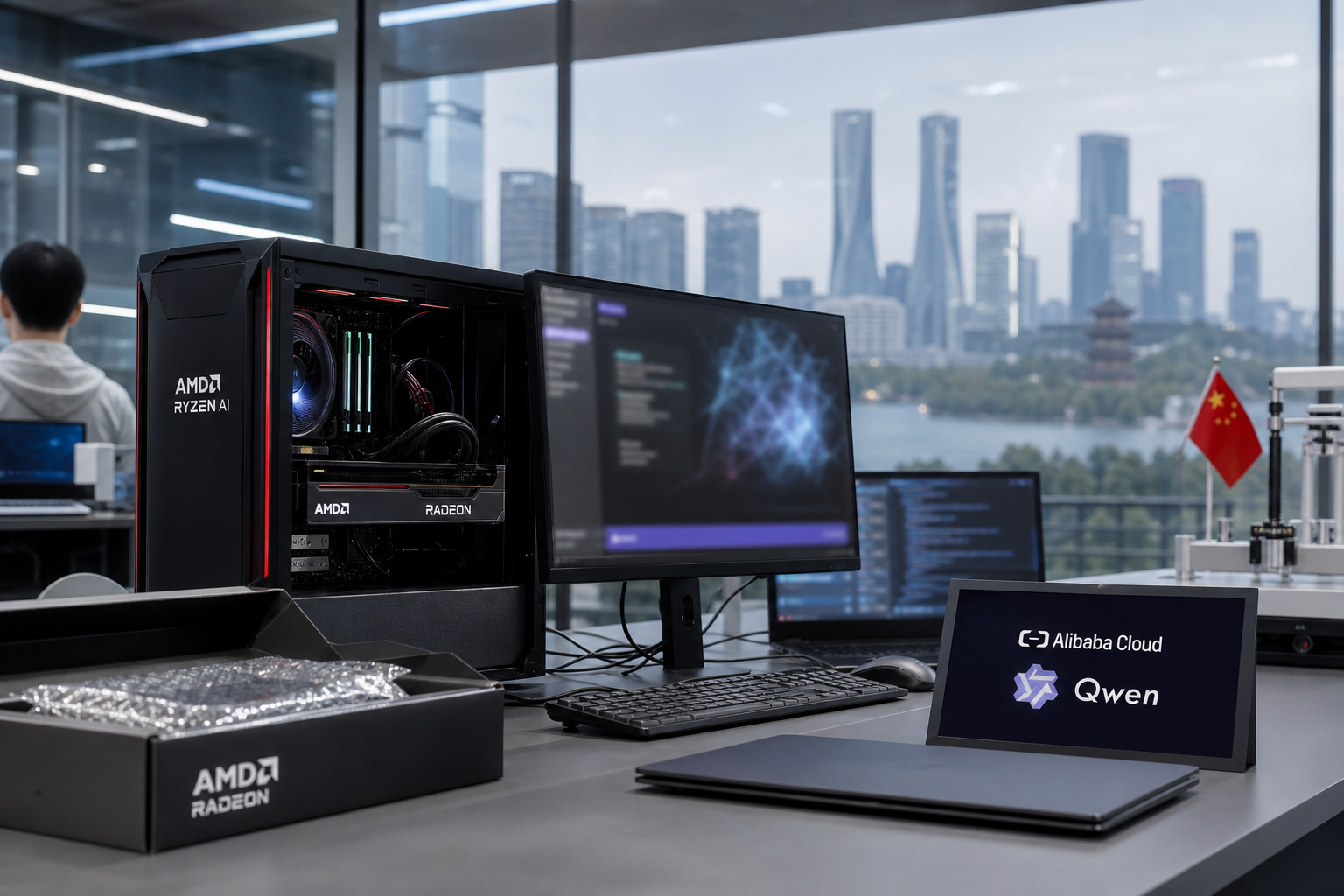
AMD said it is providing Day 0 support for Alibaba’s latest Qwen model, Qwen3.8-27B, allowing developers to run the open-source AI model locally on AMD hardware on the day it is released. According to AMD, the 27B-parameter dense model is designed for local AI development and continues the Qwen family’s optimization focus across code generation, practical work tasks, scientific research and long-context AI applications. The company said Qwen3.8-27B can run through the open-source inference framework llama.cpp on AI PCs and workstations powered by AMD processors, as well as on a single AMD 32GB graphics card. AMD also said the model supports AMD hardware platforms with more than 24GB of variable graphics memory, or VRAM capacity. In preliminary testing, AMD reported local inference speeds of up to 24.5 tokens per second on the AMD Ryzen AI Max+ 395 processor and up to 51.8 tokens per second on a single Radeon AI PRO R9700 GPU. The tests were conducted on Windows using the llama.cpp Vulkan backend with multi-token prediction, or MTP, enabled. AMD added that performance could improve as software and model optimization continues. Alibaba said today that it has officially open-sourced the Qwen3.8 model family, which developers, research institutions and enterprises can freely download, deploy and use.

810
AMD adds day-one support for Alibaba’s open-source Qwen3.8-27B model
Meta
2026-08-11 10:33:11

Meta returns to open-weight AI with Muse Glimmer and plans to release Spark 1.2

Meta has reopened its open-weight AI strategy with the release of Muse Glimmer, a model whose underlying parameters can be downloaded and modified by developers. The company said it will also release the weights for the more capable Muse Spark 1.2 in the coming weeks, marking a clear shift back toward the approach it once used to distinguish itself from rivals. CEO Mark Zuckerberg backed the move in a post on Meta’s website, arguing that powerful and free AI should reach billions of people rather than remain concentrated in large institutions. He also defended model distillation and said people should retain the ability to learn from observable information, a position that cuts against recent complaints from OpenAI and Anthropic over how their closed models’ outputs are used. Muse Glimmer is Meta’s first open-weight model since Llama 4 and its first to ship under the Apache 2.0 license. The model supports text and image input, carries a 128K context window, and is aimed at local agent use on personal devices. Meta’s release also comes with a broader commercial and infrastructure angle, as the company plans to spend as much as $145 billion on AI infrastructure this year while building out related cloud services.

1150
Meta returns to open-weight AI with Muse Glimmer and plans to release Spark 1.2
AI Agents
2026-08-11 00:17:09

AI agents are pushing storage into the runtime loop, reshaping the role of SSDs, HBM and memory tiers

A MarsBit report argues that AI agents are changing storage from a passive persistence layer into part of the execution path itself. As agents continuously observe, reason, call tools, write back results and preserve state, the value of storage is no longer limited to saving data after a task is complete. The report says SSDs are beginning to take on functions tied to model weights, KV cache spillover, indexing, encryption, compression, lifecycle control and long-term memory, pointing to a broader shift toward programmable, functional SSDs. The piece lays out how this transition could play out on both devices and in the cloud. On the edge, SSDs may become the long-lived state layer for personal agents, holding local models, adapters, vector indexes, personal memory and tool traces. In cloud deployments, storage nodes could move closer to the inference path, handling shared prefixes, KV data, adapters, vector search and governance. The report cites Mooncake and NVIDIA CMX as examples of systems where storage is already participating in token production rather than merely holding cold data. It also argues that the rise of agent systems does not diminish HBM. Instead, HBM, HBF, DRAM/CXL and SSDs are likely to be re-tiered by speed, mutability, capacity, cost and governance needs. Existing AI SSD efforts from Phison, Longsys, Maxio and partners are presented as early industrial samples of this shift, where the focus is moving from faster disks for AI workloads to a reallocation of responsibilities across runtime, memory hierarchy, controllers and flash.

1360
AI agents are pushing storage into the runtime loop, reshaping the role of SSDs, HBM and memory tiers