Tesla2026-10-01 03:37:02Tesla Lines Up $30 Billion in Credit Facilities as Free Cash Flow Turns NegativeTesla signed three credit agreements on Sept. 29, 2026, securing a combined $30 billion in committed borrowing capacity, with Citibank and Wells Fargo serving as administrative agents. In an 8-K filing, the company said it had no outstanding borrowings at signing and does not currently plan to draw on the facilities in 2026. The move came as Tesla’s second-quarter results showed record revenue of $28.24 billion and deliveries of 480,126 vehicles, but much weaker profitability and cash generation. Operating income fell 57% year over year to $398 million, leaving the operating margin at 1.4%, down from 4.1% a year earlier. GAAP net income was still positive at $1.11 billion, down 5%, while free cash flow swung to negative $1.09 billion from positive $150 million in the same quarter last year. Capital expenditures rose 142% to about $5.8 billion, and Tesla said full-year 2026 capex is expected to exceed $25 billion. Electrek argued the facilities look like a response to shrinking profits and heavier spending, though Tesla’s filing states the company does not plan to use them this year.130
Wells Fargo2026-09-29 12:43:42Wells Fargo investment unit raises 2027 forecast for US 10-year Treasury yieldWells Fargo’s investment arm now expects the yield on the US 10-year Treasury note to reach 5.25% to 5.75% by the end of 2027, according to a ChainCatcher newsflash. The updated range is above its previous forecast of 4.5% to 5%. The brief did not provide further details on the basis for the revision, but it clearly indicates a higher projected level for the benchmark Treasury yield over the same time frame. The item was published as a 7X24 H newsflash by ChainCatcher.260
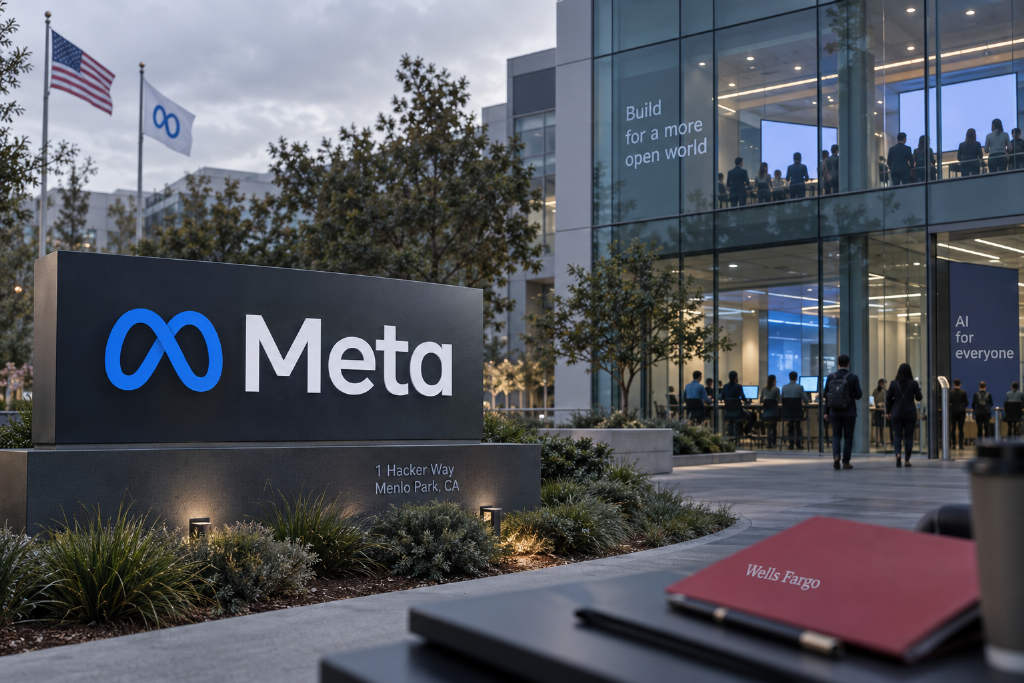
Meta2026-09-22 07:53:52Meta jumps nearly 12% in a day, adding about $25 billion to Zuckerberg’s net worthMeta shares surged nearly 12% on Sept. 21 local time, lifting founder Mark Zuckerberg’s estimated net worth to $253.6 billion, according to Forbes as cited by BlockBeats. The one-day increase was estimated at $25 billion. The move came after Wells Fargo raised its price target on Meta from $640 to $796 and kept its overweight rating ahead of the Meta Connect event later this week. The report also said investors were showing confidence in the outlook for Muse, Meta’s personal AI assistant. Usage data for Muse was described as a key metric to watch. The figures cited in the report also converted Zuckerberg’s estimated fortune to about RMB 1.70 trillion, with the single-day gain equal to roughly RMB 167.458 billion.400
Meta2026-09-22 07:57:18Meta shares jump nearly 12%, lifting Zuckerberg’s net worth to $253.6 billionMeta shares surged nearly 12% on Sept. 21 local time, pushing founder Mark Zuckerberg’s estimated net worth to $253.6 billion, or about 1.70 trillion yuan. His wealth increased by $25 billion in a single day, equal to roughly 167.458 billion yuan. The stock move came after Wells Fargo raised its price target on Meta from $640 to $796 and kept its overweight rating ahead of the company’s Meta Connect event later this week. Investor confidence in the outlook for Muse, Meta’s personal AI assistant, also supported the rally. According to the report, Muse usage statistics are seen as a key metric to watch as the conference approaches. The move highlights how analyst target changes and product expectations can quickly feed into market pricing for major technology stocks.370
Wells Fargo2026-09-11 06:22:09Wells Fargo CEO’s warning on the Clarity Act centers on deposits, stablecoin rewards, and regulatory gapsA debate around the Digital Asset Market Clarity Act has opened a broader fight over who gets to hold the public’s cash balances and under what rules. The article argues that the common claim that the Clarity Act simply permits interest on stablecoins is inaccurate. H.R. 3633 is mainly a market-structure bill that allocates oversight between the U.S. Securities and Exchange Commission and the Commodity Futures Trading Commission, while stablecoin issuance rules chiefly come from the 2025 GENIUS Act. That law requires payment stablecoins to be fully backed by cash and short-term U.S. Treasuries and bars compliant issuers from directly paying interest or yield merely because users hold, use, or redeem the tokens. The real dispute sits at the boundary: can exchanges, wallets, or affiliates offer rewards that are economically similar to interest if they are tied to balances and holding periods? The piece says banks have a valid concern when platforms gain deposit-like funding power without bank-level capital, liquidity, deposit insurance, and prudential oversight. Still, it argues that not every reward arrangement should be treated as a systemic threat. The larger question is whether regulation can distinguish among payment stablecoins, investment products, and platform subsidies, while focusing on reserve quality, asset segregation, redemption rights, disclosures, and loss allocation rather than treating every user incentive as the same thing.820
Wells Fargo2026-09-08 10:59:44Wells Fargo Cuts SpaceX Target Price to $212ChainCatcher reported that Wells Fargo lowered its target price for SpaceX (SPCX.O) from $215 to $212.870
tokenized dep2026-08-27 07:03:21Why banks are pushing tokenized deposits: keeping money from moving to stablecoinsBanks say tokenized deposits are about payment modernization, programmable money, and round-the-clock settlement. Artem Tolkachev, head of real-world assets at Falcon Finance, argues that this explanation misses the central issue: balance sheets. In his view, tokenized deposits let banks keep funds that might otherwise leave the banking system through stablecoins, preserving deposits that can still be used for lending. The distinction matters because instruments that may look similar to users can shift risk in very different ways. Tolkachev compares tokenized deposits, reserve-backed stablecoins, and overcollateralized synthetic dollars, saying the key questions are where the funds sit and who controls them. The article also points to positions from the Federal Deposit Insurance Corporation, the Federal Reserve Bank of Dallas, the Federal Reserve, and the Bank for International Settlements. Those views converge on one concern: if stablecoins pull deposits away from banks, funding costs could rise before any headline decline in deposit balances becomes obvious, with loan repricing following later. Wells Fargo and JPMorgan are cited as examples of banks already moving tokenized deposit products into live or planned use cases.500
Policy and Re2026-08-26 20:22:48Major U.S. banks move ahead with joint stablecoin planBank of America, Wells Fargo, Santander and more than a dozen major banks are moving forward with plans to jointly launch a crypto stablecoin, according to Techub, citing a Wall Street Journal report. The report said an alliance made up of state bankers associations aims to roll out BankChain Alliance, a blockchain platform designed to support stablecoins, in the first half of 2027. The banks’ stance on issuing their own stablecoins has become more positive, with part of that shift tied to the success of non-bank entrants such as Visa and BlackRock in the sector. The report also noted that Visa, Mastercard and Stripe were said to have started developing a joint U.S. dollar-pegged stablecoin in June. Last month, Visa introduced Visa Stablecoin Platform, an enterprise product that gives financial institutions and fintech companies access to stablecoin management tools. Some of the banks involved in the joint effort have already started their own stablecoin initiatives over the past year, while JPMorgan said it does not currently plan to issue a stablecoin but will keep evaluating its options based on client demand and regulatory conditions.910