Citi2026-10-08 03:03:25Citi raises TSMC target price to NT$4,000 on AI demand outlookCiti said in a research note that Taiwan Semiconductor Manufacturing Co. could keep revenue growth above 40% through 2027, supported by strong demand for AI computing power, the potential expansion of AI agents, and the rise of the co-packaged optics, or CPO, network cycle. The bank added that TSMC’s AI-related revenue growth next year could come close to doubling, as most of its AI chip customers, including Nvidia, Advanced Micro Devices, and Broadcom, are expected to see faster growth. Based on that view, Citi said the market is likely to continue lifting earnings expectations for TSMC. The bank also projected that the company’s capital expenditure could rise to $81 billion in 2027 and $90 billion in 2028, backed by what it described as a strong revenue outlook. Citi maintained its Buy rating on TSMC and lifted its target price to NT$4,000 from NT$3,800. The note was cited by Jin10, according to Odaily.00
TSMC2026-10-08 03:11:46Citi raises TSMC target price to NT$4,000, says AI revenue growth could nearly double next yearCiti analysts said in a research note, cited by Jinshi and relayed by ChainCatcher, that Taiwan Semiconductor Manufacturing Co. (TSMC) could keep revenue growth above 40% through 2027, supported by strong demand for AI computing power, the potential expansion of AI agents, and the rise of the co-packaged optics networking cycle. The analysts added that growth among major AI chip customers, including NVIDIA, Advanced Micro Devices (AMD), and Broadcom, is expected to accelerate, which could push TSMC’s AI-related revenue growth close to doubling next year. Citi said that outlook may lead the market to keep lifting its earnings expectations for the chipmaker. The bank also said TSMC’s capital expenditure could rise to $81 billion in 2027 and $90 billion in 2028 on the back of its revenue outlook. Citi maintained its buy rating on the stock and raised its target price from NT$3,800 to NT$4,000.00
Lumentum2026-10-07 16:30:18Lumentum jumps about 570% in a year, lifting market cap to roughly $101.7 billionLumentum, a supplier of components used in AI infrastructure, has seen its stock surge about 570% over the past year, outperforming Nvidia and Micron, according to a Techub News item citing BeInCrypto. On Oct. 6, the company’s shares rose another 3.82% to close at $1,133.40, bringing its market capitalization to about $101.7 billion. The company makes lasers and optical components used in data centers, telecom networks, and AI infrastructure. For the fourth quarter of fiscal 2026, Lumentum reported revenue of $1.01 billion, up 109.3% from a year earlier. Views on the stock’s next move remain split. Citi set a price target of $1,400, while UBS assigned a target of $820. The report did not provide additional detail on the basis for those targets.20
gold2026-10-09 03:11:11Goldman Sachs and Citi stay bullish on gold as spot prices and Hong Kong mining stocks riseGold and related mining shares in Hong Kong moved higher on Oct. 9, with spot gold up 0.98% over the past 24 hours to $4,174 per ounce, according to Bitget market data cited by BlockBeats. In Hong Kong trading, Chifeng Gold, Zijin Gold International, Ganfeng Lithium and Tianqi Lithium each rose more than 5%, while Zijin Mining and Shandong Gold gained more than 4%. The move came as fresh data from China’s central bank showed the country’s gold reserves reached 77.47 million ounces at the end of September, up 740,000 ounces from a month earlier. The increase marked China’s 23rd straight month of adding to its gold holdings. Major banks also kept a constructive view on the metal. Goldman Sachs said strong demand from central banks seeking to diversify foreign exchange reserves could lift gold to $4,900 an ounce by the end of 2026. Citi set a 0-3 month target of $4,800 per ounce and a 6-12 month target of $5,000 per ounce, both above the current spot price.20
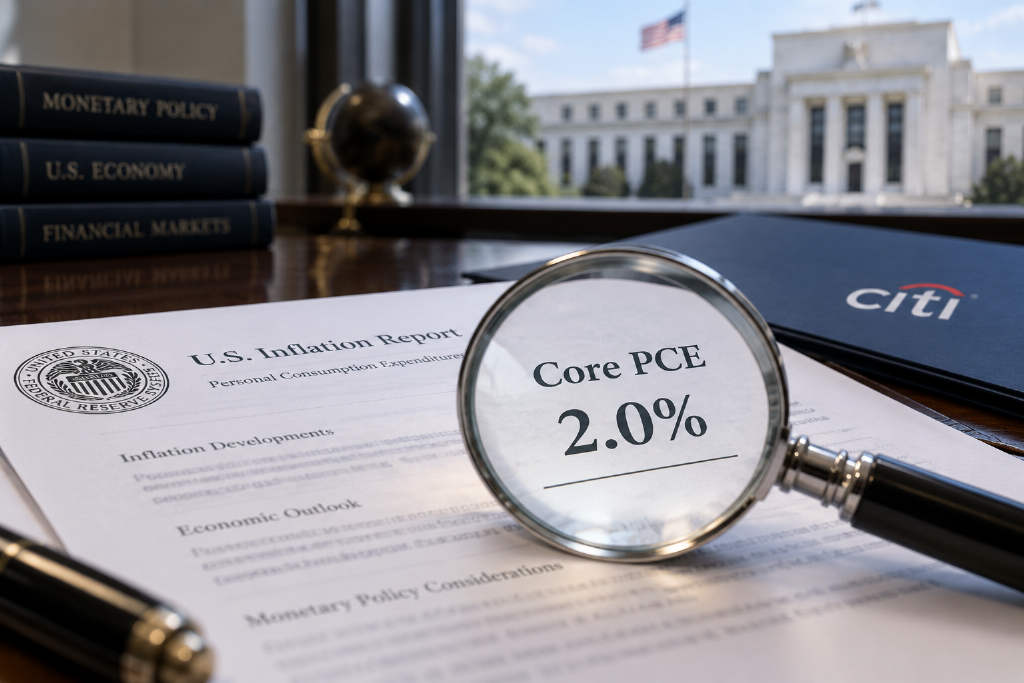
Citi2026-10-09 02:49:11Citi says a dovish Fed surprise may be building as core PCE nears 2% annualized paceCiti said a potential "dovish surprise" from the Federal Reserve would more likely come from an earlier end to the hiking cycle, not a quick shift to rate cuts. In a report cited by BlockBeats on Oct. 9, economist Andrew Hollenhorst said the key test is whether core PCE inflation keeps running near a 2% annualized pace over the short term. Citi argued the U.S. economy does not appear overheated and said there has not been a strong case for more tightening. The bank pointed to the September meeting minutes, which suggested at least some officials did not view the economy as clearly overheating and supported a rate hike largely on risk-management grounds because of upside inflation risks. Citi is focused on monthly core PCE rather than the still-elevated year-over-year reading. It noted that August core PCE rose 0.2% month over month, July was revised to 0.1%, and August rose 3.0% from a year earlier. The bank also said firms have not broadly passed energy costs into core prices and expects core inflation to stay subdued over the next four months, with downside risk for September.10
Citi2026-10-06 10:24:19Citi Raises AMD Price Target to $800 From $575Citi has raised its price target on Advanced Micro Devices, Inc. (AMD.O) to $800 from $575, according to a brief newsflash cited by Odaily and sourced to Jin10. The item only states the target change and does not include any additional details on the rationale behind the revision, any rating action, or a broader note on the stock. No further information was provided in the source text beyond the updated target level and the previous figure. As a result, the report is limited to the target adjustment itself and the named sources attached to the newsflash.10
AI shopping a2026-10-06 03:40:34Jan Kniffen says AI shopping agents could steer customers away from Nike and other legacy brandsJan Kniffen, CEO of retail advisory firm J. Rogers Kniffen Worldwide Enterprises, said on CNBC that AI shopping agents are likely to start selecting and purchasing products for consumers in the near term, a shift he said could put established brands such as Nike at risk of losing customers. His point was straightforward: if a shopper asks for a category like running shoes rather than naming a brand, the AI agent may recommend competing labels such as Hoka or On. Nike is already under pressure. The company’s latest quarterly revenue fell 4%, and it expects a high-single-digit decline for the current fiscal year. The report noted that Nike has tried selling through AI channels including Google’s Gemini chatbot, but that may not prevent AI agents from choosing rival products instead. Kniffen also said scale still matters in the AI era and described Walmart as the best operator of AI applications in the United States. Separately, Citi analysts said in a report that Nike is shifting toward a cost-cutting narrative. Nike shares are down 47% this year, making the stock one of the worst performers in the Dow Jones Industrial Average, according to the report cited by BeInCrypto.00
Dollar stable2026-10-02 12:14:52Dollar stablecoins are moving into bank rails as APIs, says Wen HongjunA sharp rise in U.S. Treasury yields, the launch of OUSD, Citi’s partnership with Coinbase, and the rollout of Roughrider through Fiserv are being read by commentator Wen Hongjun as part of the same structural shift: dollar stablecoins are moving out of the foreground as crypto products and into the background as bank infrastructure. Wen argues that the economics of stablecoins look stronger in a higher-rate environment because reserve income becomes more valuable. In that setup, distribution matters more than issuance. He points to OUSD’s zero-fee mint and redeem model plus reserve-yield sharing for more than 140 partners, Citi handling fiat flows while Coinbase runs the onchain layer, and Roughrider being embedded into Fiserv’s existing banking interface for more than 90 financial institutions in North Dakota. His broader claim is that stablecoins are being packaged into standardized banking functions: mint, transfer, and redeem. If that continues, banks may not need to become crypto companies at all. They would simply call a stablecoin API, while core processors and interface providers capture a larger share of the value chain.320