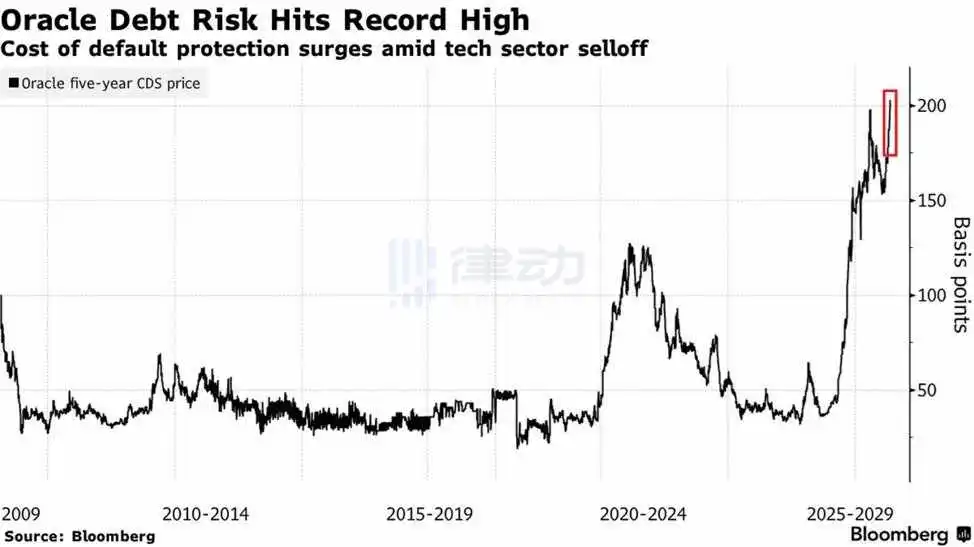
Oracle2026-07-24 13:29:05Oracle’s 5-Year CDS Hits Record High as Credit Risk Concerns DeepenOracle Corp.’s 5-year credit default swaps climbed to about 203 basis points on July 24, setting a record high and signaling sharper concern over the company’s credit profile. At that level, default protection on $10 million of debt would cost roughly $203,000 a year. According to the source material, Oracle’s CDS has risen more than fourfold since mid-2025 and has moved above its peak during the 2008 financial crisis. Borrowing costs are also moving higher. The spread on Oracle’s 6.7% bond due 2056 widened by 8 basis points on Monday to 263 basis points, while the spread on its 5.7% bond due 2036 widened by 9 basis points to 205 basis points. Separately, S&P Global Ratings downgraded Oracle to BBB- on July 9, just one notch above junk status, citing the company’s rapidly growing AI-related spending. The report said Oracle’s credit risk has now reached crisis levels.2680
WuBlockchain2026-07-21 12:28:07WhiteLine says AI spending is now constrained more by credit than free cash flowWhiteLine Daily argues that the market is entering a new phase in the AI buildout, where the key question is no longer just how much large tech companies are willing to spend. The focus is shifting to the cost of financing that spending and whether new AI revenue can keep pace. The note highlights Alphabet and IBM ahead of their July 22 results, saying enterprise budgets appear to be moving toward servers, storage, and memory rather than being evenly spread across software and consulting. That puts pressure on cloud providers to show that rising demand for compute can turn into revenue, operating profit, and orders. The analysis also pushes back on the idea that weaker free cash flow alone would force Alphabet to slow down. WhiteLine says Alphabet still has strong operating cash flow and fast-growing cloud revenue, making it more likely to rely on a mix of cash flow, debt, and equity than to cut infrastructure spending. Oracle is presented as a live market test: even with strong order metrics, its shares still fell after investors focused on whether future profits would cover depreciation, interest expense, and financing costs. WhiteLine’s central view is that the first hard limit on AI CapEx is credit deterioration, not free cash flow compression.1600