Mastercard
Oct 16, 2026

Mastercard folds fiat and stablecoin rails into one platform, targeting the corporate money flow gateway

Mastercard and its stablecoin infrastructure unit BVNK have launched Global Money Platform, a product designed to bring together several pieces of cross-border money movement that companies often have to source separately. According to the company announcement, banks, fintech firms and enterprises can access multi-currency accounts, fiat-to-stablecoin conversion, stablecoin-linked cards and local bank payouts through Mastercard Move via a single API. The platform uses a modular structure, allowing firms to adopt specific functions based on business needs rather than replacing existing bank relationships outright. The launch follows Mastercard’s acquisition of BVNK, announced in March 2026 for up to $1.8 billion, including up to $300 million in contingent payments, and completed on Aug. 3. BVNK’s role has been to help businesses collect, pay, store, convert and manage funds across fiat and onchain assets. Mastercard says the combined platform supports more than 50 fiat currencies, stablecoins and other digital assets, and connects to more than 20 blockchains and real-time payment networks. The company also said Mastercard Move can reach more than 17 billion payment endpoints and that it plans by 2027 to expand stablecoin balance payout capabilities to more than 40 local currencies across over 200 countries and territories. Nuvei and Marqeta are set to be the first integrations, with Ontop, Beem and Almond FinTech also joining.


520
Mastercard folds fiat and stablecoin rails into one platform, targeting the corporate money flow gateway
Mastercard
Oct 15, 2026

Mastercard and BVNK launch stablecoin payments platform reaching hundreds of millions of merchants

Mastercard and fintech firm BVNK on Oct. 15 announced the launch of Global Money Platform, a new offering that connects stablecoin balances to hundreds of millions of merchant locations worldwide and supports card issuance in more than 130 countries. The platform combines fiat accounts, stablecoin conversion, payment cards and cross-border payouts through a single API, allowing banks, fintech companies and enterprises to offer accounts that hold both fiat currency and stablecoins. The companies said Nuvei, Marqeta, Ontop, Beem and Almond FinTech have already integrated with the platform. Mastercard added that Mastercard Move can connect to more than 17 billion payment endpoints and convert stablecoin balances into local currency before sending funds directly to bank accounts. According to the announcement, the platform is scheduled to expand by 2027 to cover more than 200 countries and territories and support over 40 currencies. Bitcoin.com News also said Mastercard acquired BVNK in August in a deal valued at up to $1.8 billion.

810
Mastercard and BVNK launch stablecoin payments platform reaching hundreds of millions of merchants
BVNK
Oct 15, 2026

BVNK Launches Global Money Platform Connecting Stablecoins to Mastercard Rails

BVNK has launched a global money platform designed to connect stablecoins with Mastercard rails, according to TheDefiant. The company said Nuvei and Marqeta are among the first planned integrators for the platform. The report also said local payout coverage is expected to expand in 2027. In a separate note included with the article, TheDefiant said its articles are stored on Filecoin. No additional rollout details, transaction figures, or regional breakdowns were provided in the source text.

760
BVNK Launches Global Money Platform Connecting Stablecoins to Mastercard Rails
stablecoins
Oct 13, 2026

Why stablecoin cards are unlikely to displace Visa

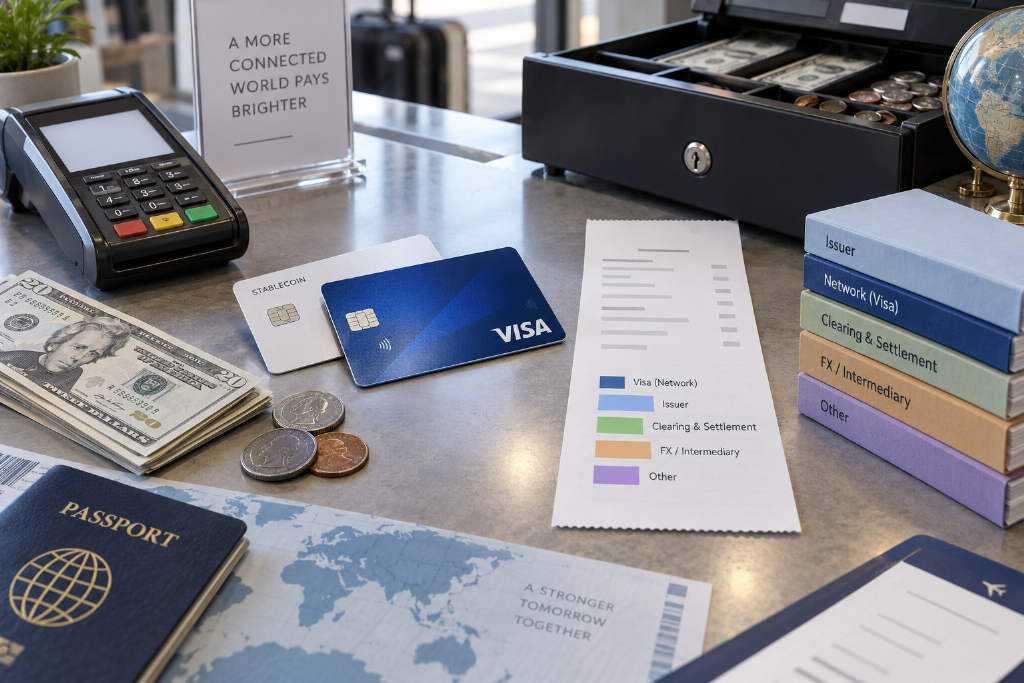
A commentary carried by WuBlockchain argues that stablecoin-linked payment cards are unlikely to replace Visa in domestic consumer payments, even if they improve parts of the settlement stack. The piece says the market often overstates how much of a merchant’s card fee goes to the card network. In a $100 rewards credit card transaction, the merchant may pay about $2.20 in total discount fees, but roughly $1.75 goes to the issuing bank as interchange, $0.30 to $0.70 goes to the acquirer or processor, and only about $0.13 to $0.18 goes to Visa or Mastercard as assessment fees. On that basis, removing Visa alone cuts only a small slice of the total cost. The article also argues that most stablecoin card programs are debit products, not credit products. Because users preload funds in USDC or USDT, there is no revolving credit income and no traditional credit-funding cycle. That leaves a much thinner revenue pool. The commentary says stablecoins can make a real difference in clearing and settlement, where T+2 timelines can be compressed toward near-real-time settlement, and in cross-border foreign exchange flows. But it concludes that these gains mainly benefit issuers and card operators rather than merchants, whose discount rates do not automatically fall just because settlement becomes faster.

700
Why stablecoin cards are unlikely to displace Visa
stablecoins
Oct 14, 2026

Stablecoin cards are unlikely to upend Visa, and the savings case is thinner than advertised

A detailed analysis of stablecoin-linked payment cards argues that the biggest cost in card acceptance does not sit with Visa or Mastercard, but with issuing banks and merchant acquirers. Using a $100 rewards credit card purchase as an example, the piece says merchants may pay about $2.20 in total discount fees, while Visa or Mastercard collect only about $0.13 to $0.18 of that amount. The largest share, roughly $1.75, goes to the issuing bank as interchange, with another $0.30 to $0.70 going to the merchant-side processor. The article also says most stablecoin cards on the market are debit products funded in advance with assets such as USDC or USDT, which puts them in a very different economic model from credit cards. Even where exempt debit interchange can reach about $0.62 per transaction, that revenue still has to cover network fees, processor fees, partner bank costs, fraud losses, and operating expenses. Its conclusion is that stablecoins do have a real role in payments, but mostly in settlement and cross-border foreign exchange rather than in reducing the core cost of domestic card acceptance. Faster settlement may improve working capital for issuers and card programs, yet that benefit does not automatically lower merchant discount rates or change the checkout experience for consumers.

850
Stablecoin cards are unlikely to upend Visa, and the savings case is thinner than advertised
PBOC
Oct 13, 2026

PBOC approves preparatory work for three bank card clearing entities

The People’s Bank of China said on Oct. 13 that it has issued administrative licensing decisions allowing three companies — Visa Information Technology (Beijing) Co., Ltd., LianTong (Hangzhou) Technology Services Co., Ltd., and Mastercard NetsUnion Information Technology (Beijing) Co., Ltd. — to begin preparatory work for bank card clearing institutions in China. According to the disclosure, the three entities correspond to the China operations of Visa, American Express, and Mastercard. The central bank said the approved companies must complete their preparation within one year. After that, they are required to submit applications to commence operations to the PBOC, and can only receive a bank card clearing business license after approval by the PBOC together with the National Financial Regulatory Administration. Only then can they formally launch business. PANews reported that the simultaneous approval of preparatory qualifications for the three major international card organizations is seen by industry participants as a sign that China’s bank card clearing market is continuing to open up.

1010
PBOC approves preparatory work for three bank card clearing entities
Policy Regulation
Oct 12, 2026

Stripe, Mastercard and Circle spent more than $3 billion acquiring stablecoin firms over two years

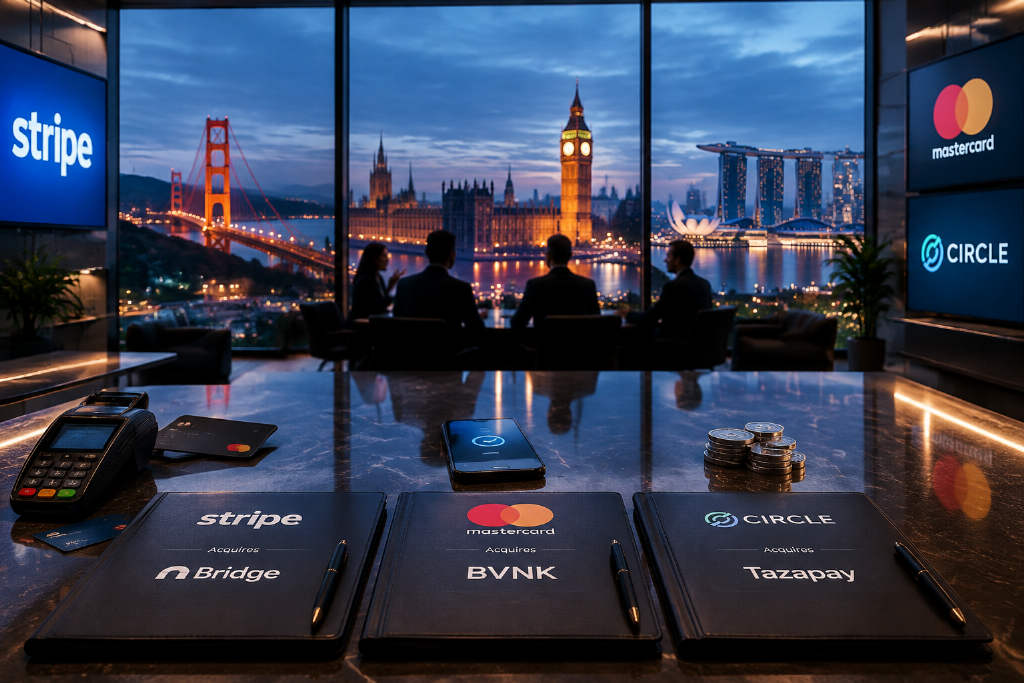
Venture investor Alex Lazarow said in a recent article that Stripe, Mastercard and Circle have each moved to acquire stablecoin-related companies over the past two years, with the combined value of the three deals topping $3 billion. The targets were Bridge in the U.S., BVNK in the U.K., and Tazapay in Singapore. According to Lazarow, the three companies were founded between 2020 and 2022 and had raised roughly $200 million in total before being acquired. He said the transactions point to growing competition around stablecoin payment infrastructure among established payment companies and crypto firms. Stripe announced in 2024 that it would buy Bridge for slightly more than $1 billion. Mastercard’s BVNK deal was valued at up to $1.8 billion, including $1.5 billion in base consideration and $300 million in contingent payments. Circle agreed to acquire Tazapay in a stock deal worth $400 million, with completion expected in 2027. Lazarow also cited rising stablecoin adoption, clearer regulation and stronger demand for real-time cross-border payments as key forces behind the M&A activity.

470
Stripe, Mastercard and Circle spent more than $3 billion acquiring stablecoin firms over two years
Policy Regulation
Oct 12, 2026

Forbes: Three stablecoin infrastructure deals topped $3 billion over the past two years

Forbes reported, citing an article by venture investor Alex Lazarow, that Stripe, Mastercard and Circle have each acquired stablecoin-related payment infrastructure companies over the past two years, with the combined value of the three deals exceeding $3 billion. The targets were Bridge in the U.S., BVNK in the U.K. and Singapore-based cross-border payments platform Tazapay. According to the report, the three companies were founded between 2020 and 2022 and had raised about $200 million in total, pointing to rising interest in stablecoin payment infrastructure from both traditional payments firms and crypto companies. The article said growing stablecoin adoption, clearer regulatory frameworks and rising demand for real-time cross-border payments are driving the M&A trend. It also cited data showing adjusted stablecoin transaction volume rose 91% year over year in 2025 to $10.9 trillion, close to Visa’s $14.2 trillion, while real-world payment volume more than doubled to about $390 billion.

450
Forbes: Three stablecoin infrastructure deals topped $3 billion over the past two years
Total 258 items
Go topage