ZetaChain2026-09-21 07:11:00ZetaChain votes to shut down its L1 and move to Solana, rewriting the case for ZETAZetaChain has approved Proposal 68 with 99.4% support, clearing the way for the project to shut down its own Cosmos-based Layer 1 and migrate to Solana. The plan would convert ZETA on a 1:1 basis into a Solana SPL asset and shift the token’s role away from gas fees, staking, and validator security toward access to Anuma, the team’s AI application. At roughly $0.03, ZETA is down 99% from its February 2024 all-time high of $2.85, with a market capitalization near $50 million and a fully diluted valuation around $65 million. The move marks a sharp strategic break from ZetaChain’s original cross-chain interoperability thesis, which struggled to gain enough developers and deployed applications to justify an independent chain. The team now argues that Solana’s execution environment and tooling are a better fit for Anuma, a “private AI” product launched in February 2026 that, according to official figures cited in the article, has more than 300,000 users and has processed over 1 million AI requests. The key question for token holders is whether demand tied to locking ZETA for Anuma Pro can replace the structural demand once associated with running an L1.380
Aptos2026-09-21 08:31:05Aptos validator count falls 42% in under two years as nodes cluster in Europe and the U.S.Aptos’ validator set has shrunk sharply, with the network moving from 146 validators across 22 countries and 48 cities in October 2024 to 84 validators across 13 countries and 28 cities by September 2026. The article argues this was not just a drop in node count. It ties the shift to faster chain performance, reward design changes, and a steep decline in APT’s dollar price, all of which altered where validators could operate economically. After the Baby Raptr upgrade and AIP-131, also known as Velociraptr, pushed Aptos block times below 50 milliseconds in June 2025, latency and data center location carried more weight for validator proposal success. Because Aptos rewards are linked to staked amount, reward rate, and proposal success rate, operators farther from the main validator cluster faced weaker revenue performance. At the same time, annual staking rewards fell from 7% to 2.6%, while APT dropped from $9.50 to $0.58. Even though average stake per validator rose from 5.75 million APT to 8.97 million APT after weaker operators exited, the annualized reward measured in U.S. dollars still fell 96%. The piece says this tension is not unique to Aptos. It also points to Ethereum’s EIP-8363 debate and argues that long-term decentralization depends on whether validators can survive weak markets, keep operating costs down, and leave room for new entrants.360
a16z2026-09-20 05:30:57Crypto market rethinks VC backing as a16z portfolio closures mount and Hyperliquid tops $30 billionA TechFlowPost analysis argues that crypto investors are placing less weight on venture capital branding and more on actual users, revenue, and token distribution. The piece points to a list compiled by X account Zhuifeng Lab showing that several a16z crypto-backed projects shut down across 2026, including Entropy, Yupp, Foundation, Syndicate, Orchid Protocol, Legend, Proof of Play, and Linera. It says that out of 189 projects backed by a16z crypto, 42 have either ceased operations or been sold. The article contrasts those failures with Hyperliquid, a perpetual futures DEX that took no outside VC funding. According to the report, HYPE hit an all-time high of $92.56 on Sept. 18, pushing its market capitalization above $30 billion and into the top 10 crypto assets. TechFlowPost says Hyperliquid relied on founder Jeff Yan’s own capital and early trading profits rather than seed rounds, strategic investors, or advisor token allocations. The analysis frames the shift as a broader reassessment of the old assumption that VC backing signals quality. It highlights three structural frictions in crypto venture investing: timing mismatch, incentive mismatch, and narrative decay. It also argues that Hyperliquid’s rise came from product-led growth, user-aligned token distribution through points and an airdrop, and protocol revenue used by its Assistance Fund to buy back HYPE on the open market.390
tread.fi2026-09-16 01:50:09tread.fi sets TREAD genesis for Sept. 16, listing spot pair on HyperliquidDigital asset retail and institutional execution layer tread.fi said its native token TREAD will undergo genesis at 13:00 UTC on Sept. 16, 2026. The token will launch on Hyperliquid as a HIP-1 spot asset, with TREAD/USDC as its main trading pair. According to the announcement, TREAD is designed as a consumptive utility token for use rather than staking, with utility to be defined through Tread Improvement Proposals. TREAD has a fixed total supply of 100 million tokens and no inflation mechanism. The genesis allocation accounts for 15.2% of supply and will be fully unlocked based on platform usage. Tokens will be sent directly to users’ registered HyperCore addresses, with no claim transaction and no gas payment required. Team members are not eligible for that distribution. The broader allocation includes 35.5% for community and ecosystem, 23.8% for the Tread Labs treasury, 18.0% for the team, and 7.5% for the foundation treasury. Tokens allocated to the team and Tread Labs treasury will remain locked for one year and then unlock linearly over three years. tread.fi also said there are no allocations for private investors, venture capital, centralized exchanges, presales, or SAFTs. The platform said it has processed more than $100 billion in volume for more than 30,000 retail traders and institutional clients across over 20 centralized and decentralized exchanges.410
STANDARD2026-09-15 03:30:04STANDARD token economics draw focus after launch trading tops $40 millionSTANDARD, a Robinhood chain ecosystem token tied to The Standard Reserve, briefly reached a $40 million valuation within two hours of launch before pulling back to $28.91 million, while trading volume moved past $40 million, according to BlockBeats. On-chain circulation currently stands at 98,323,639.9815 tokens. The project says it is designed as an "on-chain sovereign central bank," using roughly 4,000 lines of immutable smart-contract code instead of a traditional central bank or DAO-based governance process to run monetary policy automatically. Its issuance model reacts to net ETH flows in the official Uniswap v4 pool: issuance expands when funds flow in and slows when funds flow out, with protocol revenue used for reserve accumulation, protocol-owned liquidity, or buybacks and burns depending on conditions. The white paper sets a hard cap of 1 billion STANDARD tokens. Of that amount, 100 million were pre-minted at genesis and locked as protocol-owned liquidity in the ETH-STANDARD pool on Uniswap v4. The remaining 900 million form the issuance budget. The protocol’s base issuance starts at 700,000 tokens per day, adjusted by a policy multiplier ranging from 0.2x to 1.25x, with 1x at launch.760
Robinhood Cha2026-09-11 10:39:11Robinhood Chain’s CME pushes meme trading beyond stock pairings into commodities and offbeat asset poolsCapital on Robinhood Chain is rotating toward a new launch platform, Commodity Market Exchange, or CME, after earlier attention centered on stock-paired meme trading. According to the source article, CME’s token has climbed past a $15 million market capitalization, while daily trading volume has approached the $10 million range. The platform’s pitch is straightforward but unusual: instead of limiting meme pairs to stablecoins, ETH, or tokenized equities, it expands pool assets to 94 real-world commodities and non-standard items. The system does not give users direct ownership of physical goods. Rather, it relies on a lightweight synthetic-asset structure. CME issues 94 ERC-20 commodity tokens, pulls reference prices from sources including near-month commodity futures, fast-food menu prices, and TCGplayer card listings, updates those prices about every 60 seconds, and uses one-sided Uniswap pools with off-chain keeper bots to move liquidity when prices shift. Its token model is also a major part of the draw. The article says 40% of commodity fees are automatically distributed to token holders in the matching commodity token every 15 minutes, 30% of fees are converted into ETH to buy back and burn CME, and creator revenue sharing is set at 0% in the secondary market. The piece also notes that depeg risk remains if extreme one-way price action or network delay hits the oracle and keeper setup.1140
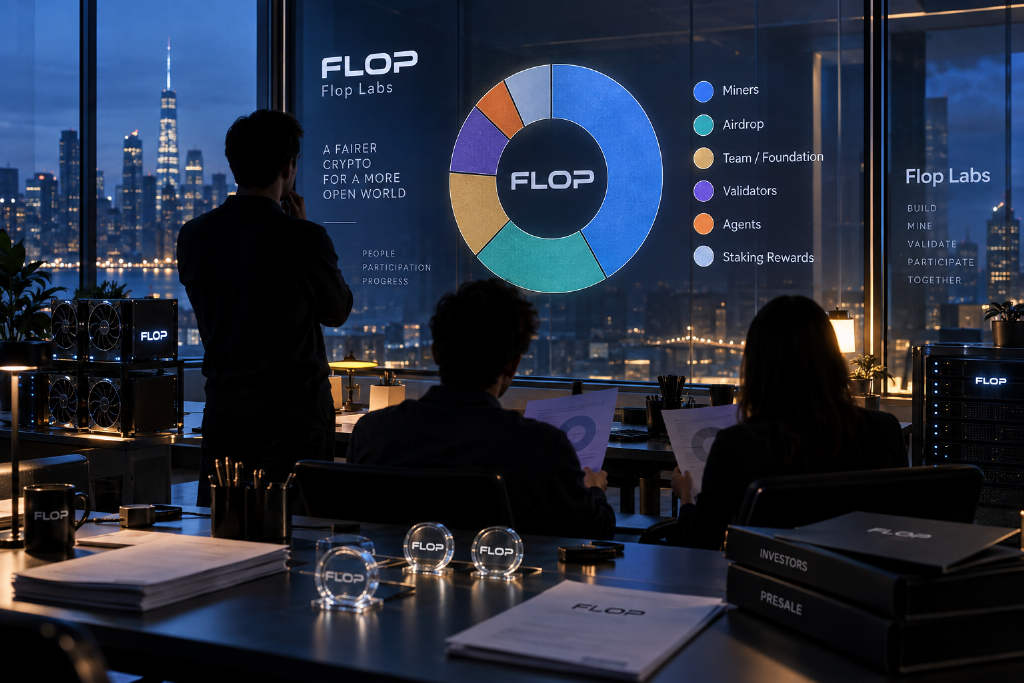
Flop Labs2026-09-10 07:53:02Flop Labs releases updated FLOP tokenomics draft with no VC allocation or presaleFlop Labs has released an updated draft of the FLOP tokenomics model following community feedback, laying out a contribution-based distribution structure with no venture capital allocation and no presale. The project said every token must be earned through network contribution. Under the draft, total supply is projected to reach 18.1 billion FLOP by year 10, while long-term inflation is set at 0.5% annually. The issuance model uses a fixed halving cycle and keeps a permanent tail-emission mechanism after halvings to continue rewarding network participants. The year-10 allocation shows miners receiving 8.8 billion tokens, or 48.6% of supply, the largest share in the model. Airdrops account for 4.4 billion tokens, or 24.3%, with separate allocations for miners, validators, agents, and reserves/incentives. Other disclosed allocations include 2 billion tokens for the team and foundation, 1.2 billion for validators, 1.2 billion for brokers/agents, and 600 million for staking rewards.1010
Flop Labs2026-09-10 07:16:00Flop Labs revises FLOP tokenomics, sets 10-year supply at 18.1 billionFlop Labs has released an updated tokenomics model for FLOP, saying the token’s total supply is projected to reach 18.1 billion by year 10, slightly higher than in its earlier draft. The project also lowered its long-term annual inflation rate to 0.5%. Under the revised allocation plan, miners receive 48.6% of the supply, airdrops account for 24.3%, and the team and foundation take 10.8%. Validators and brokers/agents each receive 6.5%, while staking rewards make up 3.2%. Flop Labs also said there is no venture capital allocation and no presale, adding that all tokens will be obtained through participation. The update outlines both the projected long-term supply path and the breakdown of token distribution in the latest version of the FLOP model.300