


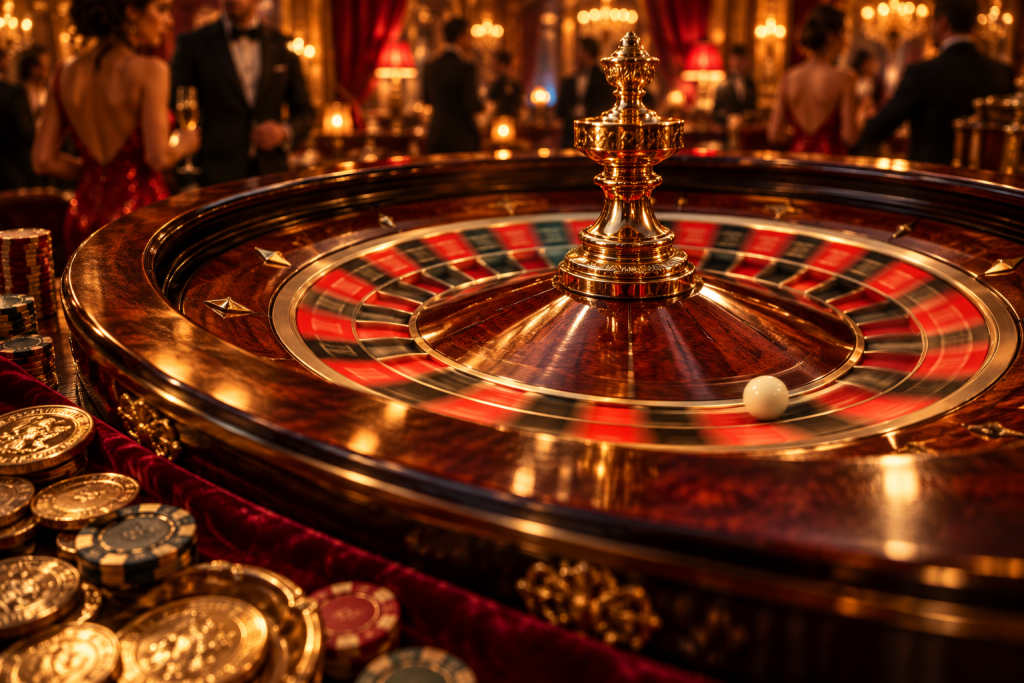
The wheel began as a by-product of a failed physics experiment
Before roulette was a casino game, the spinning wheel itself was an instrument of scientific curiosity. In the 17th and early 18th centuries, European inventors chased perpetual motion machines, and one of the most famous attempts came from the French mathematician and philosopher Blaise Pascal. His experiments with a spinning wheel did not produce a machine that ran forever, but they did leave behind a rotating disc with numbered compartments, a mechanism that gambling houses in Paris later adapted into a betting game. The original roulette wheel was not designed as a casino device; it was repurposed from laboratory equipment.
That origin explains a few things about the early wheel's appearance. It was simpler than a modern wheel, often smaller in diameter, and its numbering followed no universal standard. Different houses in Paris used different sequences, and early wheels sometimes carried fewer pockets than the 37 or 38 players know today. The one element that did stabilise early was the presence of a zero, which gave the house its mathematical advantage. Without a zero, a bet on red or black would pay even money on a proposition that was exactly balanced. The zero pocket tilted that balance.
What the earliest documented wheels showed
Historical accounts of the first roulette wheels describe a wooden disc set into a shallow bowl, with metal or wooden separators between the pockets. The pockets themselves were often painted in alternating colours, though the familiar red-and-black pairing took time to become standard. Some early wheels used red for a single zero and black for the numbers, while others used different colour schemes entirely. The wheel sat flat or at a slight angle, and the dealer spun it by hand before sending a small ball in the opposite direction.
The numbering on these early wheels was not fixed. A wheel in one Parisian gaming house might run from 1 to 36 with the zero placed between two particular numbers, while a wheel across town used a different order. This matters because the modern wheel's number sequence is not random decoration. The arrangement of high and low numbers, odd and even numbers, and red and black pockets is balanced so that no large section of the wheel is dominated by one colour or one half of the number range. That balance took decades to refine.
How the single zero became the European standard
The defining feature of the original French wheel was the single zero. When roulette spread through Europe in the 19th century, the single-zero layout travelled with it, and it remains the standard on what players now call the European wheel. A European wheel has 37 pockets: the numbers 1 through 36 plus a single zero. The zero is usually green, a colour choice that separates it visually from the red and black numbers and signals that it is not part of either even-money proposition.
The zero's function is structural. On a wheel with no zero, a bet on red would cover 18 pockets and a bet on black would cover the other 18, making the wager a coin flip with no built-in advantage for the house. Adding one green pocket means red and black each cover 18 pockets out of 37, leaving the zero outside both. That single pocket is where the house edge on even-money bets comes from. The same logic applies to any bet that does not include the zero.
The American wheel added a second green pocket
When roulette crossed the Atlantic, operators made one significant change: they added a double zero. The American wheel has 38 pockets, the numbers 1 through 36 plus a single zero and a double zero, both green. The extra pocket increases the house edge on most bets because the same 18 red or 18 black pockets now sit inside a larger total. A player betting red on a European wheel faces 18 winning pockets out of 37; on an American wheel, the same bet faces 18 winning pockets out of 38.
The double zero did not appear everywhere at once. Early American wheels sometimes carried an eagle symbol instead of a double zero, and some carried both an eagle and a double zero as separate pockets. The eagle was an additional house pocket that functioned like another zero, and it disappeared as the double-zero layout became standard. The presence of these extra pockets is the clearest visual difference between the two main wheel families still in use.
| Feature | Original French wheel | European wheel today | American wheel today |
|---|---|---|---|
| Total pockets | Varies by house, often fewer than 37 | 37 | 38 |
| Zero pockets | Single zero | Single zero | Single zero and double zero |
| Zero colour | Red, black, or green depending on the house | Green | Green |
| Number sequence | No universal standard | Standardised balanced sequence | Standardised sequence with extra zero inserted |
| Effect on even-money bets | Zero creates the house edge | 18 winning pockets out of 37 | 18 winning pockets out of 38 |
Why the number sequence is deliberate, not decorative
A casual look at a modern roulette wheel suggests the numbers are scattered at random. They are not. The sequence is arranged so that high and low numbers alternate as much as possible, and so that red and black pockets are distributed evenly around the wheel. The single zero sits between two black numbers on a European wheel, and the double zero sits between two red numbers on an American wheel, a placement that keeps the green pockets from clustering and disrupting the colour balance.
This arrangement matters for the player because the wheel's geometry interacts with the betting layout. A bet on a single number covers one pocket, but a bet on a section of the wheel, such as the French call bets that cover groups of adjacent numbers, depends on where those numbers physically sit. The standardised sequence makes those section bets possible and predictable. The original wheels, with their inconsistent numbering, could not support that kind of wagering.
From hand-spun wooden disc to precision-machined equipment
The physical construction of the wheel changed as much as its numbering. Early wheels were wooden, hand-built, and imperfect. A slight warp in the disc or an uneven pocket could bias the wheel toward certain numbers, and observant players sometimes exploited those biases. Modern wheels are machined to tight tolerances, with pockets of uniform depth and width, a level rotor, and low-friction bearings. The ball is usually made of ivory, Teflon, or a similar synthetic material, and the wheel is checked regularly for wear.
That shift from handcrafted to precision equipment did not change the game's mathematics, but it changed the player's relationship to the wheel. A biased wheel was a physical defect that could be observed and exploited. A modern wheel is designed to make every pocket as equally likely as the mechanism allows. The house edge comes from the zero or zeros, not from any mechanical favouritism built into the wheel itself.
What a player should look at before sitting down
Anyone approaching a roulette table benefits from identifying which wheel they are facing before placing a bet. The first thing to check is the number of green pockets. One green pocket means a European-style layout with 37 total pockets; two green pockets means an American-style layout with 38. That single observation tells the player more about the house edge on their bets than any other visual feature of the table.
The second thing to check is the table's posted minimum and maximum bets, which are printed on a placard at the table. These limits vary by venue and by table, and they determine whether the player's intended bet sizing is possible. The third thing to check is whether the table offers any rule variants, such as the la partage or en prison rules found on some single-zero tables, which alter what happens to even-money bets when the zero appears. Those rules are printed on the table layout itself, and they change the effective cost of betting red or black.
FAQ
Did the original roulette wheel have a double zero?
The earliest French wheels used a single zero. The double zero was an American addition that appeared after the game crossed the Atlantic, and some early American wheels carried an eagle symbol as an additional house pocket. The double-zero layout eventually became standard in the United States.
Why is the zero green on modern wheels?
The green colour separates the zero from the red and black number pockets, making it immediately visible as a pocket that does not belong to either even-money proposition. Early wheels did not always use green for the zero, but the convention became standard as the game's colour scheme settled into its modern form.
Did the original wheel have 37 pockets like today's European wheel?
Not necessarily. Early wheels varied by gaming house, and some carried fewer pockets than the modern 37-pocket European layout. The standardisation of the number sequence and pocket count happened gradually as roulette spread and operators adopted consistent equipment.
Play responsibly
Gambling should be treated as paid entertainment, never as a way to earn income or recover losses. 1-800-MY-RESET (1-800-697-3738)
18+ or 21+ depending on where you are; follow the minimum age that applies to you.
This article is general information about how these mechanics work. It is not legal advice and not a recommendation to gamble or to use any particular operator. Availability and legality differ by jurisdiction — check the rules that apply where you are.