


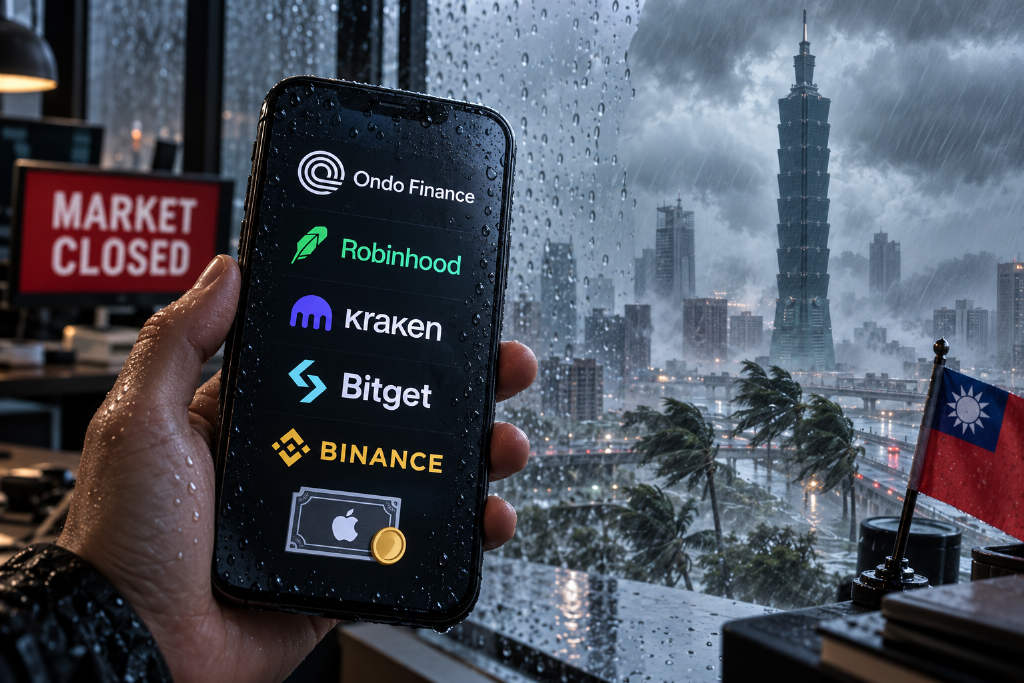
Taiwan’s debate over whether the stock market should shut when Taipei suspends work and classes during a typhoon has resurfaced after Typhoon Jangmi hit the island. Democratic Progressive Party Taipei mayoral candidate Puma Shen said on Oct. 22 that stock trading could eventually be considered separately from the work-and-school suspension system, meaning financial institutions would not necessarily have to follow the same closure standard used for general government offices. Taiwan’s Financial Supervisory Commission said the matter remains under review and that authorities are still collecting opinions and studying feasibility.

ABMedia said the discussion can also be viewed through a different lens as global finance moves deeper into digital infrastructure. Platforms including Ondo Finance, Robinhood, Kraken, Bitget and Binance have rolled out tokenized stock products, raising the question of whether equity trading still needs to depend entirely on traditional exchange hours and physical financial institutions.
Earlier this year, Robinhood CEO Vlad Tenev said turning stocks into blockchain-based tokens should be part of the market’s future. He argued that such a structure could enable real-time settlement, 24/7 trading, native fractionalization, and lower clearing and capital costs. He also said it could reduce systemic risk by cutting the uncertainty that clearing firms and brokers carry during the settlement window, removing the rationale for some trading restrictions.
Puma Shen calls for a separate standard for market operations
According to Liberty Times, Shen was handing out the second issue of his campaign paper at Nanjing Fuxing MRT Station on the morning of Oct. 22 when reporters asked about typhoon leave. He said the basis for suspending work and classes should be made public and transparent, including wind speed, rainfall and the standards used in decision-making meetings.
On Taipei’s role as a financial center, Shen said the city’s stock market operations are currently not separated from the work-and-school suspension system. He said it is worth discussing whether different standards should be set and how financial institutions should handle work suspensions. He added that typhoon preparedness remains the immediate priority. Later that afternoon, Shen said the issue had been discussed before, but would require both central and local government participation, and could continue to be negotiated with the central government.
The link between Taiwan’s stock market and Taipei’s work suspension rules is not just an administrative habit. It is written into Taiwan Stock Exchange rules. Under the exchange’s handling rules for natural-disaster work suspensions, if the Taipei mayor announces a full-day or morning suspension for all public agencies and schools, the centralized market closes for the full day. If only an afternoon suspension is announced, the centralized market generally remains open, but other post-close trading activity stops. The rules also cover brokerage operations, settlement deferrals and financial arrangements in affected areas.
That is where tokenized stocks enter the conversation.
How tokenized stocks work: stock ownership is not the same as stock price exposure
Traditional stock trading involves brokers, exchanges, clearing and settlement institutions, and custody systems. Tokenization on blockchain tries to convert part of those rights or economic interests into tokens that can circulate onchain.
Most current products follow a similar model: a regulated institution holds the real shares, then issues tokens that track their price. Investors can trade those tokens through crypto exchanges, digital wallets and, in some cases, decentralized exchanges.
This setup means secondary-market trading in the token does not have to follow U.S. stock exchange hours exactly. But trading in the underlying shares, minting and redemption, corporate actions, and the final legal rights tied to the asset may still depend on the existing financial system.
Five major tokenized U.S. stock models
Ondo Finance: combining real equities with onchain liquidity
Ondo Finance’s Ondo Global Markets issues tokens that give investors economic exposure to actual U.S. stocks or ETFs held by the platform. Its Ondo Stocks use a total-return tracking model, meaning the token reflects not only price moves but also the value of after-tax dividends that are reinvested. The underlying shares are held by a U.S.-registered broker or another qualified custodian, with collateral and legal structures designed to protect token holders.
ABMedia noted that in July 2026, Ondo announced a different custodial tokenized securities model in the U.S., with Micron (MU) and the iShares Core S&P 500 ETF (IVV) as the first products. It also worked with Broadridge to provide shareholder communications and proxy voting functions.
That marked a shift beyond simple price tracking. Ondo was starting to test how shareholder rights could be integrated into tokenized infrastructure within an existing securities regulatory framework.
Robinhood: stock tokens do not equal direct ownership of listed shares
Robinhood’s Stock Tokens use a tokenized debt security structure. According to Robinhood Chain developer documentation, the tokens are issued by Robinhood Assets (Jersey) Limited under the ERC-20 standard and provide economic exposure to U.S. stocks and ETFs. They can be transferred and used in compatible blockchain applications and are integrated with Chainlink price feeds.
But holders do not gain legal or beneficial ownership of the listed company’s shares, and they cannot directly claim shareholder rights against the issuer. The fact that the token can move around the clock does not mean the listed stock itself trades around the clock, nor does it mean every user can redeem without restriction.
Bitget rToken: linking real U.S. stock liquidity with crypto market access
Bitget’s rToken products are issued by Reality, an RWA platform it supports. The model turns U.S. stocks and ETFs into tokenized instruments backed 1:1 by real assets. According to Bitget materials, the underlying shares are held through U.S. broker Alpaca Securities, with reserves verified by a third party. Products trade under symbols such as rAAPL, rNVDA and rTSLA, and users can gain economic exposure through USDT.
One feature of the setup is its link to traditional market liquidity. During regular U.S. stock trading hours, spot orders in rToken products can connect through supporting infrastructure to liquidity on Nasdaq and the New York Stock Exchange. Some popular tokens also support weekend and holiday trading.
On Oct. 13, 2026, Bitget added rToken Stock Transfer, allowing eligible users to move U.S. stocks and ETFs held at traditional brokerages into a designated custody account through a securities transfer process and then convert them into rTokens. That means investors may not need to sell the shares, wire out dollars and repurchase the same exposure with stablecoins. They can tokenize through a qualified transfer route instead.
Even so, ABMedia said rToken holders generally should not expect direct registered shareholder status or ordinary proxy voting rights.
Bitget Wallet: self-custody brings stock exposure onchain
ABMedia also highlighted a separate development beyond centralized exchange products. Self-custody wallets such as Bitget Wallet are trying to extend stock access from brokerage and exchange accounts into blockchain wallets controlled directly by users through their own private keys.
Unlike Bitget exchange’s rToken service, Bitget Wallet is not a single issuer. It aggregates multiple tokenized securities providers so users can get economic exposure to U.S. stocks and ETFs directly through an onchain wallet. The wallet has integrated three tokenized stock systems: Reality, Ondo Finance and xStocks, covering names such as NVIDIA, Tesla and Apple, along with multiple ETFs.
Reality offers more than 1,700 tokenized U.S. stocks and ETFs, covering about 95% of U.S. stock trading volume. Ondo offers more than 450 assets. xStocks offers more than 800. Each uses a different approach to custody, liquidity and dividend handling.
The main distinction is that investors hold the tokenized stock directly at their own blockchain address. They manage the asset through a self-custody wallet and can transfer or trade it on supported blockchain networks, subject to the token’s smart contract, whitelist and transfer rules.
That differs from a traditional brokerage account, where ownership records and transfers sit inside a centralized ledger. Here, the holding and transfer record can appear directly onchain.
Bitget Wallet’s integrated xStocks support round-the-clock onchain trading. Some Reality rToken pairs also offer 24/7 service. Ondo provides different trading windows depending on the product and market mechanism. So even when the traditional U.S. stock market is closed, some tokenized equities can continue to circulate in supported onchain venues.

Still, self-custody does not mean direct ownership of the underlying shares. Users control the token in the wallet, while the real stock remains with a broker or custodian arranged by the issuer. The economic rights investors receive depend on the legal structure of each token.
Kraken xStocks: tracker certificates backed by real shares
Kraken’s xStocks are mainly issued by Backed Assets (JE) Limited. They use a tracker certificate structure, with each token backed 1:1 by the corresponding stock or ETF held in segregated accounts at regulated custodians. TSLAx tracks Tesla shares, for example, while SPYx tracks the SPDR S&P 500 ETF. The tokens can circulate across multiple blockchains, allowing eligible users to keep trading in the secondary market while the traditional U.S. market is closed.
For dividends, xStocks use reinvestment and rebasing mechanisms to adjust holders’ economic exposure. But holders do not receive direct shareholder voting rights or direct claims to cash dividends. The design is aimed at turning time-restricted equities into assets that can move through a global blockchain financial system.
Binance bStocks: building an onchain stock market with 24/7 trading
ABMedia split Binance’s tokenized stock business into two parts. First, in February 2026, Binance Alpha began offering Ondo’s tokenized stocks, including AAPLon, TSLAon and NVDAon. Those products were structured by Ondo rather than issued by Binance itself.
Then in June that year, Binance launched a separate bStocks product issued by BTech Holdings Limited, a company registered in Abu Dhabi Global Market. The tokens are issued on BNB Smart Chain, backed by U.S. securities held by regulated institutions, and allow users to trade around the clock in supported markets, transfer onchain, and convert between shares and tokens through eligible processes.
Even though bStocks are backed by real shares, token holders do not directly become shareholders of the listed companies and do not receive ordinary voting rights or direct dividend rights.
Within 125 days of launch, bStocks reached $1 billion in assets under management, and about 56% of trading activity took place outside regular U.S. stock market hours. ABMedia said that suggests one of the strongest use cases is not replacing the stock market itself, but letting investors adjust equity exposure when the cash market is closed.
Stock perpetual futures already trade 24 hours a day
Tokenizing real shares is not the only way to break past exchange hours. Crypto venues also offer stock perpetual futures, a more direct route to continuous trading.
Unlike Ondo or xStocks, which are tied to real shares, stock perpetual futures are derivatives. Investors do not need to hold the actual stock. Instead, they post margin in assets such as USDT or USDC and trade the price moves of listed companies including Tesla, NVIDIA and Apple.
The structure follows the perpetual futures model already established in crypto markets, with long and short positioning, margin, leverage, funding rates and liquidation. The key difference is simple: the derivatives market can keep trading even when the underlying stock exchange is closed.
ABMedia said Binance, Bitget, OKX, Coinbase Global Exchange and the Hyperliquid ecosystem all offer some form of stock perpetual futures. Bitget, for example, upgraded its stock contracts to a 24/7 trading model on Feb. 7, 2026, supporting names such as NVDA, TSLA, AAPL, META and COIN without stopping for weekends or U.S. public holidays.
Binance also offers stock perpetual contracts including MSTRUSDT, AMZNUSDT and COINUSDT, settled in USDT, with maximum leverage of 10x according to official product materials.
Hyperliquid, a decentralized derivatives platform, uses its HIP-3 mechanism to let third parties create onchain perpetual markets tracking stocks, commodities and indexes, extending stock-price trading into decentralized finance.
How these contracts are priced when U.S. stocks are closed
The biggest technical issue is pricing. When U.S. exchanges are shut, there is no live spot price for the underlying stock. In normal conditions, contracts can reference external market data and price oracles, while funding rates help keep the contract close to a reference price.
But once the underlying market is closed, platforms need another price-discovery mechanism. Coinbase, for instance, uses a hybrid price index for its stock perpetual futures. When traditional markets are open, it references external stock quotes. During weekends and some closure periods, it combines tokenized stock quotes with an index derived from the contract’s own mark price to keep the market functioning.
Binance has also introduced an order-book-based index calculation method for stock perpetuals to reduce abrupt price jumps when the traditional market reopens.
That means stock perpetual futures can form an independent price-discovery market based on trader supply and demand while the cash market is closed.
Still, those prices reflect the derivatives market’s real-time expectations for the stock’s value, not actual executed prices on the formal exchange. When the traditional market reopens, gaps can remain. Traders in these products also face extra risks tied to funding rates, leverage and liquidation.
ABMedia added that the value of stock and commodity perpetual futures may go beyond after-hours access. They may also serve as a price-discovery tool before traditional markets reopen.
In April, ABMedia cited a report titled “Binance research shows crypto perpetual futures predict Monday’s U.S. stock open with accuracy as high as 89%.” The article said that when the New York Stock Exchange and the Chicago Mercantile Exchange are closed over the weekend, market expectations around geopolitics, energy prices and financial assets do not stop. Those expectations may show up early in round-the-clock crypto perpetual markets.
The cited research said weekend price moves in perpetual contracts tied to traditional assets such as gold and oil showed a clear relationship with price action when traditional markets reopened on Monday, with directional consistency of about 89% and a correlation metric close to 0.80. Some expected price changes had already appeared in crypto derivatives markets before the traditional reopen.
Can these products solve Taiwan’s typhoon-day market closure problem?
Returning to Shen’s proposal, stock perpetual futures show at least one thing: a market can continue to offer tools for trading and hedging a stock’s price even when the underlying share itself is not trading.
If products that track Taiwanese stocks such as TSMC were developed in compliance with Taiwan’s rules, investors could theoretically still build long or short positions and adjust risk exposure through an independent derivatives market even if the Taiwan Stock Exchange were shut by a typhoon.
But that would not mean Taiwan’s cash equity market was open in the ordinary sense. It would not replace transfer of ownership, spot settlement, or the exercise of shareholder rights. If Taiwan’s stock market were closed for an extended period, contracts tied to local shares could also face wider basis gaps, weaker liquidity and abnormal pricing because the spot market would lack a live reference price. For such products to be offered legally in Taiwan, questions around derivatives regulation, clearing and investor protection would still need to be resolved first.