


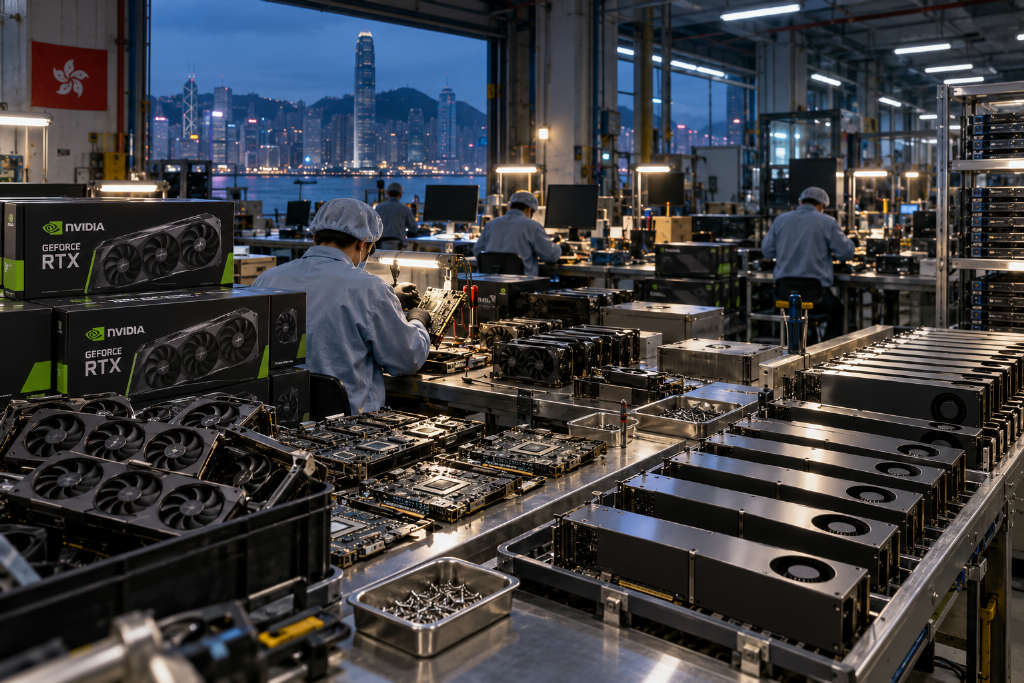
A factory video reposted by Hong Kong hardware media outlet HKEPC on X on Oct. 23 appears to show large batches of new RTX 5090 gaming GPUs being dismantled and rebuilt into dual-slot blower cards for AI servers.
According to HKEPC, several videos circulating on X recently showed graphics card modification workshops handling GeForce RTX 5090 units at scale. Instead of reaching the consumer retail market, those top-end gaming cards were shown being sent in bulk to a large conversion facility, where workers replaced the original triple-fan cooling setup with a dual-slot blower design.
Retail-box RTX 5090 cards shown being stripped and rebuilt
The footage shows workbenches stacked with RTX 5090 retail boxes and bare cards from multiple brands. HKEPC said NVIDIA’s own reference cards were also visible. The report described the units as cards taken out of retail packaging that had originally been intended for store shelves.
Workers first remove the stock triple-fan cooler. They then use hot air to take the GPU and memory off the original board and transplant them onto another PCB. After that, they install a blower cooler that takes up only two slots. The modified cards are then sent to a testing line, where dozens of units run performance and stability checks at the same time on open-air test platforms. Cards that pass are repacked for shipment.
Why the cards are being converted into blower models
Gaming versions of the RTX 5090 usually use triple-fan coolers and occupy three to four slots. The report says that design pushes hot air back into the chassis and makes it difficult to place many cards side by side inside a server.
A blower cooler vents hot air directly out of the rear of the card while keeping the thickness to two slots, making it more suitable for multi-GPU AI server deployments.
Similar conversion lines were reported in 2025
The article says this is not the first time such a production line has come to light. Tom’s Hardware reported in July 2025 on a video shot by Bilibili creator Ajian Talk. In that footage, a Shenzhen operator identified as “CT” converted Zotac, Palit, and Inno3D RTX 5090 cards into blower versions.
That earlier report said each card went through a 24-hour stress test and that a single chassis could hold as many as eight cards.
Export controls remain a central issue
The full RTX 5090 cannot be sold into China because of U.S. export controls, the report said. NVIDIA sells the lower-spec RTX 5090 D in the Chinese market instead.
The newly circulated video does not disclose where it was filmed. Foreign media reports have largely pointed to a modification factory in China, but neither the location nor the identity of the operator has been independently confirmed. The information currently available also does not prove how the cards entered China.
NVIDIA denied production-stop rumors but acknowledged tight supply
Before the video emerged, RTX 5090 products had already been pulled from many sales channels in the U.S. and Taiwan, leading to market rumors that production had stopped. On Oct. 16, NVIDIA Senior Vice President of Personal Computing Jeff Fisher denied those claims in interviews with CNA and other media during a visit to Taiwan.
Fisher said official shipments would continue. He also said supply-chain tightness was a global constraint, though he did not say when conditions might improve.
Retail prices remain far above MSRP
Cards still available on the market are selling at more than 4.6 times the suggested retail price, according to the report. On U.S. e-commerce platform Newegg, most RTX 5090 listings were priced above $9,300, or about NT$303,000.
The highest listed price was $10,899. The RTX 5090 originally carried an official MSRP of $1,999.
Key points from the report
- HKEPC reposted the factory video on X on Oct. 23
- The footage shows new RTX 5090 cards being converted into dual-slot blower GPUs for AI servers
- The full RTX 5090 is restricted from sale into China under U.S. export controls
- NVIDIA sells the lower-spec RTX 5090 D in China
- Jeff Fisher denied production-stop rumors on Oct. 16 but acknowledged supply constraints
- Most Newegg RTX 5090 listings were above $9,300, with the highest at $10,899