


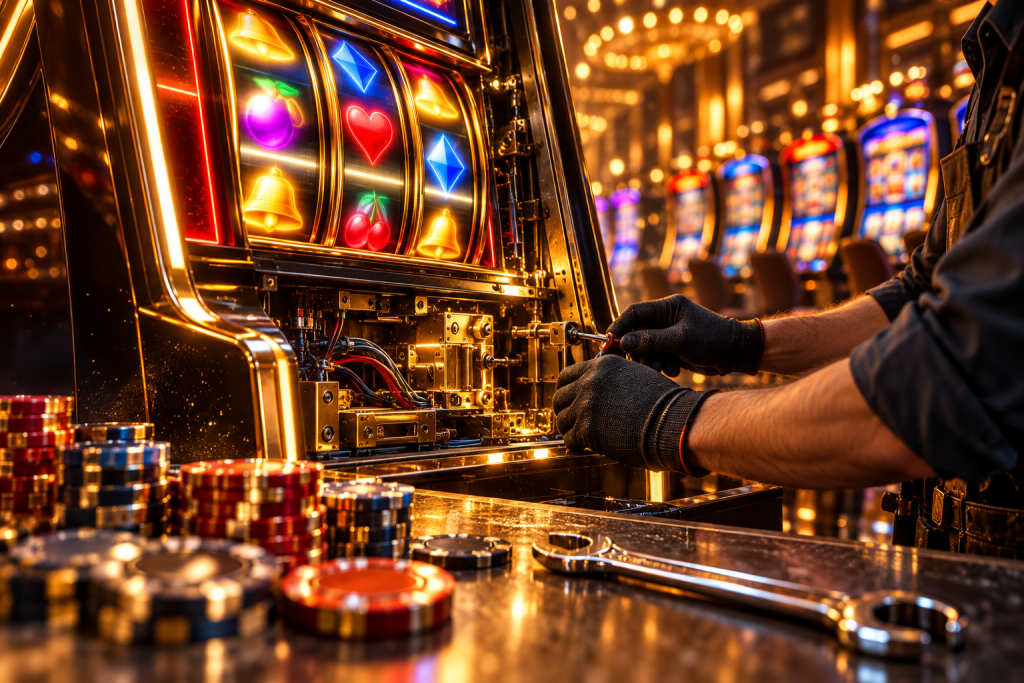
Building a casino slot machine is a manufacturing process that combines a physical cabinet, a certified random number generator, a display system, and a payout table into a single regulated device. The finished machine is then submitted to a testing laboratory before it can be placed on a casino floor. This article describes the general construction sequence and the channels where the current technical specifications for any given model are published.
The build process is governed by the requirements of the jurisdiction where the machine will operate. Different gaming authorities accept different testing standards, so a manufacturer designs to a specification set rather than to a single universal blueprint. The machine's documentation, not this article, carries the exact component list and certification status for each model.
What the build starts from
A slot machine begins as a cabinet design. The cabinet is the outer housing that holds every internal component, and its dimensions, weight, and mounting points are fixed by the manufacturer's engineering drawings. The cabinet must accommodate the display, the player controls, the bill validator, the printer, and the logic boards while remaining serviceable by a technician with access to the rear door.
Inside the cabinet, the core assembly is the game controller. This is a dedicated computing board that runs the game program and drives the display. The controller is separate from the random number generator in most modern designs, although the two are often mounted on the same board or in the same cage.
The random number generator
The random number generator is the component that determines each spin's outcome. It produces a continuous stream of numbers even when the machine is idle, and the game program maps the next number in the stream to a position on the virtual reels or to a table outcome. The mapping is fixed in the game software and is part of what the testing laboratory verifies.
Manufacturers do not build their own random number generator from scratch for every model. They use a hardware or firmware generator that has already been submitted for certification, then integrate it with the game program. The certification process checks that the generator's output is statistically random and that the mapping from generator output to game outcome matches the published payout table.
Reels, display, and player interface
Older machines used physical reels driven by stepper motors. Modern machines use a video display that draws virtual reels, but the underlying outcome logic is the same: the random number generator selects an outcome, and the display presents that outcome to the player. Some machines combine a mechanical reel set with a video display for bonus features.
The player interface includes the spin button, the bet selection controls, the bill validator, the coin hopper or ticket printer, and the display that shows the player's credit balance. Each of these components is a separate subassembly with its own wiring harness and its own service manual entry.
How the components are compared
The build differs by component type and by what the component is responsible for. The table below compares the main assemblies by their role in the finished machine.
| Component | Role in the build | What is certified or tested |
|---|---|---|
| Cabinet | Outer housing and mounting structure | Physical safety, access control, tamper evidence |
| Random number generator | Produces the outcome stream | Statistical randomness, non-predictability |
| Game controller | Runs the game program and drives the display | Program integrity, payout mapping |
| Display system | Presents reels and bonus features to the player | Correct representation of the selected outcome |
| Player interface | Accepts money, registers bets, pays winnings | Meter accuracy, anti-fraud features |
| Payout table | Defines the prize for each winning combination | Matches the programmed outcome mapping |
The payout table and the game program
The payout table is the document that lists every winning combination and the prize associated with it. The game program must implement exactly the payout table that was submitted for certification. Any mismatch between the table displayed to the player and the table programmed into the controller is a defect that prevents certification.
The payout table is not a single universal document. Each game title has its own table, and the same cabinet can run different game titles with different tables. The table is fixed for a given game version and is printed on the machine or available through the game's help screen.
Assembly and quality control
Assembly begins with the cabinet shell. The wiring harness is installed first, followed by the power supply, the controller cage, the display, and the player interface components. Each connection is checked against the wiring diagram, and the completed machine is powered on for a burn-in test before it leaves the factory.
After assembly, the machine goes through a calibration and verification sequence. The bill validator is tested with sample bills, the printer is tested with sample tickets, and the random number generator output is logged and compared against the expected distribution. The machine is then sealed and prepared for shipment to a testing laboratory or directly to a casino, depending on the jurisdiction's requirements.
Certification before the casino floor
Before a slot machine can be placed on a casino floor, it must be certified by a testing laboratory recognized by the jurisdiction where it will operate. The laboratory examines the random number generator, the game program, the payout table, and the physical security features. The laboratory's report is submitted to the gaming authority, which issues the approval that allows the machine to be operated.
The certification process is specific to a game version and a jurisdiction. A machine certified for one state is not automatically certified for another, and a change to the game program requires re-certification. The manufacturer publishes the certification status for each model and jurisdiction, and the gaming authority maintains the authoritative record.
What to confirm before you rely on any specification
Specifications for a given slot machine model change as manufacturers release new versions and as jurisdictions update their technical standards. The current specification set for any model is published by the manufacturer and by the testing laboratory that certified it. Before relying on a specification, confirm the model number, the game version, and the jurisdiction where the machine will operate.
The authoritative sources are the manufacturer's published technical documentation and the gaming authority's certification database for the relevant jurisdiction. These channels carry the current component list, the payout table, and the certification status. This article does not publish those documents and does not state any model-specific figure.
FAQ
Does a slot machine use a computer inside the cabinet?
Yes. A modern slot machine contains a dedicated game controller that runs the game program and drives the display. The controller is a computing board, but it is not a general-purpose computer. It is locked down so that only the certified game program can run, and it is sealed to show evidence of tampering.
Who builds the random number generator?
The random number generator is built by the slot machine manufacturer or by a component supplier, and it is submitted for certification as part of the machine. The generator produces a continuous stream of numbers, and the game program maps those numbers to outcomes. The mapping is fixed and is verified by the testing laboratory.
Can a slot machine be built at home?
The components of a slot machine can be assembled by anyone with the engineering drawings and the parts, but a machine built outside a licensed manufacturing process has no certification and cannot be placed on a casino floor. The certification process is the step that turns a collection of parts into a machine that a jurisdiction permits for gambling use.
Play responsibly
Gambling should be treated as paid entertainment, never as a way to earn income or recover losses. 1-800-MY-RESET (1-800-697-3738)
18+ or 21+ depending on where you are; follow the minimum age that applies to you.
This article is general information about how these mechanics work. It is not legal advice and not a recommendation to gamble or to use any particular operator. Availability and legality differ by jurisdiction — check the rules that apply where you are.