


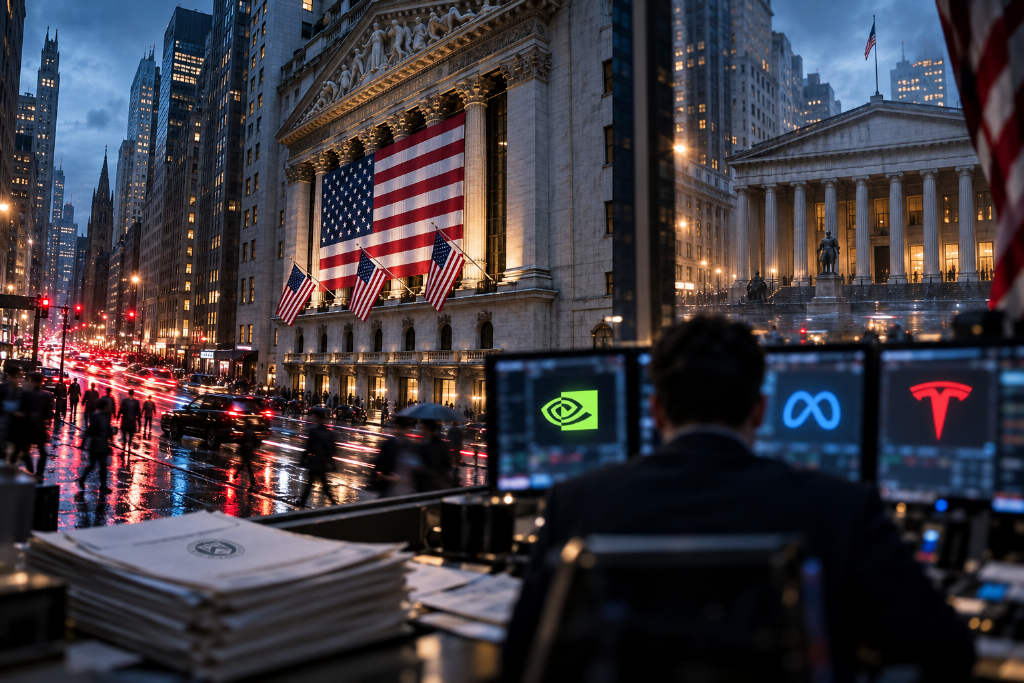
PANews said Wall Street closed last week with another wave of selling in technology shares, as concerns over returns on AI infrastructure spending, financing costs, and stretched valuations hit the market at the same time. The Dow Jones Industrial Average fell 0.34% on Friday, the S&P 500 dropped 1.09%, and the Nasdaq lost 2.14%. For the week, the Nasdaq Composite slid 4.48%, its worst weekly performance since June’s “AI trading dark week.” The S&P 500 fell nearly 2% for the week, while the gap between the Dow and the Nasdaq exceeded 6 percentage points, an extreme reading not seen since 2002. The VIX jumped more than 21% intraday and briefly moved above 22.
Oil retreats from highs while Treasurys regain their hedge role
Brent crude had earlier approached $110 a barrel, and WTI crude rose for seven straight sessions to trade above $101. Early Monday, oil pulled back after Iran reiterated that a plan to reopen the Strait of Hormuz within seven days remained valid, while U.S.-Iran talks were still unresolved. The report also said the Trump administration was pushing a deal to bring Russian diesel into the market, with Russian Deputy Prime Minister Alexander Novak saying supplies could reach the United States 15 to 20 days after a contract is signed. Brent then fell back to around $108.
In precious metals, spot gold held above $4,170 an ounce, while spot silver traded around $57 an ounce and was close to half its January record peak. Money Metals said silver’s deep decline reflected not only fading speculation but also its industrial exposure, which has already priced in the damage that higher energy costs could do to global manufacturing expansion. At the same time, data cited from the World Gold Council and Morgan Stanley showed central bank gold allocations had, for the first time in history, surpassed U.S. Treasurys. Combined with a six-year physical supply deficit in silver, the report said the macro foundation for precious metals had not broken down.
Industrial metals also remained under pressure. PANews said the spread between Comex and LME copper kept collapsing as uncertainty around Trump’s tariff outlook and worries over macro demand weighed on pricing. Macquarie warned that policy uncertainty had taken over the direction of the market.
The Treasury market, by contrast, saw a sharp return of haven demand. The 10-year U.S. Treasury yield fell about 17 basis points last week to around 5.08%, its best weekly move since February, and slipped further to 5.05% early Monday. Before the Federal Reserve entered its pre-meeting blackout period for the October policy meeting, Fed Chair Warsh declined to give guidance on another rate increase at the IMF annual meeting and said the global economy was broadly evolving as expected. That pushed market pricing for an October hike below 15%. Goldman Sachs and Julius Baer said the market was showing a renewed stock-bond seesaw effect, with cooling AI capital expenditure feeding into weaker demand expectations, forcing large CTA short covering and restoring Treasurys as a portfolio hedge.
Hedge funds cut leverage in crowded AI trades
The report said the market is moving away from the “computing power growth” story that drove U.S. equities for the past three years and toward a framework centered on free cash flow and interest coverage. Last week’s move was not described as a broad liquidation. UBS’s trading desk called it “deleveraging rather than de-risking.” Hedge fund net exposure fell sharply, but gross exposure remained in the 90th percentile of the past five years, suggesting capital was still in the market and rotating aggressively out of expensive AI-linked names and into traditional defensive sectors.
Semiconductors and AI hardware infrastructure were hit hardest. The Philadelphia Semiconductor Index fell for an eighth straight session, wiping out more than $2 trillion in market value and marking its longest losing streak since the 2008 financial crisis. Memory-related shares dropped 16% for the week, while speculative growth stocks broadly fell more than 12%. Bank of America strategist Michael Hartnett said his bull-and-bear indicator had dropped below the threshold that ended its sell signal, but crowding in technology allocations remained at a five-year high. In his view, market stabilization depends on whether semiconductor pricing and credit costs can hold.
Credit markets sent an even louder warning. Goldman Sachs strategist Louis Miller said credit spreads for hyperscale cloud service providers had widened to their broadest levels of the year, while credit default swaps hit record highs. Equity prices, he argued, had not fully priced in that premium, leaving related stocks with roughly 15% downside implied by credit. Goldman data cited in the report showed cloud capital expenditure growth would peak at 116% in the third quarter of 2026 and then slow quarter by quarter. By 2028, depreciation and amortization tied to data centers could turn into a negative contributor to S&P earnings per share. The report also said lower-rated AI data center debt was becoming increasingly fragile and several emerging cloud providers had delayed IPO plans. On Wall Street, the question is shifting from whether demand for computing power exists to who will fund as much as $10 trillion in physical infrastructure and financing costs.
That stands in sharp contrast to the move into value and inflation-resistant assets. Consumer staples rose more than 5%, oil majors and low-volatility value names hit fresh highs, and small caps and the equal-weight S&P outperformed the broader market. At the same time, JPMorgan, Bank of America, and Citigroup have moved to restrict third-party AI agents from directly operating bank accounts, aiming to prevent trillions of dollars in low-cost deposits from being automatically transferred out. The report said the pressure AI may place on traditional banking models is now feeding back into the technology trade itself.
Company moves: CoreWeave tumbles, Apple rises against the trend
CoreWeave fell 11.91% in a single session and nearly 25% for the week. PANews described the Nvidia-backed cloud computing company as a major casualty of the selloff. Its five-year CDS spread rose above 1,100 basis points, implying a default probability above 60%, and some unsecured bonds fell into distressed territory. Nvidia CEO Jensen Huang defended the company, saying its cost of capital was falling, but firms including Baird said its free cash flow ranked near the bottom of the group.
Other AI infrastructure names were also sold heavily. Nebius dropped 12.18% in one day and more than 25% for the week. Oracle, described in the report as a debt-heavy cloud expansion story, fell 4.64%, and data center networking supplier Lumentum lost 5.22%.
Memory and chip names also weakened sharply. SanDisk fell 6.85%, SK Hynix dropped 6.58%, Micron Technology lost 5.63%, and AMD fell 5.95%. The report said investors were worried that potential capacity additions by 2029 could turn the sector into a “red ocean,” while high rates were slowing the pace of AI hardware purchases. Comments from South Korea’s finance minister supporting the chip boom through 2027 did not stop the outflows.
Semiconductor equipment shares also moved lower. ASML slipped 0.96%. Taiwan Semiconductor Manufacturing Co. posted a 68.7% jump in third-quarter net profit, but its shares still fell 1.80% on concerns over early-stage 2nm margins, leaving the stock down 2.28% for the week. A semiconductor ETF tracked in the report fell 11.4% over the week.
Apple was one of the few large technology names to rise, gaining 0.43%. PANews said preorders for its first foldable phone, the iPhone Duo, sold out within minutes on Friday, with shipping dates pushed back to December. That demand helped the stock reach another record high.
Meta Platforms fell 3.72% as investors focused on expectations that third-quarter free cash flow would turn negative, at -$9.14 billion, while heavy borrowing for infrastructure construction added to capital expenditure concerns. Among other megacaps, Microsoft fell 1.93% after regulatory filings showed plans to more than double its data center expansion. Alphabet fell 2.32%, Amazon dropped 1.87%, and Nvidia lost 1.43%.
Tesla closed down 2.13%. Its next-generation Roadster drew attention with a “flying” stunt and pushed the stock up as much as 5% before the open, but JPMorgan and HSBC said the display was more a demonstration of engineering capability than a near-term earnings driver. They noted mass production had been delayed until 2028, and the stock reversed lower. SpaceX fell 1.74%, even as a Barclays report helped lift prediction-market odds of a Tesla-SpaceX merger to above 50%.
Moderna dropped more than 12% intraday and finished down 7.82% after the U.S. Food and Drug Administration formally refused to accept its application for the seasonal flu vaccine mRNA-1010, citing a lack of rigorous controlled study design in its phase 3 trial. That triggered a reassessment of the company’s ability to monetize its mRNA pipeline. A biotech ETF fell more than 2.5% intraday, while Eli Lilly and Merck rose as defensive money moved into traditional pharmaceutical names.
Defensive blue chips were stronger. Chevron, Exxon Mobil, and Coca-Cola each rose more than 2% and hit record highs. PepsiCo and Walmart also advanced. The report said geopolitical tensions, higher oil expectations, and lower valuation multiples made traditional energy and consumer staples a preferred shelter for hedge funds.
What markets are watching this week
Monday, Oct. 19
- At 9:20, Hong Kong stocks are closed, Stock Connect is suspended, and Dongxing Securities and Cinda Securities will be delisted.
- German Chancellor Merz is set to meet Jensen Huang. Markets will watch for concrete investment or order announcements tied to industrial AI, data centers, and sovereign computing capacity in Germany.
- At 15:00, China’s State Council Information Office will hold a “technology-driven commerce” briefing, with attention on policy signals for AI applications, retail digitization, and consumer sectors.
- The Financial Street Forum opens and runs through Oct. 22. Investors will watch comments from Pan Gongsheng, Wu Qing, and Zhu Hexin, especially on monetary policy, capital market reform, and growth support.
- The World Bank Global AI and Digital Summit and the Shanghai Bund Summit run through Oct. 22, while the RISC-V China Summit continues through Oct. 20. Focus areas include AI financing and governance, global capital allocation, open-source chips, and domestic substitution.
Tuesday, Oct. 20
- Nvidia’s GTC Berlin opens and runs through Oct. 22. Markets will watch AI chip architecture, inference, robotics, and European customer orders.
- The APEC finance ministers’ meeting takes place in Hong Kong through Oct. 21. At 12:15, European Central Bank chief economist Philip Lane is scheduled to speak. Investors will look for signals on fiscal cooperation, digital infrastructure financing, and European monetary policy.
- U.S. earnings due before the bell include GE Aerospace, RTX, 3M, and General Motors. Netflix and SpaceX report after the close.
Wednesday, Oct. 21
- At 08:00, South Korea will release trade data for the first 20 days of October. Semiconductor exports, HBM, DDR5, and AI memory demand will be key.
- Jensen Huang is scheduled to deliver his GTC keynote. Markets want clarity on European sovereign AI, inference demand, new architectures, and the scale of partnerships, with a focus on orders rather than long-term vision alone.
- The World Intelligent Connected Vehicles Conference opens, while a China-Europe investment, trade, and technology cooperation event runs through Oct. 23. Investors will watch autonomous driving, vehicle-road-cloud standards, and cross-border industrial cooperation.
- Scott Bessent and Stanley Druckenmiller will attend a JPMorgan-Robinhood investor conference. The event is closed to the media, but any public remarks would be watched for views on fiscal financing, rates, and market risk.
- Before the bell, IBM and AT&T report. After the close, Meta, Tesla, Lam Research, and Texas Instruments are due.
Thursday, Oct. 22
- Meta’s conference call is scheduled for 04:30, followed by Tesla’s Q&A webcast at 05:30. For Meta, the report highlighted market expectations for $63.29 billion in revenue, $40.97 billion in capital expenditure, and free cash flow of -$9.14 billion. For Tesla, the focus is on how more than 486,000 vehicle deliveries and 13.7 GWh of energy storage deployments translate into profit.
- The Bank of Korea will announce its rate decision. Markets expect a pause after a series of hikes. Another increase could support the won but pressure chip stocks and companies with heavy financing needs.
- The U.S. Treasury will auction 20-year bonds. Demand and the final yield will be watched closely as a test of whether the current Treasury rebound can continue and how that may feed through to gold and technology shares.
- Earnings due include Nokia, Spotify, American Airlines, and Procter & Gamble. After the close, investors will also watch Bloom Energy, Western Digital, and Newmont.
Friday, Oct. 23
- At 07:30, Japan will release September CPI. The market expects 2.1% year-on-year, versus 1.9% previously. A hotter reading could strengthen bets on Bank of Japan tightening and affect the yen and global carry trades.
- The European Society for Medical Oncology Congress opens and runs through Oct. 27. Moderna and Merck are set to release detailed phase 3 data on a personalized mRNA cancer vaccine used with Keytruda.
- The Shanghai Global Developer Pioneer Conference and an embodied intelligence skills competition run through Oct. 25, with more than 200 teams competing.