


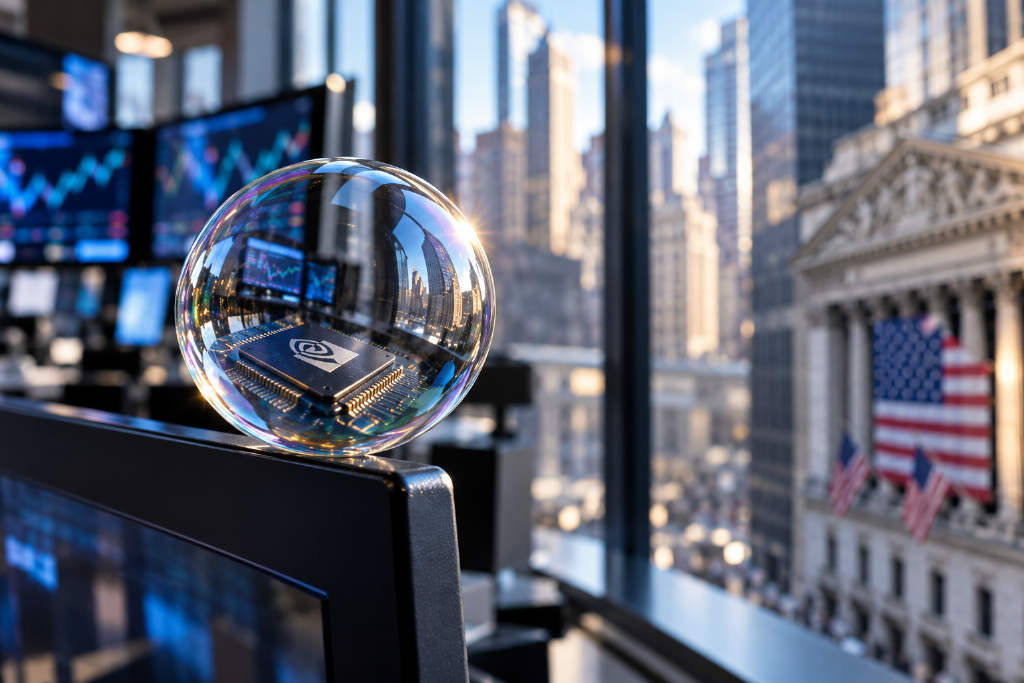
Wall Street is issuing fresh warnings about an AI bubble, but Howard Marks does not think the market has reached a firm verdict yet.
According to Bloomberg, a growing number of professional investors see bubble-like signs in AI stocks. Bridgewater founder Ray Dalio said earlier this month that AI is a "classic bubble" and is getting close to bursting. Galaxy Digital CEO Michael Novogratz called AI "the biggest bubble of my lifetime," while adding that it has not yet reached its wildest stage.
Market stress and debt concerns move to the front
That unease has shown up in trading. The Nasdaq 100 fell 5.5% last week, while the Nasdaq Composite lost 4.5%. U.S. CPI and PPI both came in above expectations, and the 10-year Treasury yield briefly rose to 5.33%.
AI cloud company CoreWeave (CRWV) also came under pressure on debt concerns, dropping about 15% on Wednesday and another 12% on Friday.
Marks says investor caution is still visible
Marks, the Oaktree Capital co-founder who correctly warned about the dot-com peak in early 2000, said a classic bubble usually turns investing into a mass frenzy. Some people get rich overnight, while those who stay out feel foolish and full of regret.
He said today’s signals are mixed. Investors do fear missing the rally in technology shares, but people in the market are still comparing current conditions with past bubbles. For Marks, that means caution has not disappeared, and it is still too early to say a bubble has definitively formed.
Four warning signs Marks says are already present
In his Dec. 9, 2025 memo, "Is This a Bubble?", Marks said at least four warning signs have already appeared in the current market.
Circular financing
Marks has questioned whether money is effectively circulating among AI companies. The International Monetary Fund said in this month’s Global Financial Stability Report that related transactions between large cloud providers and other AI companies total about $300 billion and are tied to $650 billion in debt. Earlier this month, Broadcom (AVGO) was also reported to be preparing to lend Anthropic as much as $42 billion so Anthropic could rent Broadcom chips.
Debt-driven expansion
Marks said debt is a key factor because it magnifies losses, and investments built largely on uncertain expectations are not well suited to borrowed money. Debt was also central to Dalio’s warning. CoreWeave’s sharp declines last week showed that investors are starting to focus on the financing risks behind AI infrastructure.
Valuation and concentration
The Shiller P/E ratio, which uses inflation-adjusted average earnings over the past 10 years, is now around 41, close to the record 44 seen in 1999. Nvidia, Apple, and Microsoft together account for about 21% of the S&P 500. In October 1999, it took nearly 10 companies combined to reach the same weight.
FOMO behavior
Novogratz acknowledged the bubble argument while also saying that people who have not invested in AI should "go home and stick their head in a bucket of ice," echoing the fear-of-missing-out mindset Marks described.
Why Marks says this is not a typical bubble yet
Marks also pointed to several differences between the current market and a classic bubble period.
Investors are broadly alert
The most dangerous stage of a bubble often comes when most people do not believe they are in one. This time, warnings from figures such as Dalio and institutions such as the IMF are already circulating widely. Media references to the dot-com bubble have also become more frequent. Investors have reacted sharply to negative news, and CoreWeave’s sell-off after debt concerns surfaced looked more like nervousness than blind euphoria. Marks sees that as one reason not to classify the current market as a textbook bubble.
Leading companies have real revenue and profits
In the memo, Marks also summarized the bullish case. AI products have already been commercialized at scale, with about 1 billion users, and major companies have revenue, profits, and cash flow. That is different from the dot-com era, when many companies had little more than an idea and no earnings. He also said valuations for today’s AI leaders remain below the price-to-earnings multiples once seen in Microsoft, Cisco, and Oracle during the internet bubble.
Marks added that even if AI is eventually judged to be a bubble, it may not resemble past episodes. He has previously divided bubbles into two types: a "mean reversion bubble," built on financial promises and leaving little behind after it bursts, and a "transformational bubble," driven by technological breakthroughs such as railroads and the internet. Those bubbles can still produce investor losses, but they also leave infrastructure that pushes society forward. In his view, AI is closer to the second category.
Marks’ approach: do not go all in, but do not exit completely
Marks has long argued that when a technology’s outlook is highly uncertain, investors should avoid going all in or walking away entirely. His preference is to keep a measured position and stay selective and cautious. A full commitment can lead to devastating losses, while complete non-participation can mean missing a major technological shift.
The next market focus, he said, will be on the Federal Reserve’s rate path, the debt profile of AI companies, and whether AI investment can actually turn into revenue and profits.